
The best mindbody alternative for gyms may not be the one with the longest feature list. It’s the one that fits how your functional fitness gym runs, from managing members and payments to recording workout scores and tracking performance. A broad studio platform may look polished on paper but still leave coaches juggling extra steps.
If you’re considering a switch, there’s more to think about than software. Member records, recurring payments, and the daily rhythm of classes all need attention. The right choice should make operations easier without making the transition harder on your team or members.
This guide compares Mindbody alternatives through real gym workflows, so you can focus on the features that matter to your facility. You’ll learn what to check about pricing, performance tools, and migration support, and how to plan a change that protects continuity. We’ll also look at where a functional fitness platform like VO2WOD may fit, including gym administration, automated payments, workout scoring, and a live athlete performance dashboard.
Key Takeaways
- Start with the friction your team faces, then define what a better platform needs to handle.
- Compare each mindbody alternative for gyms against your essential workflows, not the size of its feature list.
- Distinguish full gym management platforms from narrower booking tools, and verify current capabilities and terms with each provider.
- Plan the switch around member records, memberships, payment processes, workout history, and reporting so key details aren’t lost.
- Use a final fit check to see whether gym administration and coaching performance needs can work together in one platform.
Why gyms look for a Mindbody alternative, and what they need instead
Software can fit a gym well for years, then feel awkward as class formats, memberships, or coaching practices change. That doesn’t automatically mean the platform is failing. It does mean the gap between the software and your current routines is worth examining before you choose a mindbody alternative for gyms.
A good-fit alternative matches your gym’s real workflows, not just its feature list. Start by identifying where work gets repeated, delayed, or shifted into spreadsheets and messages. Ask owners, coaches, and front-desk staff separately, since each group sees different friction. A concern about cost, usability, or support may matter to one facility and not another. Compare it with your own experience and verify the provider’s current terms.
Which Mindbody pain points should a gym verify first?
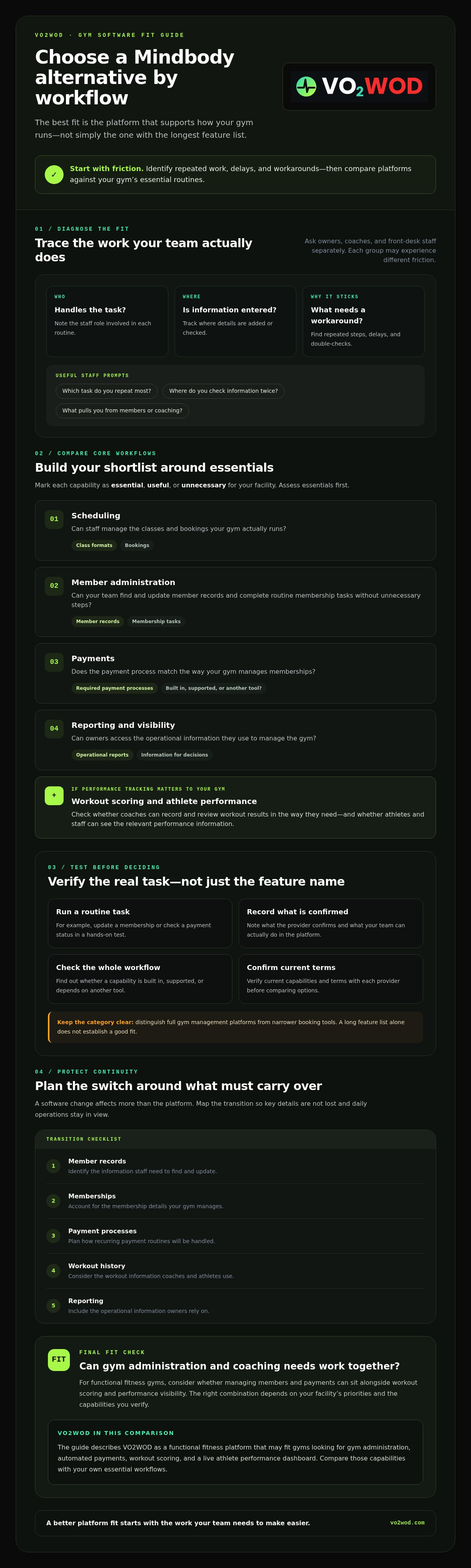
Trace four everyday processes from start to finish: scheduling, member administration, payments, and reporting. For each one, note who handles it, where information is entered, and what requires a workaround. Ask staff questions tied to their daily work: Which task do you repeat most? Where do you have to check information twice? What routinely pulls you away from members or coaching?
- Scheduling: Can staff manage the classes and bookings your gym actually runs?
- Member administration: Can the team find and update the records it needs without unnecessary steps?
- Payments: Does the payment process match the way you manage memberships?
- Reporting: Can owners access the information they use to make operating decisions?
These questions turn general dissatisfaction into a shortlist of requirements. They can also help you distinguish a software limitation from a process that needs clarification or adjustment.
Why functional fitness changes the comparison
Gym operations may center on classes, memberships, and payments. Functional fitness can add another need: recording workout scores and sharing performance information. Decide whether coaches need results during a session, after it, or both, and how athletes and staff should see those results. These aren’t universal requirements. They’re workflow questions for gyms where performance tracking supports coaching.
Fitness apps broadly cover tools for fitness-related tracking and activities. A gym may need more than an individual-facing app, including business administration and team access to workout information. Keeping that distinction in mind helps focus your comparison on the system your facility needs. For more functional fitness criteria, see the functional fitness gym software guide.
How to evaluate a Mindbody alternative for your gym’s real workflows
Turn your requirements into a side-by-side comparison before booking demos. Put workflows in the rows and capabilities to verify in the columns. This makes gaps easier to spot, especially when one platform handles gym administration while another focuses on booking or coaching tools. For each item, record what the provider confirms and what your team sees in a hands-on test.
| Workflow | What to verify | Priority |
|---|---|---|
| Member administration | Can staff complete routine membership tasks in the platform? | Essential, useful, or unnecessary |
| Payments | Are your required payment processes built in, supported, or dependent on another tool? | Essential, useful, or unnecessary |
| Workout scoring | Can your gym record and review workout results in the way coaches need? | Essential, useful, or unnecessary |
| Reporting and visibility | Can owners access operational reports, and can coaches see relevant athlete metrics? | Essential, useful, or unnecessary |
Mark each capability as essential, useful, or unnecessary for your facility, then assess the essentials first. A tool that checks every optional box but misses a daily requirement is a poor fit. This approach helps you choose a mindbody alternative for gyms based on what staff and coaches need, rather than feature count alone.
Which operational capabilities belong on the shortlist?
Test a routine task, such as updating a membership or checking a payment status, instead of relying on a feature name in a demo. Ask how owners find the operational information they use to manage the gym. Then look at the whole workflow: does the software reduce repeated data entry and handoffs, or simply move those tasks elsewhere? Include usability, support options, and migration assistance in your notes, and verify each directly with the provider.
How should functional fitness gyms compare coaching tools?
If workout tracking matters to your gym, check whether coaches can record, score, and review results consistently. Ask to see how athlete metrics appear during or after a session, and whether that view fits your coaching routine. Treat these as gym-specific criteria, not universal requirements. For a broader look at bringing operational information together, read the centralized gym data platform guide.
Finally, compare the effort involved in each essential workflow. Note every extra step, tool, and handoff. VO2WOD combines gym administration, automated payments, workout scoring, Vo2hub, and a live athlete performance dashboard. You can review VO2WOD’s gym and performance capabilities against your shortlist.
Mindbody alternatives compared: match the platform to your gym
Use a shortlist to focus your research, not to declare a winner. Platforms differ in purpose and feature coverage. Treat each as a candidate to investigate, then confirm current capabilities in provider documentation or a product demonstration. Ask providers to show how your actual workflows work, not just give a polished overview.
| Platform or category | Potential fit | Operational strengths to verify | Performance-data needs | Migration questions |
|---|---|---|---|---|
| Mindbody | Keep as a benchmark if your gym already uses it | Recheck scheduling, member administration, payments, and reporting against current needs | Can it support your workout-scoring and coach-visibility requirements? | What export options and transition steps are available? |
| Gym-management suites | Assess if your facility needs membership and daily administrative workflows in one system | Confirm membership tasks, payment processes, staff routines, and reporting | Ask whether workout scoring and athlete metrics are included or need another process | What data can be moved, and what assistance and terms apply? |
| Broad studio platforms | Compare with your gym’s class and membership model | Test whether the workflows suit your facility instead of assuming feature coverage | Confirm how workout results and coaching views are handled | Ask what records transfer and what must be rebuilt |
| Narrower scheduling or class-management tools | Evaluate if booking is the main need and other operations are handled elsewhere | Check whether the tool covers enough of your operational needs or leaves gaps | Verify whether performance tracking is available or requires a separate system | Clarify export formats, migration responsibility, and timing |
How do broad studio platforms differ from gym-focused systems?
A platform’s label doesn’t prove it’s a fit. Compare each provider’s intended business model with your membership structure, class schedule, and staff routines. Then test functional fitness needs: can the system record and score workouts, or would coaches need a separate process? Confirm each answer with current provider documentation or a demonstration. A feature listed in marketing materials may not work the way your team expects.
When should functional fitness owners consider VO2WOD?
Consider VO2WOD if your must-haves include both gym administration and coaching performance visibility. Its platform combines administration, automated payments, automated workout scoring, and Vo2hub. The live athlete performance dashboard displays workout metrics in real time, which may be relevant if coaches need shared athlete information. Compare these capabilities with your priorities. No single platform is the right fit for every facility.
Software, plans, features, and terms can change. Before choosing a mindbody alternative for gyms, verify current details directly with each provider, including migration support. A clear comparison shows what each tool handles, what it doesn’t, and where your team may still need another step.
How to switch from Mindbody without disrupting gym operations
A smooth transition starts before any records are exported. Treat the change as an operating plan, not just a software setup task. Assign an owner, agree on target dates with both providers, and document who handles each step. That gives your team a clear point of reference when questions come up, while keeping member-facing routines in view.
What should you confirm before moving gym data?
First, list the information your gym needs to retain and use in the new system. Don’t assume every record transfers in the same way. Ask both providers about export formats, transfer options, data ownership, timelines, responsibilities, support, and how they handle missing or unusual records. Get the answers in writing so expectations are clear.
- Document current needs. List member records, membership details, payment processes, workout history, and reports your staff relies on. Note what must remain accessible after the change.
- Check export and transfer details. Confirm what can be exported, in what format, and whether the receiving platform can use it. Identify information that may need a separate process.
- Set responsibilities and timing. Clarify which tasks belong to your gym and which each provider will support. Agree on key dates, including when records will be reviewed and when staff will begin testing.
- Reconcile the transferred information. Compare sample records with the originals. Flag missing, duplicated, or unclear entries and agree on how to resolve them before relying on the new system.
- Test and prepare the team. Run real operating scenarios, train staff on changed routines, and prepare clear instructions for members before launch.
How can a gym test the new system before launch?
Use scenarios that reflect a normal gym day. Have staff check a membership, follow a payment workflow, record and review a workout score, and find a report they need. Confirm that each step works as expected, including who can access the information. Testing connected tasks can reveal handoffs or gaps that a feature checklist won’t show.
Give coaches and front-desk staff time to practice their specific routines. Tell members what is changing, when to expect it, and what they need to do. Keep a written fallback process for unresolved issues, including who handles questions and how staff will track follow-up. For a step-by-step planning aid, use the gym software switching checklist.
If you’re evaluating VO2WOD as a mindbody alternative for gyms, include migration questions alongside its gym administration, automated payments, workout scoring, Vo2hub, and live athlete performance dashboard. Ask about VO2WOD’s data migration assistance as you plan the transition.
Choose a Mindbody alternative that makes gym management feel lighter
The right choice isn’t necessarily the platform with the most features. It’s the one that covers your gym’s essential workflows, supports the way your coaches work, and passes practical transition checks. If a tool looks promising but leaves questions about records, payments, or staff routines unanswered, pause before committing. A clear comparison can help prevent avoidable friction later.
A final checklist for comparing your shortlist
Before deciding, bring owners, coaches, and administrative staff together to confirm what the gym needs the software to do. Use their input to separate must-haves from preferences. Then verify details directly with each provider, since features, support, and subscription terms can change.
- Workflow fit: Can the platform handle your essential membership, payment, administration, and reporting tasks?
- Coaching needs: If your gym tracks performance, can coaches record and review workout scores and access the athlete information they need?
- Data and migration: What information can be transferred, how will it be handled, and who is responsible for each step?
- Current terms and support: Are the features you need included in the current subscription, and what support is available during the transition?
- Open questions: Write down anything the provider hasn’t confirmed. Resolve those questions before committing or setting a transition date.
This gives your team a practical way to choose a mindbody alternative for gyms: prioritize essential workflows, then select an option that supports them and has a transition plan you understand. Don’t let an attractive feature list distract you from a critical gap.
Explore VO2WOD for functional fitness operations
For a functional fitness gym looking to bring administration and coaching performance tools together, VO2WOD is worth evaluating. Its capabilities include gym administration, automated payments, automated workout scoring, Vo2hub, and a live athlete performance dashboard that displays workout metrics in real time. Use these as comparison points, not as a promise that every feature will suit every facility. Verify current availability and subscription details with the provider, and ask how its dedicated data migration assistance may apply to your transition.
If those capabilities align with your shortlist, explore the VO2WOD platform for your gym and confirm how it fits your workflows and migration questions.
Make your next platform choice with confidence
The right mindbody alternative for gyms should fit the work your team does every day, not just look impressive in a feature list. Start with the workflows owners, coaches, and staff rely on, then confirm that the platform supports them in practice. Before switching, verify data handling, migration responsibilities, current terms, and staff readiness so the change feels planned rather than rushed.
For functional fitness facilities, administration and coaching visibility may need to work side by side. VO2WOD brings gym administration and automated payments together with automated workout scoring, Vo2hub, and a live athlete performance dashboard that displays workout metrics in real time. Dedicated data migration assistance is also available. Check current feature availability and subscription details, and ask how migration support fits your transition needs.
Explore the VO2WOD platform for your gym to see whether its capabilities match your priorities. With clear requirements and careful checks, you can choose a system that better supports your team and the community you coach.
Frequently Asked Questions
What is the best Mindbody alternative for a functional fitness gym?
The best option is the platform that fits your gym’s essential workflows, including the coaching and performance needs you actually use. Compare membership administration, payments, workout scoring, and how coaches review athlete metrics. VO2WOD may suit gyms looking to combine administration with automated workout scoring, Vo2hub, and a live athlete performance dashboard. Verify current features, terms, and migration support directly before choosing. There’s no universal winner for every facility.
Is Mindbody good for gyms, or is it better suited to studios?
Mindbody may work for a gym if its current features support the facility’s membership, class, payment, and reporting workflows. The studio label alone doesn’t determine fit. Functional fitness gyms should also check whether workout scoring and coach-facing performance visibility meet their needs or require another process. Ask staff to test routine tasks, then compare the results with other platforms. Decide based on demonstrated workflow fit, not assumptions about the business category.
How do I compare Mindbody alternatives for workout scoring and athlete tracking?
Test the full coaching workflow: enter a workout result, apply the scoring method your gym uses, and check how coaches review athlete metrics during or after a session. Confirm whether the functions are included, how results are accessed, and whether staff would need a separate tool or manual step. VO2WOD includes automated workout scoring and a live athlete performance dashboard that displays workout metrics in real time. Verify current availability directly with the provider.
Can I switch gym management software without losing member data?
You can plan a switch to protect continuity, but don’t assume every record will transfer automatically or in the same format. List the member details, memberships, payment processes, workout history, and reports your gym needs. Ask both providers what can be exported and transferred, who handles each task, and how exceptions are addressed. Review sample records in the new system before relying on them, and keep access to the old system until you’ve checked the transition.
How much does a Mindbody alternative cost for a gym?
Costs depend on the provider, plan, location, and optional features, so compare current quotes and terms rather than relying on a single industry-wide figure. Mindbody Starter pricing begins at $79 per month per location. Prices and plan details can change, and other providers structure their fees differently. Confirm current pricing, included features, and terms directly. This is not VO2WOD pricing.
What should I check before moving payments to new gym software?
Map how payments work today, including recurring memberships, payment timing, failed payments, and outstanding balances. Ask the new provider which processes its platform supports and whether payment details can be transferred or must be collected again. Confirm responsibilities and timing with both providers, then test the payment workflow before launch. Plan member communication and a way to track unresolved payment questions. Don’t assume payment records or authorizations move automatically with other member data.
Does VO2WOD help gyms migrate data from existing software?
Yes. VO2WOD offers a dedicated Data Migration Service for gyms transitioning from existing software. Ask the team what information can be transferred, what formats are accepted, which tasks the gym must complete, and how exceptions are handled. Clarify timing and responsibilities before setting a transition date. Migration support is available, but confirm the specific scope for your records directly with VO2WOD.


