
The best TeamUp gym software alternative may not be the one with the longest feature list. If member details, payments, bookings, and workout results live in separate places, another tool can add features without easing the daily workload. The right fit brings the workflows your gym relies on closer together.
Compare more than headline features. Consider how a platform supports coaches and members, how your data will move, and how essential operations will continue during the transition.
This guide offers a practical framework for comparing TeamUp alternatives by workflow fit, operational continuity, and support for functional fitness. VO2WOD brings gym management, automated payments and workout scoring together with a Live Athlete Performance Dashboard and Vo2hub for centralized workout data and member engagement. You’ll also find steps for planning a migration, so you can identify what needs to move and prepare your community for the change.
Key Takeaways
- Choose a teamup gym software alternative by mapping your gym’s essential workflows, not by counting features.
- Compare platforms across administration, payments, workout scoring, athlete performance visibility, and migration support.
- Before switching, inventory member, billing, schedule, and workout data, then plan the transition in a clear sequence.
- VO2WOD brings gym management and automated payments together with workout scoring and athlete performance tracking.
- Use the comparison framework to identify which platform best supports your team’s daily work and your members’ training experience.
Why look for a TeamUp gym software alternative?
Software comparisons often start with a small snag that keeps coming back. A coach spends time chasing workout scores across spreadsheets. A member asks about a payment, and staff search more than one place for an answer. Class administration may be manageable, yet athlete records or reporting still take extra effort. These examples can prompt owners to assess how well their tools support the work happening each day.
The goal isn’t to replace familiar software just because something newer is available. First, separate the jobs your system needs to support. Operational needs include gym administration and payments. Coaching and training needs may involve recording scores and seeing athlete performance. Member engagement matters too: workout information should be useful to the community, not only stored for staff reference.
A useful TeamUp gym software alternative is a better fit for your gym’s real workflows, not simply a longer feature list. A platform can offer many functions and still leave handoffs between administration, coaching, and members feeling disconnected.
What gym owners usually want to improve
For some owners, the friction is repetitive administration: updating records, following up on payments, or switching between tools to answer routine questions. For others, workout scores are recorded separately from member and class information. When details are spread out, coaches may spend less time coaching, and members may have a less consistent experience accessing information about their training.
Write down the specific tasks that feel heavy. For example:
- Staff repeat the same administrative updates in multiple places.
- Payment follow-up takes manual steps that interrupt other work.
- Workout results are hard to connect with athlete performance or member engagement.
Use these prompts to pinpoint where extra work occurs, who handles it, and how often it affects the member experience.
When comparing alternatives makes sense
A reassessment can make sense when a gym grows, changes its class operations, or needs different reporting to support decisions. Coaching practices can also create new workflow needs. In each case, name the gap before comparing software. “We need a clearer way to review workout performance” is more useful than “we need something newer.”
Turn that gap into a practical test: describe the task, the people involved, the information they need, and what a smoother handoff would look like. Then compare options against that real example. If you’re defining which systems matter most to a functional fitness facility, this functional fitness gym software guide can help frame the decision around both operations and training workflows.
With that groundwork, you can assess whether an alternative would solve a genuine workflow problem instead of adding another tool without easing the day-to-day load.
How to evaluate a TeamUp gym software alternative
A clear comparison starts before you look at feature lists. Separate essential workflows from optional extras, then assess whether each option supports the way your functional fitness gym actually runs. A polished list matters less if staff still have to bridge gaps between class operations, payments, administration, and workout records.
- List must-haves. Name the jobs your software needs to support, such as class booking, payment handling, member administration, workout scoring, or performance visibility. Mark each as essential or optional.
- Map daily workflows. Write down what happens, who does it, and where information needs to go. For example, trace a workout from the coach recording a result to the athlete being able to review it.
- Compare evidence. Look for product details or a demonstration that shows how your actual workflows work. Record what you can see, rather than treating a feature name as proof of a good fit.
- Assess transition needs. Note what information and routines would need to move, and what staff and members would need to learn. This gives you a grounded basis for planning a change.
Match software capabilities to daily operations
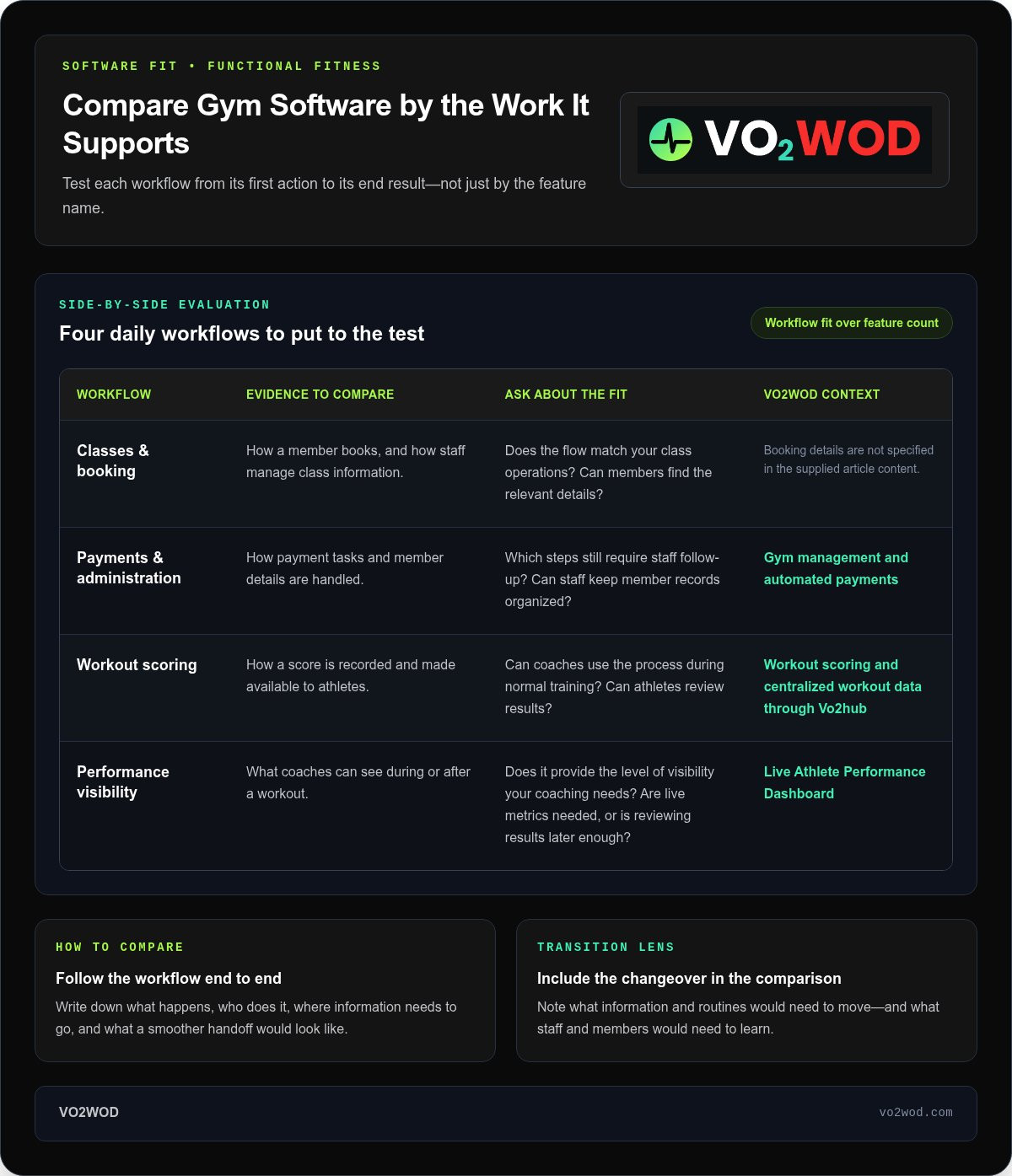
Assess booking, payments, member administration, and workout recording as separate tasks. Then follow each from the first action to its end result. Can a member book a class and find the relevant details? Can staff handle payment administration while keeping member records organized? Can a coach record a score and make the result useful to the athlete? Keep the test practical and specific to your gym.
Need
Evidence to compare
Unanswered question
Classes and booking
How a member books and how staff manage class information.
Does the flow match your class operations?
Payments and administration
How payment tasks and member details are handled.
Which steps still require staff follow-up?
Workout scoring
How a score is recorded and made available to athletes.
Can coaches use the process during normal training?
Performance visibility
What coaches can see during or after a workout.
Does it provide the level of visibility your coaching needs?
Compare performance and member-engagement needs
Decide whether coaches need live athlete metrics during workouts or whether reviewing results later is enough. Consider how athletes record scores and revisit workout data, too. These are different needs: a gym focused on real-time coaching visibility may prioritize different capabilities than one focused on helping members engage with past results. A centralized gym data platform can bring operational and workout information into a more connected view. VO2WOD offers a Live Athlete Performance Dashboard and Vo2hub to centralize workout data. You can explore VO2WOD’s gym management and performance platform against your checklist.
TeamUp alternatives compared: admin tools and functional-fitness workflows
A useful comparison separates running the gym from supporting the training. Scheduling, payments, and administration keep operations moving. Workout scoring and performance visibility help coaches and athletes work with training data. Management breadth and coaching visibility are separate comparison dimensions. Consider both, then judge how well each platform supports the handoffs between them.
Where TeamUp’s stated strengths may fit
TeamUp emphasizes scheduling, payments, business tracking, customization, and integrations. Those areas may suit gyms whose priorities center on organizing classes and managing day-to-day business tasks. The fit depends on how your staff use those workflows and what you need from training data. Assess the specific training and scoring tasks your gym relies on instead of assuming that general management capabilities cover them.
The comparison below summarizes the capabilities described for each platform, so you can see which workflows to prioritize in your decision.
Comparison area
TeamUp
VO2WOD
Operational administration
Scheduling and business tracking are emphasized.
Gym administration is part of the platform.
Payments
Payments are among the emphasized capabilities.
Automated payments are part of the offering.
Workout scoring
Compare the scoring workflow with the tasks coaches perform during and after training.
Automated workout scoring is included.
Performance visibility
Compare the level of athlete performance visibility your coaches need.
The Live Athlete Performance Dashboard visualizes athlete performance in real time.
Migration support
Include data transfer and setup in your transition plan.
Professional data migration assistance is available.
What a functional-fitness-focused alternative can add
For a functional fitness gym, the training workflow deserves as much attention as administration. VO2WOD combines gym administration with automated workout scoring. Its Live Athlete Performance Dashboard provides a real-time visualization of athlete performance, giving coaches a view of training results as they happen. Vo2hub centralizes workout data and supports member engagement, connecting recorded results with a shared place to revisit training information.
Not every gym needs the same setup. A team focused mainly on scheduling may weigh administration more heavily. A coaching team that relies on live performance insight may prioritize visibility and scoring. Compare each workflow against your priorities and the capabilities the platform demonstrates. This keeps the teamup gym software alternative decision fair, specific, and grounded in how your gym operates.
Plan a gym software switch without losing operational clarity
Changing platforms is an operational project, not a single setting to switch on. The work includes deciding what information matters, assigning people to review it, sequencing the move, and helping staff and members understand what changes. A simple plan gives your team a shared reference point while familiar routines shift.
Before moving data, make an inventory. Include member profiles, billing details and payment schedules, class schedules, and workout records. Note where each set of information currently lives, who uses it, and which tasks depend on it. Then map the transition sequence around your gym’s operations. For example, decide how staff will handle upcoming payment activity and class information during the change instead of leaving those questions until launch.
Prepare data and responsibilities before moving
Assign a person to review each important category. The person who understands billing can check billing records; a coach familiar with training history can review workout information. Decide how the team will validate essential records after transfer, such as comparing a selection of member profiles, upcoming schedules, and workout results with the original system. This creates a clear review process without assuming every legacy field or file will transfer unchanged.
- Member records: Identify essential profile information and who will review it.
- Billing: Document active payment arrangements and assign responsibility for checking them.
- Schedules: List current classes and upcoming changes that staff need to preserve.
- Workout data: Note which scores or performance records matter to coaches and athletes.
VO2WOD offers professional data migration assistance for gyms transitioning their data. Pair that support with your own inventory and review plan. Choosing a teamup gym software alternative is only one part of the change; clear ownership helps staff understand what they need to review and when.
Keep coaches and members oriented during the change
Set a transition timeline that accounts for staff preparation, data review, and member communication. Choose dates around your gym’s schedule and identify who will send updates. Before the move, show coaches where workout scores will be entered and where performance information can be found. Give staff a short reference document they can return to when questions come up.
Member updates can stay simple: explain what is changing, when it takes effect, and what members need to do, if anything. Keep the language calm and consistent. If a process is still being finalized, avoid making promises about records or timing that the team can’t support. A gym management software switching checklist can help organize the steps before, during, and after a transition.
For a closer look at a platform that includes gym management, workout scoring, and data migration assistance, explore VO2WOD for your gym.
Consider VO2WOD as a TeamUp gym software alternative
For a functional fitness gym, software needs to support the work behind the workout as well as the training itself. VO2WOD brings gym management and performance tracking together, with capabilities for administration, automated payments, automated workout scoring, and athlete performance visibility. It is designed for gyms looking to connect operational tasks with the training information coaches and members use.
How VO2WOD connects gym operations and performance
Gym administration and automated payments support operational workflows, while automated workout scoring helps capture training results. The Live Athlete Performance Dashboard visualizes athlete performance in real time, giving coaches a view of metrics as workouts unfold. Vo2hub centralizes workout data and supports member engagement, giving athletes a place to engage with their training information.
Consider how those capabilities would fit into an ordinary day at your gym. A coach records workout scores, reviews athlete performance, and members engage with workout data through Vo2hub. Meanwhile, administrative work and automated payments are part of the same platform. The value lies in how those steps fit together for your team, not in simply having each capability on a checklist.
- For owners: Consider whether gym administration and automated payments match the way you handle routine operations.
- For coaches: Assess how automated scoring and real-time performance visualization fit your coaching workflow.
- For members: Consider whether centralized workout data supports the way your community engages with training results.
VO2WOD also offers professional data migration assistance for gyms transitioning their data. Make that support part of a broader change plan: identify the information your gym relies on, decide what staff need to review, and plan how coaches and members will adjust to new workflows. Migration assistance can support the transition while your team validates the records it depends on.
What to consider before choosing your next platform
Before making a decision, return to your priority workflows and compare them with the platform’s capabilities. A useful review should include more than a quick tour. Walk through realistic tasks with the people who handle them, so the comparison reflects how the system would be used across your gym.
- Trace how staff handle administration and payment tasks.
- Follow a workout score from entry through athlete access to the result.
- Review how coaches view athlete performance and how workout data is centralized.
- Identify what needs to move and how staff will check key information during the transition.
If these workflows align with what your gym needs, VO2WOD is worth considering as a TeamUp gym software alternative. A closer look at the platform can help you assess its fit for your gym’s operations, coaching approach, and member experience.
Explore the VO2WOD platform and consider how its management and performance workflows could fit your community.
Choose a platform that supports your gym’s next chapter
Your next software decision can shape how smoothly your team works and how connected athletes feel to their training. Before you commit to a teamup gym software alternative, turn your priority workflows into a practical test: can staff manage essential tasks, can coaches use performance information, and can members stay engaged without extra friction?
VO2WOD brings these needs together with automated workout scoring and payments, a Live Athlete Performance Dashboard for real-time performance visualization, and professional data migration assistance. Consider how those capabilities align with your gym’s routines and goals. Picture the change in practice, from staff responsibilities to the way athletes interact with workout data.
If you’re ready to explore a platform built around gym operations and performance workflows, explore VO2WOD and bring gym operations and performance workflows together. A thoughtful comparison can help your team move forward with greater clarity and focus on the people and progress at the heart of your gym.
Frequently Asked Questions
Is TeamUp gym software a good fit for functional fitness gyms?
TeamUp may be a good fit if its class scheduling and payment capabilities align with your gym’s routines. Its strengths include scheduling and payments, but fit also depends on how you manage class changes, handle payment exceptions, and use workout performance information. Map a typical day, from a member booking through a coach recording a result, and compare each step with the workflows your gym needs.
What should I compare when choosing a TeamUp alternative?
When choosing a teamup gym software alternative, compare administration, payments, workout scoring, performance visibility, member experience, and transition support. Make each item specific: note who corrects a member record, how coaches enter a result, and where an athlete can find it afterward. Priorities differ by gym, so mark requirements as essential or optional before reviewing platforms. This keeps appealing extras from overshadowing the everyday tasks the software needs to support.
Does TeamUp include automated workout scoring?
TeamUp emphasizes scheduling, payments, and business tracking. When assessing workout scoring, focus on the actual workflow rather than assuming general management features cover it. Consider whether a coach can enter a score after class, correct an entry, and let an athlete revisit the result. A practical walkthrough of those steps is more useful than relying on a feature label alone.
Can I switch gym software without losing member data?
You can plan for data continuity, but no switch should be treated as automatic. The process depends on which records you need, available export options, and how migration is handled. List key items such as member details, payment arrangements, schedules, and workout history, then validate important records after transfer. VO2WOD offers professional data migration assistance to help gyms transition their data.
How long does it take to switch gym management software?
The time required varies with data volume, workflow complexity, staff readiness, and the transition plan. A gym with several class types and historical workout records may need different preparation from one moving a smaller set of routines. Assign owners to data review and staff training, then schedule workflow testing and member updates around your operating calendar. Leave room to resolve issues rather than assuming one launch date suits every gym.
Does gym management software also help coaches track athlete performance?
Some platforms connect administration with performance visibility, while others focus more on operational tasks. Decide which metrics and workout results coaches use, and whether they need to see them during a session or review them later. VO2WOD offers a Live Athlete Performance Dashboard for real-time performance visualization and automated workout scoring. These capabilities can support coaching workflows that rely on visible training data, while each gym should assess its own needs.


