
The best beyond the whiteboard alternative may not be the platform with the most workout-tracking features. If your gym relies on Beyond the Whiteboard, you know how useful it can be to log training and keep athletes connected. You also know a switch can disrupt familiar routines, raise questions about member adoption, and leave you wondering what will happen to years of workout and performance data.
Choose for your whole workflow, not just the whiteboard. This guide offers a practical way to compare platforms against how your gym operates, from workout tracking and athlete engagement to billing and day-to-day management. Use it to weigh platform fit, costs, and transition effort without assuming every option does the same things.
We’ll compare workout-focused tools with broader gym platforms, then look at how VO2WOD combines live performance visibility with operational tools. You’ll also find steps for preparing your data, supporting members as they adjust, and making the transition manageable.
Key Takeaways
- Start with your gym’s daily workflows and rank the needs that matter most before comparing platforms.
- Choose a beyond the whiteboard alternative by platform emphasis, not by feature count alone.
- Consider how members will adapt to a new tracking experience and plan communication before the switch.
- Inventory the performance and gym data you need to retain, then build migration and testing into your transition plan.
- Evaluate whether VO2WOD’s performance tools and operational support align with the way your gym works.
Why gyms search for a Beyond the Whiteboard alternative
Reassessing a familiar platform takes time. You’re coaching classes, supporting members, and keeping the gym running while trying to decide whether your software still fits. Instead of treating it as one big stay-or-switch question, identify what’s prompting the search. Separate the friction members experience from the work owners and coaches handle behind the scenes.
There isn’t one universal shortcoming that sends every gym looking for a beyond the whiteboard alternative. Members may want an easier way to log workouts or a more engaging experience. Coaches may need clearer views of athlete performance. Owners may want to reduce manual admin or manage fewer disconnected tasks. A search can reflect a new priority rather than a verdict on the current platform. For broader context, gyms may also encounter Mindbody, a prominent software-as-a-service company in the wellness industry, as they explore platforms serving different business needs.
Which friction is prompting your search?
Pinpoint where the current setup creates extra effort. Is the issue workout logging, athlete engagement, coaching visibility, or administration? Then consider whether it happens regularly or whether members simply prefer a different interface. A recurring workflow problem calls for a different solution than a change in taste. Gather input from owners, coaches, and members, since each group sees a different part of the experience.
- Members can describe where recording or reviewing workouts feels awkward.
- Coaches can identify gaps in seeing and using athlete performance information.
- Owners can track repetitive administrative steps that take time away from running the gym.
Look for patterns rather than focusing on the loudest single complaint. If members like logging workouts but coaches regularly compile results elsewhere, the main issue may be visibility rather than engagement. If the owner’s concern is unrelated admin work, a workout-focused replacement may leave the root problem untouched.
What does a successful alternative need to change?
Define what success looks like before comparing platforms. “Better” is too vague to guide a decision. Specify what should happen differently in an ordinary week: fewer manual steps to score a workout, a clearer way for coaches to view performance, or less juggling between tools for gym tasks. These are outcomes to assess, not assumptions about what any one platform can do.
Next, sort requirements into two groups. Essentials affect a core workflow or member experience. Nice-to-haves may be appealing but won’t solve the main friction. This distinction keeps an attractive feature list from distracting you from the problem that prompted the search.
- Essential: A requirement tied to a repeated task, coaching need, or member barrier.
- Nice to have: An enhancement that could be useful but isn’t necessary to address the current pain.
The central test is whole-gym fit. Consider how a platform would support members, coaches, and owners, then include the effort of changing systems in your decision. The following sections compare platform types and show how to weigh your priorities.
How to evaluate a Beyond the Whiteboard alternative for your gym
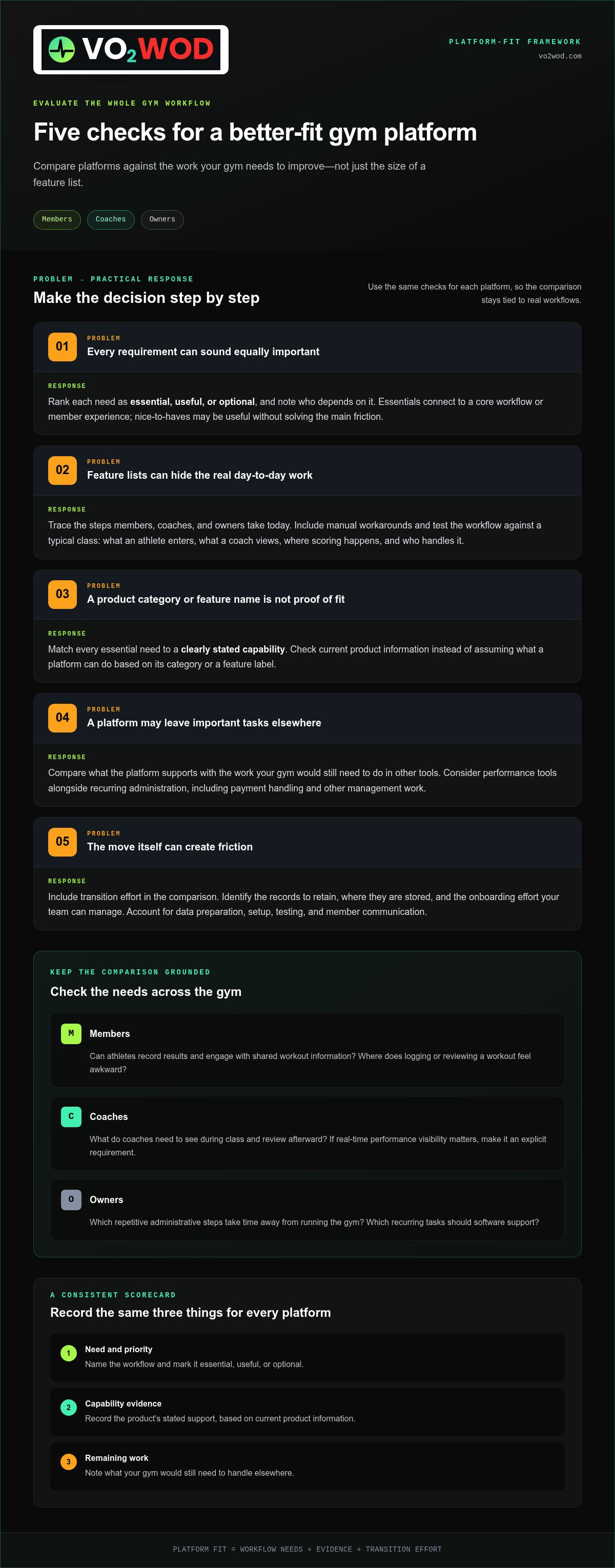
Turn your priorities into a decision process before comparing platforms. Otherwise, polished feature lists can pull attention away from the work your gym needs to improve. Start with the people who’ll use the system, map the daily workflows it should support, then assess data and transition requirements. This helps you judge whether a platform fits the whole gym, not just one role.
- Rank the needs. Label each requirement essential, useful, or optional, and identify who depends on it.
- Trace the workflow. Note the steps members, coaches, and owners take today, including manual workarounds.
- Assess evidence. Match each essential need to a clearly stated capability, rather than assuming what a product does based on its category or a feature name.
- Weigh the trade-offs. Compare what the platform supports with what your gym would still need to do elsewhere.
- Include the move. Account for data preparation, setup, testing, and member communication as part of the decision.
Start with members, coaches, and the workout floor
For athletes, consider how they’ll record results and engage with shared workout information. For coaches, identify what they need to see during class and what they review afterward. If real-time performance visibility matters to your coaching approach, make it an explicit requirement rather than assuming every tracking tool displays information in the same way.
Test your priorities against a typical class. What does an athlete need to enter? What does the coach need to view? Where does scoring happen, and who handles it? Assess a beyond the whiteboard alternative against these moments, not just a feature list.
Check the operational and data fit
List recurring administrative tasks you want software to support, such as payment handling and other management work. Decide whether you want performance tools alongside those operations or prefer separate systems. Treat data as its own requirement: note which records matter, where they’re stored, and how much onboarding effort your team can manage.
Use a compact scorecard to keep platform comparisons consistent:
- Need and priority: Name the workflow and mark it essential, useful, or optional.
- Capability evidence: Record the product’s stated support, based on current product information.
- Remaining work: Note manual steps, separate tools, or training the gym may still need.
- Transition effort: Capture data preparation, setup, testing, and member adoption considerations.
Keep claims and assumptions separate. A label such as “performance tracking” doesn’t explain exactly what coaches can see, just as “gym management” doesn’t specify which tasks are covered. VO2WOD brings together performance tools, automated workout scoring, automated payments, and gym management. Explore VO2WOD’s gym platform as part of your comparison, using the same needs and evidence checklist you apply to every option.
Compare BTWB alternatives by platform type, not just feature count
A long feature list can look impressive and still leave your main problem untouched. Compare platforms by the work they’re designed to support, who uses them most, and what your gym needs to improve. A workout-tracking tool may help athletes record training and build participation, while a broader gym platform may also address administrative work. Neither category is automatically the better choice. The right fit depends on where your current workflow has gaps.
Use this comparison as a starting point, then assess each platform’s current product information against your gym’s priorities:
Workout tracking and community
Emphasis: Workout logging and athlete participation.
Intended user: Athletes and coaches focused on recording and engaging around workouts.
Gym priority: A familiar place to log training and support community involvement. SugarWOD is described as emphasizing community and workout tracking. Its platform does not include billing, scheduling, or member management, so gyms may need separate systems for those tasks.
In-gym workout display
Emphasis: Making workout information visible in the gym environment.
Intended user: Gyms that value displaying workout information during class.
Gym priority: A more visible in-class experience. Fit Viz is associated with an in-gym display focus. Treat this as distinct from a live performance dashboard or a record of workout history.
Broader gym operations and performance
Emphasis: Performance tools alongside operational support.
Intended user: Owners and coaches evaluating needs beyond workout logging alone.
Gym priority: Bringing performance visibility and administrative tasks into the platform evaluation. VO2WOD offers a Live Athlete Performance Dashboard, automated workout scoring, automated payments, and gym management.
Athlete-first tracking versus broader gym platforms
An athlete-first option can put workout logging, community, and participation at the center. That emphasis may suit a gym whose main goal is helping members record training and connect around it. But if owners also want support for payments or other management work, a tracking-focused platform may not cover the wider workflow. Compare the platform with the gym’s real tasks, and account for any separate systems the team would continue using.
Performance visibility and in-gym experience
Displaying workout information during class serves a different purpose from reviewing past results or encouraging social participation. A live dashboard serves another distinct purpose: VO2WOD’s Live Athlete Performance Dashboard provides real-time performance visualization for coaches. Consider whether that view supports how your coaches work, rather than assuming general tracking or an in-gym display offers the same visibility. A strong beyond the whiteboard alternative comparison keeps these categories separate, then weighs them against the gym’s priorities.
There’s no universal winner. A gym centered on athlete participation may prioritize different tools than one seeking operational support or live coaching visibility. Compare stated capabilities, not category assumptions, and note which needs remain uncovered. That turns a feature comparison into a practical fit decision.
How to switch from BTWB without adding avoidable friction
Transition readiness belongs in the platform decision, not on the to-do list after you’ve chosen. A system may suit your gym’s workflows on paper, but the move also involves records, staff routines, and member habits. Plan the change in stages. A clear sequence gives everyone a place to start and makes it easier to address data or setup issues as they arise.
Prepare gym data and transition responsibilities
Begin with an inventory of the records your gym relies on. Include workout and performance history, athlete profiles, and other information staff use to support training or daily operations. Note where each record lives and who uses it. Then assign one person to coordinate migration planning, organize setup, run tests, and collect questions from staff. For a deeper planning framework, consult the published switching gym management software checklist.
Before the move, map out the work in order:
- Review the data. Identify the records you need to retain and organize them by source and purpose.
- Plan the transfer. Set out responsibilities, timing, and how you’ll review the migrated information. Don’t assume every historical record will transfer; decide what’s important to preserve and how you’ll handle anything that doesn’t move.
- Set up the new platform. Configure the gym’s key workflows before asking members and coaches to rely on them.
- Test common tasks. Walk through workout entry, scoring, and relevant administrative routines with the people who will use them.
Use the test phase to catch practical snags, not just technical ones. Can a coach find the information needed for a class? Can staff follow the intended workflow without a separate note or manual workaround? Record questions and assign someone to resolve them before the wider rollout. A thoughtful plan can reduce confusion, though it can’t promise a disruption-free move.
Make the change understandable for members
For members, the switch is most noticeable in their routine: where to find the workout, how to record results, and what to expect from the new tracking experience. Tell them what’s changing, when to begin using the new platform, and where to get help with the basic steps. Keep instructions brief and consistent. Coaches should use the same explanation so members aren’t left piecing together different answers.
Choose a clear transition date and communicate it before the new routine begins. Give coaches time to practise the tasks they’ll guide members through, then share reminders at the gym and through the communication channels members already use. After launch, gather questions and note recurring points of confusion. Use that feedback to clarify instructions and adjust the rollout.
If you’re weighing a beyond the whiteboard alternative, include data support in your transition assessment. VO2WOD provides data migration assistance for gyms moving from legacy systems. Explore VO2WOD’s data migration assistance as you plan the move, alongside your data inventory, testing, and member communication.
When VO2WOD may fit as a Beyond the Whiteboard alternative
VO2WOD combines performance tools with operational support. This can suit a gym evaluating both a clear view of athlete performance for coaches and support for gym management tasks. Rather than treating it as a feature-for-feature replacement for Beyond the Whiteboard, compare its stated capabilities with the priorities you’ve set for your gym.
Use your requirements to guide the review. If performance visibility is essential, consider the dashboard’s stated role. If you want support for operational tasks, assess the platform’s automated payments and gym management offerings. Make the fit decision based on those specific needs, not on an assumption that the platforms work alike.
Match VO2WOD’s stated capabilities to your priorities
The Live Athlete Performance Dashboard provides real-time performance visualization for coaches. It is relevant when coaches need to see athlete performance as part of their work. Consider how that view connects to your coaching approach and what information your team needs during training.
VO2WOD also includes Vo2hub and automated workout scoring. Assess each as a distinct capability against a requirement you’ve identified, rather than inferring details from its name. For operational needs, VO2WOD provides automated payments and gym management. These offerings support an evaluation that includes administrative work alongside workout performance. The decision still depends on the tasks your gym needs the platform to support.
Keep your review grounded in stated capabilities. If a priority is a coach-facing, real-time performance view, connect it to the dashboard’s stated visualization scope. If a priority is automated workout scoring, consider that offering separately. This helps you judge relevance without assuming unlisted functionality or feature parity with another platform.
Explore a platform fit for your gym
Before taking the next step, bring your must-haves together in one place. Note the performance visibility coaches need, the scoring workflow you want to support, and the operational requirements that matter to owners. Include member experience and transition readiness in the same decision. Then compare those needs with VO2WOD’s offerings and the capabilities of any other platform you’re considering.
For broader context on the software needs of functional fitness gyms, use a functional fitness gym software guide alongside your own workflow checklist. Keep the comparison focused on what your team needs, not the size of a feature list. VO2WOD provides performance tools alongside automated payments and gym management for gyms weighing those priorities.
Ready to assess the fit against your gym’s requirements? Explore the VO2WOD platform and review its offerings as part of your decision.
Make your next platform decision with confidence
A platform change is also a chance to decide how your gym wants its daily work to feel. Before moving forward, write down what a better routine should look like for members, coaches, and owners. Choose practical signs of progress, such as less duplicated work or a clearer coaching process. Give someone responsibility for checking in after the transition so small points of friction can be addressed before they become the new normal.
That clarity can make choosing a beyond the whiteboard alternative feel less like a leap and more like a considered step. The right choice isn’t the platform with the longest feature list. It’s the one your team can use to support the gym experience you want to build.
Ready to see whether VO2WOD fits your priorities? Explore VO2WOD and see how its platform could fit your gym.
Frequently Asked Questions
Is Beyond the Whiteboard still a good fit for functional fitness gyms?
It can be if the platform continues to support your gym’s training routines and members use it comfortably. A good fit isn’t measured by whether other gyms are switching; it’s measured by whether your coaches and athletes can do the work they need without persistent workarounds. Revisit the decision when your programming, member expectations, or administrative needs change. If the current setup still serves those needs, switching may not be necessary.
What should I look for in a Beyond the Whiteboard alternative?
Look for a match with the workflows your gym relies on, not simply a longer feature list. For a beyond the whiteboard alternative, compare how athletes record results, what coaches can see, how scoring works, and whether the platform supports the owner’s operational needs. Then walk through a typical week, including an unusual case such as a member correcting a result. This can reveal friction that a product overview may not show.
Can a gym management platform also track athlete performance?
Yes. Some platforms combine gym management and performance tools, while others focus more narrowly on workout tracking. The category name alone won’t tell you how performance information is handled. Check whether the platform supports the specific coaching task you have in mind, such as reviewing scores after a class or viewing performance during training. Separate those needs from general workout history, and compare each one with clearly stated capabilities.
How difficult is it to switch gym software from Beyond the Whiteboard?
The effort depends on how much data and setup your gym needs to manage, and how readily staff and members can adopt a new routine. A gym with clear records and a designated transition lead may have fewer coordination challenges than one with scattered files and inconsistent processes. Before setting a launch date, map key tasks, assign owners, and give staff time to practise. Plan for questions and adjustments after the change, too.
Will switching gym platforms preserve our historical workout data?
Don’t assume every historical record will transfer automatically or in the same format. First identify which workout results, athlete records, and performance details your coaches need to consult. Then document where the information lives and review what can be carried into the new system. Keep an organized record of anything important that won’t move, and verify a sample of transferred data before relying on it for coaching decisions.
Is SugarWOD a direct alternative to Beyond the Whiteboard?
SugarWOD can be an alternative for gyms focused on workout tracking and community participation. Its stated emphasis includes recording workouts and encouraging athlete interaction. However, it doesn’t include billing, scheduling, or member management, so a gym needing those functions may require separate software. Whether it’s a direct fit depends on what you expect the replacement to handle: athlete-facing workout engagement or a wider set of gym operations.
How can a gym help members adapt to a new workout-tracking platform?
Make the first use simple and predictable. Tell members when the new routine begins, where to find the workout, and how to enter a result. Have coaches demonstrate the process during class and share the same short instructions across the gym’s usual communication channels. Invite members to raise questions without making them feel behind. Watch for repeated points of confusion so the team can clarify instructions and support different comfort levels.


