
What if smoother functional fitness box management starts with better routines, not another app? When member details live in one place, attendance in another, and workout scores in a spreadsheet, everyday admin can crowd out the coaching and community that make your box special. Adding software before sorting out the workflow can simply move the same friction to a new place.
A calmer approach connects the member journey, coaching tasks, and business operations. With clear, repeatable processes, you can spend less time chasing information and more time helping athletes feel welcomed, supported, and seen.
This practical guide covers the operating rhythm behind a well-run box, from member onboarding and coaching workflows to attendance, payments, workout scores, and progress reviews. You’ll learn how to compare management and performance software, when automated scoring and live dashboards may help, and what to consider before moving existing data. The goal is a useful view of your box without making the transition another heavy lift.
Key Takeaways
- Think of functional fitness box management as the connected work of serving members, supporting coaches, and running the facility.
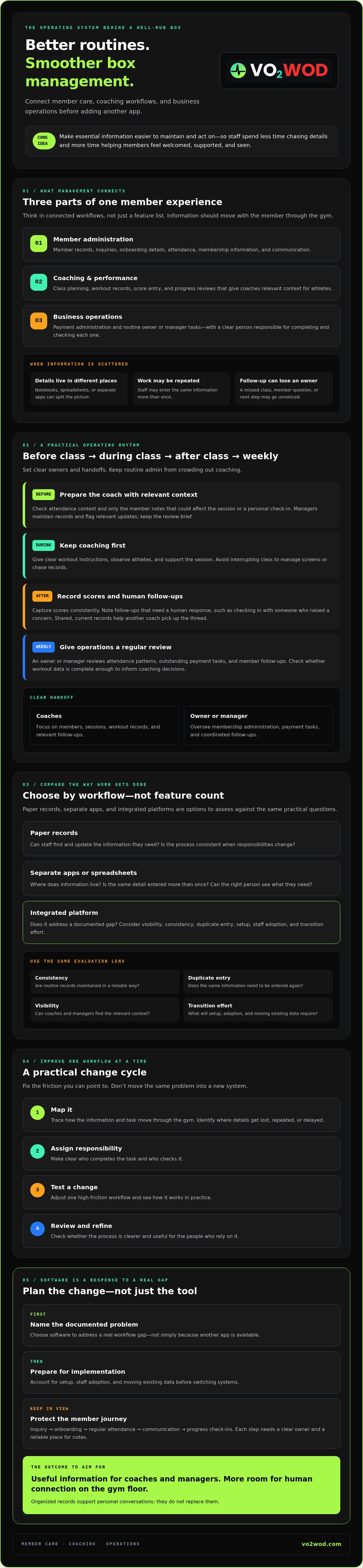
- Set a simple before-class, during-class, after-class, and weekly rhythm, with clear owners for each task.
- Compare paper records, separate apps, and integrated platforms by consistency, duplicate entry, visibility, and transition effort.
- Improve one high-friction workflow at a time: map it, assign responsibility, test a change, and review how it works.
- Choose software to address documented gaps, and plan for setup, staff adoption, and data migration before switching systems.
What functional fitness box management covers, and why it matters
Functional fitness box management is the connected work of organizing member records and communication, coaching and workout tracking, payments, attendance, and facility operations. It extends beyond coaching a class. The class-floor experience matters, but so do the processes that help members get a consistent welcome and keep coaches and managers aligned.
A box built around functional training needs to coordinate both. A coach may guide movement and review workout results, while an owner or manager handles membership administration, payments, schedules, and follow-ups. If records are scattered across notebooks, spreadsheets, and separate apps, staff may enter the same information more than once. A member’s missed classes can go unnoticed, a question may not reach the right person, and the next step may have no clear owner.
Which responsibilities belong in a box management system?
Think in connected workflows, not just a feature list. The right people should be able to find and update information as a member moves through the gym.
- Member administration: Organize member records, inquiry and onboarding details, attendance, membership information, and communications.
- Coaching and performance: Coordinate class planning, workout records, score entry, and progress reviews so coaches can use relevant information with athletes.
- Business operations: Track payment administration and routine owner or manager tasks, with a clear person responsible for completing and checking each one.
The goal isn’t to add process for its own sake. It’s to make essential information easier to maintain and act on, whether you use a shared spreadsheet or dedicated software.
How does organized management improve the member experience?
A member’s experience starts before their first workout. An inquiry leads to onboarding, then regular attendance, communication, and progress check-ins. When each step has a clear owner and a reliable place for notes, staff can offer a consistent welcome instead of asking members to repeat details or wonder what happens next.
Consistent processes help people understand what to expect, from getting started to having attendance and workout records reviewed. Accurate information also gives coaches useful context for personal conversations. They can discuss recorded progress and participation instead of relying only on memory. That doesn’t replace human connection on the gym floor. It makes more room for it.
Strong functional fitness box management brings these touchpoints into view. Once you can see how information and responsibilities move through the gym, it’s easier to spot a small process change that could make the day smoother for staff and members.
Build a functional fitness box operating rhythm around members and coaches
A reliable rhythm helps the gym feel welcoming without asking coaches to keep every administrative task in their heads. Decide what happens before, during, and after class, then reserve a weekly review for work that needs an owner’s attention. Make handoffs explicit: coaches can focus on members and workout records, while an owner or manager oversees membership administration, payment tasks, and coordinated follow-ups.
What should happen before, during, and after each class?
Before class: The coach checks attendance context and only the member notes that could affect the session or a personal check-in. Keep this review brief. Managers can maintain records and flag relevant updates so coaches aren’t sorting through scattered information as class begins.
During class: Coaching comes first. Give clear workout instructions, observe athletes, and support the session rather than interrupting it to manage screens or chase records. Schedule routine administrative tasks before or after class.
After class: Capture scores in a consistent format and record follow-ups that need a human response, such as checking in with someone who raised a concern. If different coaches work with the same member, shared, up-to-date records can help the next coach understand previous scores and agreed follow-ups. The member doesn’t have to start the conversation from scratch.
How can a weekly review keep box operations on track?
Set a regular time for the owner or manager to review attendance patterns, outstanding payment tasks, and member follow-ups using the records available. Check whether workout data is complete enough to inform coaching decisions. A missing score or inconsistent entry may point to a process that needs clarifying, not simply a need to ask staff to work harder.
Keep the review focused. Choose a short list of improvements, name an owner for each, and set a time to check whether the change helped. The U.S. Small Business Administration’s business management guidance also covers broader responsibilities such as finance and employees, useful context for owners shaping their operating routines.
This cadence makes functional fitness box management a shared practice rather than a collection of reminders in one person’s head. For a software-focused overview, see this functional fitness gym software guide. If your documented workflows point to a need for connected gym management, payments, or workout scoring, you can also explore VO2WOD’s platform as one option to assess.
Compare box management methods by workflow, not feature count
The right setup isn’t necessarily the one with the most features. Compare how each method handles the work your box actually does: keeping member records current, recording workout results, managing payments, and ensuring follow-ups have an owner. The best fit depends on your box’s size, staff roles, class volume, and current friction points.
Use this comparison as a starting point. The trade-offs depend on how your team sets up and maintains its processes.
| Method | Record consistency | Duplicate entry | Visibility | Task ownership | Transition effort |
|---|---|---|---|---|---|
| Paper or spreadsheets | Depends on staff using the same process | Can increase if records are copied between files | Limited to where records are stored and shared | Needs clear assignment and regular checking | Can be simple to adjust, but records may need organizing |
| Separate apps | Information may be split across tools | Possible when the same detail is entered more than once | Varies by tool and staff access | May be unclear across different systems | Each tool may require its own transition plan |
| Integrated platform | Related records can be managed in one system | May reduce repeated entry across connected workflows | Can offer a more consolidated view, depending on access and setup | Still requires named responsibilities | Requires setup, staff adoption, and a plan for existing data |
When are spreadsheets or separate tools still workable?
Paper or spreadsheets can suit a small team with straightforward, low-volume workflows, especially when one person can maintain the records and everyone knows where to find them. Separate apps can also work when each tool has a clear purpose and staff don’t need to enter the same information again elsewhere.
Watch for warning signs: duplicate versions of a member record, workout scores missing from reviews, or follow-ups that fall between coaches and managers. These point to a workflow gap. A new tool is useful only if it addresses that gap without adding more steps.
What should an integrated box management platform connect?
Assess the handoffs. Can member administration, payments, workout scoring, and performance information support the same operating rhythm? Can coaches find useful athlete records without taking attention away from class? Automated workout scoring and a live performance dashboard, for example, may help teams review results more consistently. Their value depends on how well the information fits your coaching process.
Before choosing a platform, ask how staff will use it, what information can be exported, and how existing data could be migrated. Confirm which source systems and data types a migration process supports. Strong functional fitness box management means a better fit between records and real work, not collecting features your team won’t use.
Create a practical plan for improving functional fitness box management
Improve one process at a time. A focused change is easier to explain, test, and adjust than a full overhaul. Use this sequence to turn a recurring frustration into a workflow your team can maintain.
- Map the workflow. Write down how the task starts, who handles each step, where information goes, and how completion is recorded. For example, trace a member follow-up from when a coach flags it to when someone makes contact and records the outcome.
- Identify the friction. Ask coaches and administrators where they repeat work, wait for missing information, or aren’t sure who acts next. Prioritize issues by their effect on members, the effort they require, and how often they recur.
- Assign an owner. Name the person responsible for each step and clarify who takes over if they’re unavailable. A task without an owner can quietly become everyone’s responsibility, which often means no one follows through.
- Test a small change. Document the current process before changing a tool or setting. Pilot a manageable adjustment with the staff involved, and choose a review date so the trial doesn’t become an unexamined permanent routine.
- Review and refine. Check whether the change helped, where friction remains, and what staff have noticed. Keep what works, adjust what doesn’t, and only then consider the next process.
How do you identify the biggest operational bottleneck?
Follow a real task from its first trigger through completion and record-keeping. Ask each person involved what they need, where they look for it, and what tends to stall the handoff. Then compare the answers. A recurring delay that affects member follow-up may deserve attention before a minor inconvenience that rarely interrupts the day.
Choose practical indicators you can review consistently: whether required records are complete, how many tasks remain unresolved, and whether member follow-ups are recorded and completed. Use these as prompts for better decisions, not targets to chase without context.
How can you introduce a new workflow without overwhelming the team?
Explain why the change is happening and the specific problem it should solve. Give staff a clear role in the pilot, invite their feedback, and address snags before expanding the process. If fragmented records are the sticking point, this centralized gym data platform guide can help you consider how unified records may fit the workflow.
That’s the heart of sustainable functional fitness box management: clearer work, with room for the people doing it to shape the process. If your review points to a need for connected gym management, payments, or workout scoring, explore VO2WOD’s platform as an option to assess against your documented needs.
Choose functional fitness box management software when it solves a real gap
Software should follow the workflow, not dictate it. Use the process you’ve mapped to define the problem a platform needs to address. Payment administration may be disconnected from gym records, workout scores may be difficult to review, or coaches may struggle to find relevant athlete information. Then compare those needs with verified capabilities. A more connected record may reduce fragmentation, but setup and staff adoption still matter.
Keep the evaluation practical. Ask the people who will use the system to walk through a real task, such as recording a workout result or finding relevant member information. Notice whether the platform removes a step or adds one. A long feature list matters less than a clear fit with the work your team needs to do.
What should you verify before adopting a management platform?
Check the details before committing. Confirm which workflows and staff roles the current subscription supports, and verify that the features you need are included. Ask what member, payment, and workout data can transfer from your existing tools, how migration is supported, and which records need manual review. Migration support can help with a transition, but confirm that your source systems and data types are supported.
Consider usability, too. Coaches should be able to access relevant information without unnecessary administrative steps, and members should be able to use features intended for them without confusion. Plan time for setup and staff familiarization, and clarify who will maintain records once the new process is in place.
How can VO2WOD support a more connected box workflow?
VO2WOD offers a subscription platform for functional fitness facilities that includes gym management, automated payments, automated workout scoring, and Vo2hub. Its live athlete performance dashboard displays performance metrics in real time. These capabilities may suit boxes looking to connect administrative records with workout and performance information. The fit depends on your documented needs and the current subscription inclusions.
VO2WOD also offers data migration assistance for gyms moving from existing tools. Before a transition, confirm which source systems and data types are supported and what will need review. That preparation helps you assess both the destination and the practical work of getting there.
Choose a tool only after matching your priority workflows to verified features. If VO2WOD appears to fit, explore the VO2WOD platform as a next step in assessing your functional fitness box management needs.
Make Your Next Operational Improvement Count
Smoother functional fitness box management doesn’t require changing everything at once. Start with a workflow that creates repeated work or missed handoffs, assign a clear owner to each step, and check whether a small change makes records and follow-ups more consistent.
Then assess tools against the needs you’ve documented. Integrated records may help connect administration and coaching, but setup, staff adoption, and data transfer deserve attention. The right platform should support the way your box works, not add complexity for its own sake.
VO2WOD’s platform includes gym management, automated payments, workout scoring, and Vo2hub. It also offers a live athlete performance dashboard and data migration assistance for gyms transitioning from existing tools. Confirm current feature availability and migration support for your systems as you evaluate fit.
If those capabilities match a real gap in your operations, explore the VO2WOD platform. Take the next step at a pace that works for your team. A clearer operating rhythm can leave more room for the coaching and community at the heart of your box.
Frequently Asked Questions
What does functional fitness box management include?
Functional fitness box management connects the work of serving members, supporting coaches, and running the facility. It can include member records, onboarding, attendance, communications, membership and payment administration, class planning, workout records, scoring, and progress reviews. It also covers the routines that keep tasks moving between coaches and owners or managers. Clear records and responsibilities help reduce repeated entry and missed handoffs without distracting from personal coaching.
How do you manage a functional fitness gym effectively?
Manage a functional fitness gym effectively by setting a repeatable routine and making task ownership clear. Before class, coaches can check relevant attendance context and member notes. During class, they focus on coaching. Afterward, they record scores and flag needed follow-ups. A weekly owner or manager review can check attendance, payment tasks, member follow-ups, and record completeness. Start by improving one recurring friction point, then review whether the change helps.
Does a functional fitness box need gym management software?
No, a functional fitness box doesn’t automatically need gym management software. Paper records or spreadsheets may work if the team can keep them accurate and easy to access. Consider software when staff repeatedly enter the same information, records conflict, or follow-ups slip between people. First identify the workflow problem, then assess whether a platform solves it without adding unnecessary setup or steps. The right choice depends on your team, class volume, and operational needs.
What features should box management software have?
Choose features based on the workflows your box needs to support. Useful capabilities may include member administration, attendance records, payment processing, workout scoring, and access to performance information. Check that staff can see the records relevant to their roles and that the system supports clear task ownership. Before selecting a platform, verify which features are included in its current subscription, how records can be exported, and what setup or staff familiarization the transition requires.
How can a functional fitness gym track athlete progress?
Track progress by recording workout scores consistently and reviewing them with relevant context, such as attendance and previous results. Coaches can use these records to inform check-ins and discuss an athlete’s performance over time instead of relying only on memory. A live athlete performance dashboard can display performance metrics in real time. Use the information to support coaching conversations, not replace a coach’s judgment or the athlete’s own experience.
Can gym management software automate payments and workout scoring?
Some gym management platforms can automate payment processing and workout scoring, but capabilities vary by provider and subscription. VO2WOD’s platform includes automated payments and automated workout scoring, alongside gym management and Vo2hub. Before choosing a system, confirm that the features you need are currently included and understand how they fit your existing workflows. Automation can support consistent administration, while staff still need clear processes for reviewing records and handling follow-ups.
How do you move member and workout data to a new gym platform?
Start by listing the member and workout records you need, then ask the new provider which data can transfer from your current system and in what format. Confirm which source systems and data types are supported, what requires manual review, and how you can check records after migration. VO2WOD offers data migration assistance, but gyms should verify that their existing tools and required data are supported before planning a transition.


