

What if the gym numbers you already have could point to your next best move, without adding another reporting chore? Data driven decisions for gym owners don’t require tracking everything. They start with a few useful signals, connected to clear questions and practical actions.
If attendance lives in one system, payments in another, and member updates in a spreadsheet, getting a clear picture can feel like a project of its own. Even when the numbers are in front of you, a change in revenue or visits doesn’t always explain what to do next. The answer isn’t simply more data. It’s a steady way to see what’s changing and why.
This guide will help you choose a focused set of operational, financial, and member indicators, interpret them through consistent comparisons, and investigate changes before deciding what to adjust. You’ll also learn how to build a repeatable review process that ends with clear next steps, not another dashboard to maintain. A calmer view of your gym’s performance can begin with the information you already collect.
Key Takeaways
- Choose financial, membership, attendance, operational, or workout-performance measures to answer a specific business question, rather than tracking every available number.
- Make comparisons meaningful by keeping metric definitions, time periods, class types, and membership groups consistent.
- Use a simple review cycle to investigate changes, choose an action, and record who will follow up and when.
- Data driven decisions for gym owners are strongest when each metric connects to a practical question and an observable next step.
- Assess whether a centralized gym platform can simplify your workflow by reducing duplicate data entry across workout scoring, payments, and performance information.
Why data-driven decisions matter for gym owners
Gut instinct matters. You know your members, your coaches, and the feel of a class. But when attendance figures sit in one report and schedule notes in another, instinct can be hard to check against what’s actually happening. A practical decision process brings the evidence together, adds context, and helps you choose a next step without turning every choice into a reporting project.
A data-driven decision is a choice informed by relevant evidence, the circumstances around it, and a follow-up to see what happened. The related idea of data-informed decision-making is a useful reminder that numbers need human judgment to be meaningful. Data can support your coaching expertise and conversations with members. It can’t replace them.
Collecting numbers fills a dashboard; using evidence connects a signal to an action you can review. That distinction is at the heart of data driven decisions for gym owners.
What data-driven decision-making means inside a gym
Suppose attendance in one class appears to drop. The observable metric is the change in recorded visits. “Members are losing interest” is an interpretation, not a fact. Before changing the schedule, check whether the class time shifted, the format changed, or the comparison covers an unusual week. Then decide whether to make an adjustment, gather more information, or leave the schedule as it is and review again.
One unusual week rarely proves a lasting pattern. Look for a repeated change across comparable periods, then follow up after any action. This helps prevent a temporary disruption from driving a decision that affects members and staff.
Why gym owners need context, not just more numbers
Metrics can move for different reasons. A class format may attract a different group than another, seasonal routines can affect visits, and a schedule change can shift attendance between sessions. Membership mix matters, too. A change in the number of new or long-standing members can alter an overall figure without showing how either group is experiencing the gym.
Context also guards against improving one measure at another’s expense. A schedule change might raise attendance in a particular class but create extra workload for coaches or make the timetable less convenient for members. Pair the numbers with staff observations and member feedback before deciding what “better” means.
Start with a small set of measures that answers current questions, and review them consistently. An overflowing dashboard can make useful signals harder to see. A focused set gives you room to notice changes, ask why, and choose a clear next step.
What data should gym owners track to make better decisions?
Start with the decision, not the dashboard. A question about class scheduling calls for different evidence than a question about cash flow or athlete progress. For data driven decisions for gym owners, a focused set of measures is more useful than collecting every number a system can produce.
Candidate measures usually fall into five groups: financial measures such as recurring revenue and average revenue per member; membership measures such as joins, cancellations, and retention; attendance by class or time; operations such as recurring admin tasks and payment status; and workout performance such as scores and athlete progress. Treat these as options, not a mandatory checklist. Choose the few that help answer a current question, and keep their definitions and reporting periods consistent so comparisons stay meaningful.
Choose metrics that match the decision in front of you
For schedule planning, look at attendance by class and time, alongside class capacity if that information is available. For member engagement, review participation patterns and ask members directly about their experience. For operational planning, examine payment status, recurring administrative tasks, and the time spent compiling reports where those details can be reliably observed. Check where each measure comes from before relying on it. Some information may require a manual count or staff input.
| Decision question | Useful measure | Limitation to keep in mind |
|---|---|---|
| Should we adjust the schedule? | Attendance by class, time, and capacity | Doesn’t explain why people attended or stayed away. |
| Are members participating? | Visit frequency or class participation, paired with feedback | Attendance alone can’t show satisfaction or intent to stay. |
| How is the business performing financially? | Recurring revenue, revenue per member, or payment status | Revenue measures don’t reveal workload or member experience. |
| Are workouts supporting coaching goals? | Workout scores and athlete progress | Performance data isn’t a complete measure of business health. |
Separate business health measures from workout performance data
Revenue and attendance help answer business and scheduling questions. Workout scores and athlete progress help coaches and athletes understand performance. Each can be useful, but they aren’t interchangeable. A strong workout score doesn’t establish that revenue is healthy, just as steady revenue doesn’t tell you whether athletes are progressing.
VO2WOD’s Live Athlete Performance Dashboard displays athlete performance metrics in real time, and its automated workout scoring can reduce manual scoring steps. These tools can support coach and athlete workflows, but shouldn’t be treated as measures of retention, revenue, or attendance. If you’re assessing whether a platform could make gym and workout data easier to work with, see VO2WOD’s gym management and performance platform.
How can gym owners interpret data without jumping to conclusions?
A change in a report is a signal to investigate, not an automatic instruction to act. Before comparing figures, make sure they mean the same thing: define what counts as an attendance visit, use comparable time windows, and separate class types or membership groups when their patterns may differ. Otherwise, an apparent shift could come from a changed definition or a different mix of people, not a meaningful change in behavior.
A metric only becomes useful when you know its definition, comparison period, and context. Keep those details consistent, then look for changes that repeat across comparable periods. There’s no single universal threshold that proves a gym should change course. The right interpretation depends on the measure and the circumstances around it.
Compare trends fairly before changing operations
Consider attendance for the same class type across matching weekly periods. The figures below are hypothetical examples, not industry benchmarks. Use them to frame questions, not to set a target.
| Baseline | Current period | Possible context to check | Follow-up question |
|---|---|---|---|
| 18 average visits per class | 14 average visits per class | Schedule, staffing, programming, or calendar changes | Did the decrease continue in comparable weeks, and what changed around the same time? |
If attendance dipped during a holiday week, for example, that may not signal a lasting shift. Check the calendar and ask whether the class time, coach, or workout format changed. If attendance remains lower across comparable periods, speak with coaches or members to understand what the numbers can’t show. A relationship between a schedule change and lower attendance is a reason to investigate, not proof that one caused the other.
Spot data quality problems that distort decisions
Before settling on an explanation, check whether the underlying information is trustworthy. Look for missing entries, duplicate records, changed workout-scoring conventions, or reporting periods that don’t line up. A spreadsheet copied and edited by several people can also end up with conflicting versions or different definitions of the same measure.
When a result looks surprising, confirm it before acting. Ask a coach whether a class roster or scoring process changed. Where appropriate, check the pattern against what members report. For data driven decisions for gym owners, this pause helps separate a real operational signal from a recording error. Note what you verified, what remains uncertain, and when you’ll review the measure again.
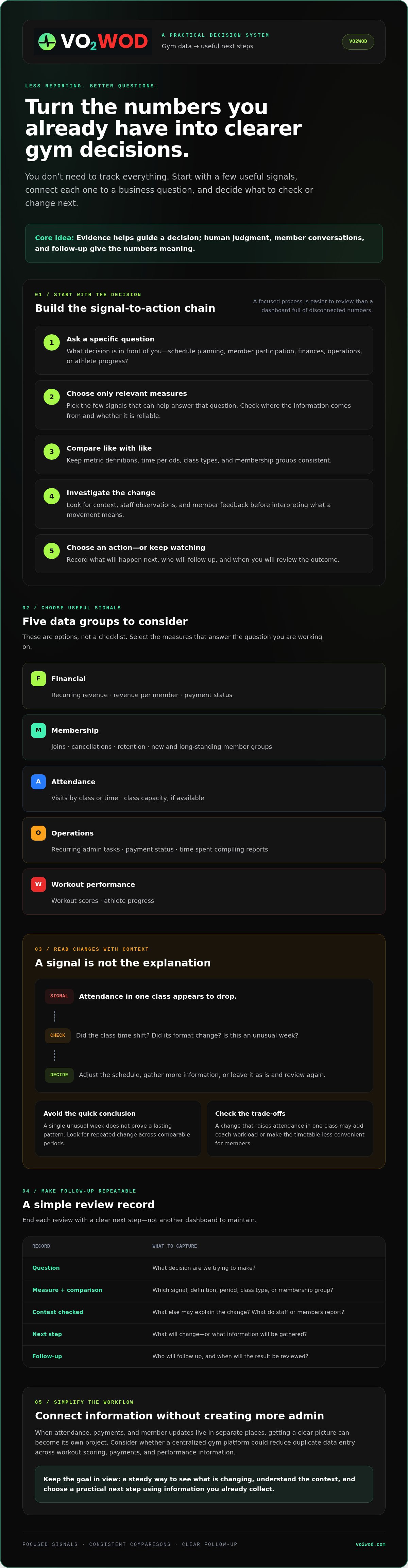
How to turn gym data into decisions and measurable follow-up
A review is useful only if it leads somewhere. Turn the signals you’ve checked into a small, repeatable cycle. Each step should help answer one question, guide one action, and make it clear when you’ll check what happened.
- Ask: State the operational question you need to answer.
- Select measures: Choose the few metrics that can shed light on it.
- Validate context: Check definitions, time periods, data quality, and relevant changes.
- Choose an action: Make a practical adjustment that responds to the evidence.
- Review the result: Return to the same measures and assess what changed.
For example, if attendance in a particular class has dipped across comparable periods, you might test a schedule adjustment. Before making the change, define what you’ll observe, such as attendance for that class over the next review period. Keep other major variables steady where practical, so it’s easier to interpret the result. The goal isn’t to prove the change worked at all costs. It’s to learn whether the evidence supports keeping, revising, or reversing it.
Set up a simple recurring gym data review
Match the review cadence to the decision. Weekly checks can help with immediate operational questions, while monthly reviews may suit broader business measures. Keep each meeting focused on a few questions instead of reviewing every report. Assign someone to verify the data and record the decision, action, expected observable change, and review date. A short written note creates a clear thread from signal to follow-up.
Test changes and learn from the result
Decide what success would look like before acting, and avoid changing several major things at once when you can. At the review, compare like with like, then consider what else may have affected the result. If attendance didn’t change as expected, check whether the adjustment was implemented as planned and whether member feedback offers useful context. A result that doesn’t match your expectation still provides information for the next decision.
If fragmented reporting makes this cycle harder than it needs to be, this guide to centralized gym data platforms offers ideas on bringing gym workflows into clearer view. VO2WOD’s gym management platform brings gym and workout data together, with automated payments and workout scoring among its capabilities. Its connected workflow is one option to assess.
How to build a reliable data workflow for your gym
Data scattered across spreadsheets and separate systems can create duplicate entry, conflicting versions, and extra time spent assembling reports. A centralized platform may make information easier to work with, but feature count alone won’t tell you whether it fits. Start with the decisions and workflows you’ve identified, then assess whether a system supports them with less friction.
Software can help capture and organize information. It can’t decide which measures matter to your gym, interpret every member’s experience, or choose an action for you. That judgment still comes from owners and coaches, supported by reliable records and a consistent review process. For data driven decisions for gym owners, the best-fit workflow is one your team can maintain and use.
What to evaluate when choosing a gym data platform
Use your actual needs as a checklist. Can the system support the measures behind your priority questions? Does it help with the steps your team repeats, such as data capture, workout scoring, payments, and preparing reports? Consider whether it reduces duplicate work without making important information harder to check.
Before switching, ask how existing member and workout records can be transferred, what information is included, and what your team will need to verify afterward. VO2WOD offers data migration assistance. Also confirm the details that affect reliable comparisons: how metrics are defined, how you can access or export data, what privacy and security practices apply, and which integrations are supported. Don’t assume a capability without checking it with the provider.
Where VO2WOD may fit into a connected workflow
VO2WOD’s platform subscription brings gym management and workout data together. Its capabilities include gym administration, Vo2hub, automated payments, and automated workout scoring. The Live Athlete Performance Dashboard provides a real-time view of athlete performance metrics. These features may help connect administrative and workout workflows, but assess them against your own decision needs rather than assuming the platform reports every business or member measure you track.
As you evaluate any platform, walk through a typical task with the people who handle it. Follow one piece of information from entry to review. Note where it’s duplicated, where definitions could drift, and whether the right person can check the result. That practical test often reveals more than a long feature list.
A more connected gym management and performance workflow is one option to consider with VO2WOD.
Make your next gym decision clearer
Better decisions don’t come from collecting every available number. They come from choosing measures that answer a real business question, comparing them consistently, and checking the result after you act. That’s the practical foundation of data driven decisions for gym owners.
Keep the process grounded: confirm what the data means, look for context before drawing conclusions, and record who will take the next step and when you’ll review it. A small, reliable workflow can give your team a clearer view without turning reporting into another heavy task.
If disconnected systems make that work harder, VO2WOD offers a platform subscription that includes gym management, automated payments, and workout scoring. Its Live Athlete Performance Dashboard displays athlete performance metrics in real time, and data migration assistance is available for transitions from legacy systems.
VO2WOD’s gym management platform is one option for bringing gym workflows together.
Frequently Asked Questions
What data should gym owners track?
Track measures that help answer current business questions. Useful categories include financial indicators, such as recurring revenue and payment status; membership measures, such as joins and cancellations; attendance by class and time; operational workload; and workout performance, such as scores or athlete progress. You don’t need every metric available. Choose a manageable set, define each measure clearly, and review it consistently so changes are easier to interpret.
How do you make data-driven decisions in a gym?
Start with a specific question, then select relevant measures and check their quality and context. For example, if attendance appears to be changing, compare similar classes across comparable periods and check for schedule or calendar changes. Choose an action, record who is responsible and what you expect to observe, then set a review date. Data driven decisions for gym owners combine evidence with staff and member insight, not numbers alone.
Can small gyms make data-driven decisions without specialized software?
Yes. A small gym can begin with reliable records in a spreadsheet or other simple tracking method. Pick a few measures that match immediate needs, use consistent definitions, and assign someone to keep entries current. Manual tools can become harder to manage if information is duplicated or spread across versions. Specialized software may help organize workflows, but it isn’t a substitute for asking clear questions and reviewing results.
Which gym metrics help with class scheduling?
Review attendance by class, time, and format, and compare it with available capacity information. Keep the comparison periods consistent, and account for schedule changes, staffing, programming, and calendar effects. Attendance can show where participation changed, but not necessarily why. Pair the figures with coach observations and member feedback before changing the timetable. This helps you consider the experience behind the count, not just the number of visits.
How often should gym owners review their data?
Choose a review schedule that fits the decision. Weekly checks can help with immediate operational questions, while a monthly review may suit broader business measures. There’s no single cadence for every metric or gym. Keep each review focused on a few questions, verify the underlying information, and record agreed actions and follow-up dates. If a measure changes quickly or prompts an operational response, check it at an appropriate interval.
What is the difference between gym performance data and business data?
Gym performance data describes workout activity, such as scores and athlete progress. Business data helps owners assess operations and financial or membership patterns, such as attendance, payment status, revenue, or cancellations where those records are available. The two types answer different questions. Performance measures can inform coaching conversations, while business measures help assess how the gym is operating. Neither category alone gives a complete picture of member experience or overall business health.
Explore VO2WOD’s gym management and performance platform to see whether its capabilities fit your gym’s needs.


