

What if every check-in did more than mark a name off a list? With automated gym attendance tracking, your team can spend less time reconciling paper records and spreadsheets and get a clearer view of who’s showing up. The key is choosing a method that fits your classes and is simple for members to use.
Manual logs take time, and missed or inconsistent entries can make participation patterns hard to spot. You may already know attendance matters, but a complicated check-in process won’t help staff or members. A well-planned system can capture visits more consistently and make the data easier to use in everyday coaching and gym operations.
This practical guide explains common check-in options, from codes and QR scans to staff-entered attendance, and what to weigh when comparing them. You’ll learn how to assess member experience, staff workload, reporting, and fit with your existing systems. Use those criteria to choose an approach that eases administration and turns attendance into useful context.
Key Takeaways
- Automated gym attendance tracking records member visits with less manual entry, but it doesn’t replace scheduling, workout logging, billing, or follow-up.
- Compare staff-entered, member-led, and software-connected check-ins against your class format and the experience you want members to have.
- Automation isn’t automatically the best fit for every gym. Weigh setup effort, check-in friction, staff workload, and record consistency before choosing.
- Introduce a new process in stages: define what counts as attendance, test the method, train staff, and review how it works during real classes.
- See how VO2WOD’s gym management, Vo2hub, workout scoring, and performance dashboards can fit into a connected workflow, and confirm what attendance capture your setup supports.
What automated gym attendance tracking does, and what it does not do
At its simplest, automated gym attendance tracking records that a member attended, with less manual entry than a paper sign-in sheet or staff-maintained spreadsheet. Depending on the setup, a member may check themselves in, a staff member may confirm their arrival in software, or a connected system may record an event after identifying the member.
Attendance tracking is the process of recording member presence so a gym can review visits consistently and understand participation over time. The process varies by provider. Ask which capture methods are supported, how a check-in becomes part of a member’s record, and what staff need to do when something goes wrong.
Which parts of attendance tracking can be automated?
A typical workflow links a check-in event to the right member record. Some systems support member-led check-ins, while others rely on staff entering or confirming attendance. “Automated” doesn’t always mean passive tracking or that staff no longer have a role. A coach may still need to correct a missed check-in, resolve a duplicate, or record an exception.
Attendance also isn’t the same as class scheduling, workout logging, billing, or member follow-up. These functions may live in one platform, but each handles a different task. Scheduling manages who plans to attend; attendance records who did. Workout logs capture training activity, billing handles payments, and follow-up is a separate way to communicate with members.
Some check-in workflows resemble access control systems, which manage entry based on whether a person is authorized. But don’t assume an attendance tool controls doors or checks membership permissions. Confirm what the software actually records and whether any access-related functions are included.
Why attendance records matter beyond counting visits
Consistent records give owners and coaches a clearer view of participation. A coach might notice that a regular class attendee has been coming less often, then decide whether a friendly check-in or coaching conversation makes sense. Reliable records can also help with planning. If attendance differs across sessions, the team has a better starting point for reviewing class patterns.
Still, a visit count is only one signal. A member may attend less often for many reasons, and attendance alone can’t tell you whether they’re motivated, satisfied, or making progress. Use the record as context, not a conclusion, and pair it with what coaches learn through real conversations.
Before choosing a provider, ask which attendance capture methods are available, what exceptions require staff attention, and how attendance information can be reviewed. Features differ, so verify the workflow rather than relying on the word “automated.”
How gym attendance tracking works: check-ins, records, and useful data
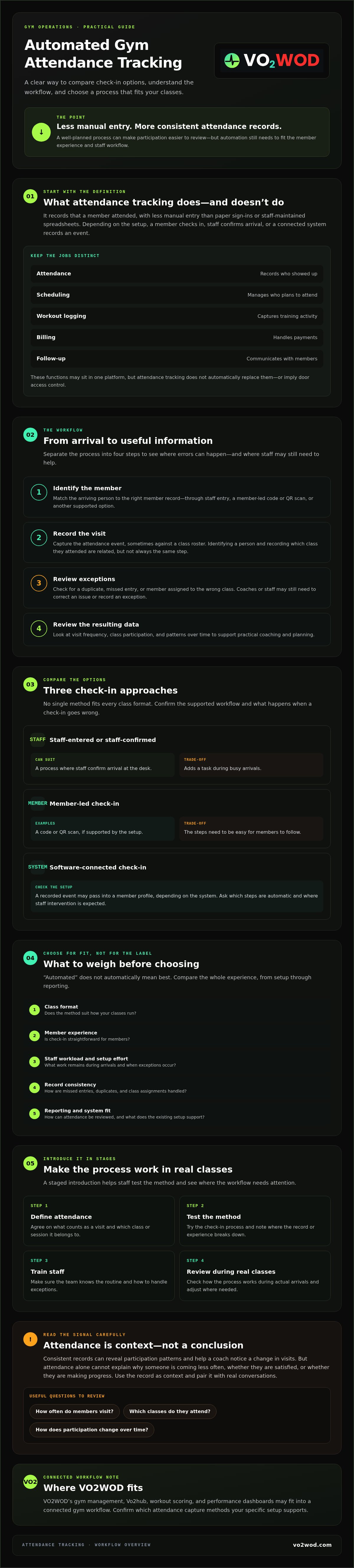
A useful attendance workflow has four steps: identify the member, record the visit, review exceptions, and look at the resulting data. The details depend on the gym’s software and check-in method, but separating these steps makes it easier to spot where errors can occur and what staff may still need to handle.
What happens from member arrival to an attendance record?
First, the process needs to match the arriving person to a member record. That might happen through staff entry, a member-led check-in such as a code or QR scan, or another option the software supports. Identification and visit recording are related but distinct: confirming who arrived doesn’t always confirm which class or session they attended.
Next, the visit is recorded, sometimes against a class roster. Staff can then review exceptions, such as a duplicate check-in, a missed entry, or a member assigned to the wrong class. A quick review helps keep records useful without assuming every check-in will be perfect. Ask providers which steps happen automatically and where staff intervention is expected.
Check-in methods bring different trade-offs. Staff-entered attendance offers a human check at the desk, but adds a task during busy arrivals. Member-led check-in can reduce entry work, though the process needs to be easy to follow. Software-connected check-ins may pass a recorded event into a member profile, depending on the setup. No single approach suits every class format, so confirm which methods are available and how they handle exceptions.
Which attendance measures are useful to review?
Start with descriptive measures that answer practical questions: how often members visit, which classes they attend, and how participation changes over time. For example, an owner could compare attendance in a regular evening class across reporting periods, provided the class and attendance rules stayed consistent.
Define the details before comparing records. Does a late arrival count? How are class changes handled? Is a visit recorded when a member checks in, or when staff confirm attendance? If those rules shift between classes or reporting periods, the numbers can look different for reasons unrelated to participation.
Attendance data records participation; it doesn’t explain its cause. A change in visits can prompt a coach to check in, but it can’t by itself reveal a member’s motivation, satisfaction, or circumstances. Treat the pattern as a useful starting point, then bring in the human context.
For a broader look at platform considerations, read this functional fitness gym software guide. If you’re assessing automated gym attendance tracking, you can also ask VO2WOD which attendance capture options your setup supports.
Manual sign-ins vs. automated attendance tracking: what fits your gym?
Automation can reduce repeated data entry, but it isn’t automatically the better choice. The right process is one your team can follow consistently, members can use without confusion, and coaches can trust when reviewing attendance.
| Consideration | Manual sign-ins | Automated or member-led check-ins |
|---|---|---|
| Setup effort | Often simple to start with a roster or sign-in sheet. | May require configuring software, member records, or a check-in method. |
| Check-in friction | Members may need to find a staff member or write their names. | Can make check-in more self-directed, but members need clear instructions and a method that suits the class. |
| Staff workload | Staff enter or reconcile visits, especially if records are spread across rosters. | May reduce routine entry, though staff can still need to resolve exceptions or help members. |
| Record consistency | Depends on people remembering to record and update visits. | Can standardize capture, but results still depend on setup, use, and exception review. |
When can a manual attendance process be enough?
A staff-led roster may work well for a small class with familiar members, a clear arrival routine, and one person responsible for updating the record. It can also suit a gym whose current process is easy to maintain and produces records coaches can use. There’s no need to change systems just because automation is available.
The trade-off is consistency. Someone must remember to mark each visit, correct errors, and reconcile records if class rosters or member lists live elsewhere. If that task is regularly missed or delayed, the process may be less dependable than it appears.
When does automated tracking become worth evaluating?
Look at the work behind the check-in, not just the technology. Repeated entry, missing visits, and member information scattered across separate records are useful signals to review your workflow. A more consistent process may be worth evaluating when several coaches run different classes or owners need to compare participation across locations.
Weigh the potential relief against setup, staff training, and member adoption. A self-check-in method that members find confusing may create a new queue instead of easing the old one. Before choosing a provider, note who records attendance now, where mistakes occur, and what information coaches need. Then confirm the provider’s supported methods and how exceptions are handled. That gives you a practical basis for deciding whether automated gym attendance tracking fits your gym, rather than assuming that more automation always means better records.
How to introduce automated attendance tracking without disrupting classes
A smooth rollout starts before the first member checks in. Map the current process, choose a capture method that fits your classes, then test it before making it the new routine. This phased approach helps you catch awkward steps while the change is still easy to adjust.
- Map the current process. Note who records visits, where records live, and when errors or delays tend to happen.
- Choose a capture method. Compare the options your provider supports against class flow, member comfort, and staff responsibilities.
- Define attendance. Decide how to record late arrivals, class changes, missed check-ins, and members who attend without booking.
- Test, train, and communicate. Explain the new steps to staff and members, and keep a familiar fallback process available during the initial rollout.
- Review and refine. Check the records and ask staff and members what felt unclear before expanding the workflow.
How should a gym test a new check-in workflow?
Start with a limited part of the schedule, such as one class type or a small group of sessions. Check whether the right member and class appear in each record, how much staff effort check-in requires, and whether members can complete the steps without slowing arrivals. Notice how the process handles duplicates, missed entries, and class changes.
Set a review date before the pilot begins. Gather feedback from the people using the process, then simplify confusing instructions or adjust responsibilities. Once the workflow feels dependable in that setting, decide whether to extend it to other classes.
How should owners handle attendance data responsibly?
Decide who needs access to attendance records and what they’ll use them for. Coaches may need participation context for planning, while broader access may not be necessary for every staff role. Ask each provider how access is managed, how long information is retained, and whether records can be exported. These details vary, so confirm them rather than assuming a feature is available.
Privacy requirements can depend on where your gym operates and how it uses member information. Get qualified guidance on the rules that apply to your situation; don’t assume one standard covers every gym. Clear internal practices can also help staff understand how attendance information should be handled.
If you’re changing platforms as part of the rollout, use this gym data migration checklist to plan the transition. Before adopting automated gym attendance tracking, ask VO2WOD which attendance capture options your setup supports.
How VO2WOD fits into a connected gym operations workflow
Attendance is one part of the picture. Functional fitness owners may also want gym operations and workout performance information to sit within a coherent workflow, so staff spend less time moving between disconnected records and more time supporting members.
VO2WOD offers gym management, Vo2hub, automated workout scoring, and a Live Athlete Performance Dashboard. The dashboard provides coaches with real-time workout metrics and scoring, while Vo2hub centralizes workout data and supports member engagement. These capabilities can provide useful context when assessing how attendance information might fit alongside member and coaching workflows.
However, the product information doesn’t confirm a specific attendance capture feature, check-in method, or attendance reporting option. Don’t assume those functions are included. Ask the product team what the current platform supports and how any attendance records would relate to the rest of your gym’s processes. For more on connecting operational information, see this centralized gym data platform guide.
What should functional fitness owners ask a platform provider?
Bring practical questions to a provider conversation. Clear answers can help you judge whether a platform fits your actual workflow, rather than just its feature list.
- Which attendance capture methods and reporting options are currently supported?
- How would attendance records relate to member profiles and class schedules?
- Can existing member or attendance data be brought into the platform, and what migration support is available?
- Which steps would staff still need to complete or review?
Ask how the proposed workflow would handle your gym’s existing records and coaching routines. If you’re considering a platform change, clarify data migration and workflow setup before making a decision. VO2WOD offers a dedicated data migration service, but confirm what it covers for your specific transition.
What a connected workflow can make easier
Keeping gym administration and performance information organized can make it easier for staff to find relevant context and coaches to review workout data. Attendance could add another useful participation signal, but only if the platform supports the capture and reporting you need. Treat that as a point to verify, separate from VO2WOD’s gym management, workout scoring, Vo2hub, and dashboard capabilities.
If you’re evaluating automated gym attendance tracking alongside your coaching and operations tools, explore VO2WOD and discuss your gym’s workflow, including which attendance options are currently supported.
Make attendance data work for your gym
The best automated gym attendance tracking process is one your members can use easily and your staff can maintain consistently. Choose a check-in method that fits your classes, define what counts as attendance, and test the workflow before expanding it. Then use visit patterns as helpful context for coaching, not as a complete measure of how a member feels or progresses.
For functional fitness facilities, VO2WOD brings together gym management and performance tools. Its Live Athlete Performance Dashboard provides coaches with real-time workout metrics and scoring, and its dedicated data migration service can support transitions from existing systems. Attendance capture methods and reporting aren’t confirmed, so ask the team what’s currently supported and how it could fit your member and coaching workflows.
Explore VO2WOD and discuss your gym’s workflow. Start by asking which attendance options your setup supports, then consider how VO2WOD’s gym management and performance tools could fit your existing workflow.
Frequently Asked Questions
What is automated gym attendance tracking?
Automated gym attendance tracking records member visits with less manual entry than paper sign-in sheets or spreadsheets. Depending on the system, a member might check in themselves, staff might confirm their arrival in software, or a connected process might add a visit to their record. It tracks presence, not necessarily class booking, workout results, billing, or follow-up. Check which parts a provider actually supports before choosing a setup.
How does a gym track attendance automatically?
A gym identifies the member, records the visit, and reviews exceptions such as missed or duplicate check-ins. The method might involve a member entering a code, scanning a QR code, or having staff enter attendance, depending on the software. Owners should confirm whether a check-in links to a class roster or only to a member record, and what steps staff still need to complete.
Is automated attendance tracking worth it for a small gym?
It can be, but a small gym doesn’t necessarily need automation. If a staff-led roster is quick to update and consistently accurate, keeping that process may make sense. Consider a change if visits are repeatedly missed, records need frequent reconciliation, or staff spend too much time entering attendance. Compare those problems with the effort of setup, staff training, and helping members adopt a new check-in method.
Can gym attendance software track class participation as well as check-ins?
Some systems may connect a recorded visit to a class roster, while others may record attendance only against a member profile. Ask the provider whether class participation reporting is supported and how class changes, late arrivals, and unbooked visits are handled. A check-in confirms a recorded visit, but it may not capture workout performance. Those records may be separate, even if a platform offers both types of tools.
What happens if a member forgets to check in?
The visit may be missing until a staff member or administrator corrects the record, depending on the system. Establish a simple fallback, such as asking the member to tell a coach or front-desk staff member, who can then check whether the visit can be added. Decide how to handle missed entries before rollout, and review records for errors so a missing check-in isn’t mistaken for an absent member.
How can gym owners use attendance data to improve member engagement?
Use attendance patterns to identify when a member’s participation changes, then let a coach decide whether a personal check-in would be helpful. For example, a coach might ask a regular attendee whether their schedule has changed. Attendance is context, not a verdict: it can’t explain someone’s motivation, satisfaction, or circumstances. Pair the record with conversation and coaching knowledge rather than making assumptions from visit counts alone.
What should I check before choosing gym attendance tracking software?
Confirm available check-in methods, whether visits can be associated with classes, how staff correct missed or duplicate records, and what reporting is available. Ask about member-record connections, compatibility with existing systems, data access, retention, and export options. Include setup and training in your evaluation. If considering VO2WOD, ask the team which attendance capture and reporting options are currently supported, since specific attendance features aren’t confirmed in the product information.


