
What if a workout score could do more than record a result? The right member performance dashboard software makes effort easier to see, giving coaches timely information during class and members a clearer view of their progress. When results are split across spreadsheets, whiteboards, and separate tools, that shared picture is harder to find.
A useful dashboard should show performance information without adding another layer of admin. Look for a clear view of workout scoring and results, support for coaching conversations, and a practical fit with the systems you already use to run your gym.
This guide explains what a member performance dashboard should do and how to assess whether it suits your facility. You’ll learn what to look for in real-time metrics and scoring, how coaches and members can use shared workout data, and how performance visibility can sit alongside gym management. We’ll also cover how VO2WOD’s Live Athlete Performance Dashboard, automated workout scoring, and Vo2hub bring performance information and member engagement together, plus how to plan a transition to a new platform.
Key Takeaways
- Understand how a performance dashboard differs from a leaderboard and broader gym management software.
- See how workout data moves from recording and scoring to display, then supports coaching and member review.
- Evaluate member performance dashboard software for live visibility, scoring, member engagement, and gym operations.
- Plan a manageable rollout by mapping current records and starting with one repeatable coaching workflow.
- Explore how VO2WOD brings its Live Athlete Performance Dashboard, Vo2hub, and automated workout scoring alongside gym management.
What Is Member Performance Dashboard Software for a Functional Fitness Gym?
Member performance dashboard software presents workout results and scoring in a visual format that’s easier to review than scattered notes or records. In a functional fitness gym, it gives coaches and members a shared place to see results and use them as a starting point for discussion.
A performance dashboard has a different focus from general gym management software. Gym management supports broader operations, while a performance dashboard focuses on workout information. It also differs from a leaderboard, which puts rankings or displayed results front and center. A dashboard can show a wider view of performance and scoring, giving coaches more context than a rank alone.
There’s a human reason to make that information visible. The Quantified Self movement reflects an interest in using numbers for self-knowledge. In a gym, workout results can help members notice their efforts and give coaches a practical starting point for a supportive conversation.
If you’re considering performance tools as part of a broader system for your facility, explore this functional fitness gym software guide.
What information can a gym performance dashboard present?
Workout results and scoring are central examples. A useful display makes available results easy to find and discuss instead of leaving them buried in separate records. When assessing a dashboard, identify the workout information your coaches refer to most often and make sure it is easy to locate in the view.
Picture a coach reviewing a class workout after members finish. They look at recorded results and scoring, then check in with a member about how the effort felt. The display makes the result visible; the coach adds context through conversation and knowledge of the athlete.
How is a performance dashboard different from a leaderboard?
A leaderboard foregrounds rankings or displayed results. That can give a class a shared point of reference, but it may not show the broader performance information a coach wants to review. A dashboard centers that wider view, including workout performance and scoring.
Choose according to the job you need the tool to do. If your goal is to show relative standings, a leaderboard may be enough. If you want coaches and members to review workout information and use it for reflection, a dashboard offers more context. Neither replaces coaching judgment. A score alone can’t explain how a workout felt, what a member is working toward, or which conversation will help most.
How Member Performance Dashboard Software Turns Workout Data into Useful Feedback
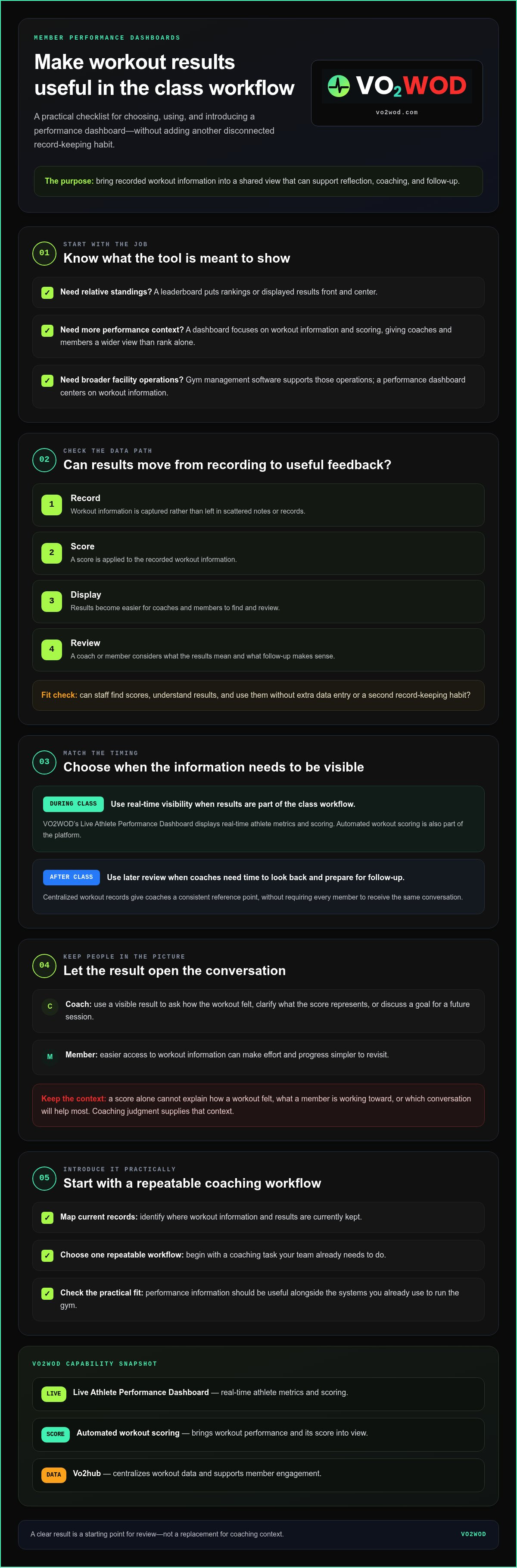
A result becomes useful when people can understand it and act on it. Member performance dashboard software connects four steps: workout information is recorded, a score is applied, results are displayed, and a coach or member reviews what they mean. That flow creates a clearer path from effort to feedback than scattered records.
A performance dashboard turns recorded workout data into a shared, usable view that can support reflection, coaching, and follow-up.
From workout result to live performance view
Once workout information is recorded and scored, it can be presented for coaches and members to review. Use real-time visibility when results are part of the class workflow, and later review when coaches need time to look back and prepare for a follow-up conversation. The useful choice depends on when your team needs the information.
VO2WOD’s Live Athlete Performance Dashboard displays real-time athlete metrics and scoring, and automated workout scoring is part of the platform. It brings performance information and its score into view. For broader context on how timely information can inform exercise decisions, University Hospitals discusses ways to exercise smarter and safer. That example is about wearables, not how VO2WOD collects workout information.
Centralized workout records give coaches a consistent reference point. Rather than relying on memory or searching separate notes, they can review recorded results in one place and use them to frame a follow-up. Consistency doesn’t mean every member gets the same conversation. It means the starting information is easier to find.
How coaches and members can use the information
A coach might use a visible result to ask how a member felt during a workout, clarify what the score represents, or discuss a goal for a future session. The number opens the conversation. Coaching judgment adds context, including the member’s experience and current priorities.
For members, easier access to workout information can make effort and progress simpler to revisit. VO2WOD’s Vo2hub centralizes workout data and supports member engagement. Explore how VO2WOD’s performance tools bring workout information into your gym’s coaching workflow.
How to Evaluate Member Performance Dashboard Software Without Adding Another Disconnected Tool
A dashboard earns its place when it helps staff complete a real task, not just when it adds another screen. Assess member performance dashboard software against your class routine: can staff find scores, understand results, and use them without extra data entry or a second record-keeping habit?
Use this comparison as a starting point. The “what to assess” column gives criteria for evaluating a platform. The VO2WOD column describes its capabilities.
| Area | What to assess | VO2WOD capabilities |
|---|---|---|
| Live visibility | Can coaches see workout performance when it’s useful in their class routine? Is the information clear at a glance? | The Live Athlete Performance Dashboard displays real-time athlete metrics and scoring. |
| Scoring | Does scoring support the workouts and result-recording habits your gym uses? How much manual effort does it leave? | Automated workout scoring is part of the platform. |
| Member engagement | Can members use workout information to support interest and reflection? Consider how the information fits into their routine. | Vo2hub centralizes workout data and supports member engagement. |
| Gym operations | How do performance tools fit alongside membership and administrative workflows? Will staff need to enter or reconcile the same information more than once? | Performance tools are offered alongside gym management capabilities. |
Which dashboard criteria matter most to a functional fitness gym?
Start with the routine, not the feature list. Trace one class from workout setup through result recording, scoring, coach review, and member follow-up. Note where information is entered, who needs to see it, and what currently slows the process. Then assess whether the dashboard makes that routine easier without adding manual steps.
Fitness technology can present different kinds of information. For example, Iowa State University discusses key details about your daily activities. That’s broader than a gym workout dashboard. Focus on the information your gym needs and the tools that make it useful to coaches and members.
Standalone dashboard or connected gym management platform?
A standalone tool may provide a focused performance view, but a separate workflow can create duplication if staff must enter or reconcile the same results across systems. A broader platform can put performance tools alongside gym operations. The practical test is whether those tools support your day-to-day process.
VO2WOD brings its Live Athlete Performance Dashboard, Vo2hub, automated workout scoring, and gym management capabilities within its platform offering. Consider how that setup fits your workflow, then explore the centralized gym data platform guide for more on reducing scattered operational records.
How to Introduce a Performance Dashboard into Your Gym’s Daily Routine
A dashboard works best when it fits the class, not when the class has to work around it. Introduce member performance dashboard software in stages, beginning with one familiar coaching routine. That gives staff and members a clear reason to use it and helps you identify friction before expanding its role.
Prepare workout data and staff routines
Map where workout scores and member records currently live. Note what staff enter manually, which information they refer to during class, and where duplicate records or gaps appear. This inventory gives you a practical starting point for organizing the transition.
Next, choose where the dashboard fits into a repeatable class workflow. A coach might review results after the workout to guide a brief check-in, or consult the display during class when it supports the coaching flow. Start with one approach, then orient staff on how to find and interpret the information.
If you’re moving existing records, VO2WOD provides data migration assistance. Plan the transition around the records your gym uses and the routines staff need to maintain. For a broader changeover plan, use this gym management software switching checklist.
Make the dashboard useful from the first classes
Before introducing the display to members, explain its purpose in plain language. For example, tell them it makes workout results easier to review and gives coaches a helpful starting point for conversations. Scores are one part of the picture. Members bring different experiences and goals to class.
Give staff a simple orientation: where to view results, when to use them, and how to turn a score into a useful question rather than a judgment. Decide who needs access to the information and set up the available access options accordingly.
After the first classes, review how the routine feels. Are coaches checking the display at the intended moment? Are they still copying information elsewhere? Do members understand why results are shown? Gather staff and member feedback, then adjust the routine. Look for practical signs that the display supports coaching without adding avoidable steps.
VO2WOD’s Live Athlete Performance Dashboard, automated workout scoring, and data migration assistance can support a more organized transition from records to routine. Explore VO2WOD’s gym performance tools as you plan your rollout.
How VO2WOD Connects Member Performance Dashboards with Gym Management
Workout results matter most when they’re easy to find and fit naturally into the way your gym runs. VO2WOD brings performance tools and gym management capabilities together in one platform, helping functional fitness teams organize their daily workflows.
What VO2WOD brings together for gym teams
The Live Athlete Performance Dashboard displays real-time athlete metrics and scoring. Automated workout scoring is also part of the platform, bringing workout results into a visible performance view. The dashboard focuses on performance information, while broader gym administration is handled by the platform’s gym management capabilities.
Vo2hub centralizes workout data and supports member engagement. Together, these tools give coaches and members a place to engage with workout information, while gym management supports other facility needs. Automated payments and administrative tools are part of the broader platform, not functions of the performance dashboard itself.
When a gym keeps results in one place and member administration in another, bringing these capabilities under the same platform can reduce the number of separate workflows staff manage. The practical benefit comes from how your team uses the tools. Focus on the workflows the platform supports and how they fit into staff routines.
What to consider before getting started with VO2WOD
Start by mapping the work your team needs the platform to support. Which workout scores do coaches record? When do they review results? Where do members engage with workout data? Which administrative tasks, such as payments, need to sit alongside those coaching routines? Clear answers show how a member performance dashboard fits into the bigger picture.
Then list the records your team needs to move. VO2WOD provides data migration assistance to support the transition from existing systems. An inventory of current records and staff routines helps your team plan the change while keeping the focus on coaching and member experience.
VO2WOD’s platform brings together a Live Athlete Performance Dashboard, Vo2hub, automated workout scoring, and gym management capabilities. Explore the VO2WOD platform to see how its performance and administrative tools could fit your gym’s routines.
Bring Workout Results into a Clearer Coaching Routine
The right member performance dashboard software does more than display scores. It makes workout information easier to review, helps coaches and members share a clearer picture of performance, and fits into gym routines without creating extra admin. Start with one repeatable coaching workflow, then assess how well the tools support your classes and broader operations.
VO2WOD brings together a Live Athlete Performance Dashboard with real-time metrics and scoring, automated workout scoring, and Vo2hub, which centralizes workout data and supports member engagement. Gym management tools sit alongside these performance capabilities, while data migration assistance supports transitions from existing systems.
Ready to see how these tools could fit your gym’s day-to-day needs? Explore VO2WOD’s gym management and performance platform. Start with the workflow that matters most, then build from there.
Frequently Asked Questions
What is member performance dashboard software?
Member performance dashboard software presents gym members’ workout results and scoring in a visual format. It gives coaches a place to review performance information and use it in coaching conversations, rather than searching through scattered records. Unlike a general gym management system, a performance dashboard focuses on workout data. VO2WOD offers performance tools alongside broader gym management capabilities.
How does a gym performance dashboard display workout results?
A gym performance dashboard organizes recorded workout information and scoring into a view that’s easier to review. A coach might consult the display after class to look at a member’s result and use it to guide a follow-up conversation. To assess a dashboard, consider how clearly it presents the information your team uses in its coaching routine.
Can member performance dashboard software show results in real time?
Yes. VO2WOD’s Live Athlete Performance Dashboard displays real-time athlete metrics and scoring, giving coaches timely performance visibility. This can make workout information available during a class routine, while later review can support follow-up conversations.
What is the difference between a gym dashboard and a leaderboard?
A leaderboard emphasizes rankings or displayed results, while a performance dashboard offers a broader view of workout information and scoring. A leaderboard makes relative standings easy to see, but may provide less context for coaching. A dashboard helps coaches review results and discuss them with members. Neither replaces coaching judgment: a score alone can’t explain how a workout felt or what a member is working toward.
How can a performance dashboard help coaches engage members?
A performance dashboard gives coaches a clear prompt for member conversations. They might refer to a recorded result, ask how the workout felt, or discuss a goal for a future session. Easier-to-review workout information can make follow-up more consistent. Coaches still need to interpret results with care and make space for each member’s experience and goals.
Can a performance dashboard work with existing gym management software?
Some dashboards are part of a broader gym management platform, while others are separate tools. Map where workout results and member records live, then identify any information staff would have to enter or reconcile more than once. VO2WOD offers performance tools alongside gym management capabilities.
How do gyms move workout data to a new performance dashboard?
Start by listing where workout scores and member records are stored, which records matter, and how staff use them. Plan the move around those needs and the new platform’s supported data. VO2WOD provides data migration assistance to support transitions from existing systems. A clear inventory helps your team prepare and establish a practical workflow for its records.


