
What if better coaching came from tracking less and acting on the right information sooner? Data driven fitness coaching tools can help functional fitness coaches connect workout scores, attendance, and athlete notes. When those details live in separate places, it’s hard to see the full picture and easy to spend class time updating records instead of supporting athletes.
Data matters when it leads to a useful coaching action. Tracking progress can reveal patterns, but the challenge is deciding which signals deserve attention and what to do with them without adding more admin.
This guide explains how to identify useful fitness data, build a repeatable process from measurement to coaching action, and choose tools that fit your gym’s daily workflow. You’ll see how real-time performance visibility and automated workout scoring can bring results into view, and how a connected platform can help coaches use those insights while staying present on the floor. The goal isn’t more dashboards. It’s clearer decisions, smoother classes, and better support for each athlete.
Key Takeaways
- Choose data driven fitness coaching tools based on the coaching decision they support, not the number of metrics they display.
- Use a repeatable process to connect a relevant workout signal and its context to a coaching action, then review what you learn.
- Compare workout scoring, performance dashboards, workout hubs, and gym management platforms by the job each does in your daily workflow.
- Start with one coaching question and a small pilot. Decide who records, reviews, and discusses the information.
- VO2WOD connects automated workout scoring, real-time athlete performance visibility, and centralized workout data for functional fitness gyms.
What Are Data-Driven Fitness Coaching Tools, and What Should They Help You Do?
Workout results in one place, attendance in another, and athlete notes somewhere else can be a lot to piece together between classes. Data driven fitness coaching tools capture, organize, display, or interpret training information so coaches can use it to guide decisions. The goal isn’t to measure everything. It’s to bring the right signal into view with enough context to decide what to do next.
Definition: Data-driven fitness coaching tools collect and organize training information, such as workout scores or progress records, to help coaches understand an athlete’s training and make more informed coaching decisions.
This approach is part of a wider culture of self-tracking. The Quantified Self movement describes using technology to gather personal data for self-improvement. In a gym, numbers need interpretation. A score is a clue, not a complete picture of an athlete’s readiness, effort, or progress.
Which fitness data can help a coach understand an athlete’s training?
Workout scores show how an athlete performed in a particular session. Progress records can reveal changes across repeated workouts or lifts. Attendance patterns show how consistently an athlete has been able to train, but they don’t explain why a class was missed.
Some tools also track physiological measures:
- Heart rate is the number of times the heart beats in a minute. It can help describe how hard the body is working, but the reading alone doesn’t explain the athlete’s experience.
- VO2max estimates the body’s ability to use oxygen during exercise. It offers one view of aerobic fitness, but doesn’t capture every part of functional fitness or performance.
- Rate of perceived exertion (RPE) is an athlete’s own rating of how hard an effort felt. It adds subjective context that a score or sensor reading may miss.
Every measure has limits. Interpret it alongside the workout, the athlete’s training history, and what they share with you. The same result can mean different things for different people.
How are coaching tools different from general gym management software?
Performance tools help coaches and athletes see training information, such as scores and progress. Gym management tools handle operational work, including member records and payments. Some platforms connect both, bringing performance information and gym operations into a more unified workflow.
That connection can make information easier to find, but it doesn’t make every metric useful. Start with the coaching question: what do you need to understand, and what decision might the answer inform? A tool earns its place when it helps connect a signal to a thoughtful next step while leaving room for the conversation only a coach can have.
How to Turn Fitness Data Into a Better Coaching Decision
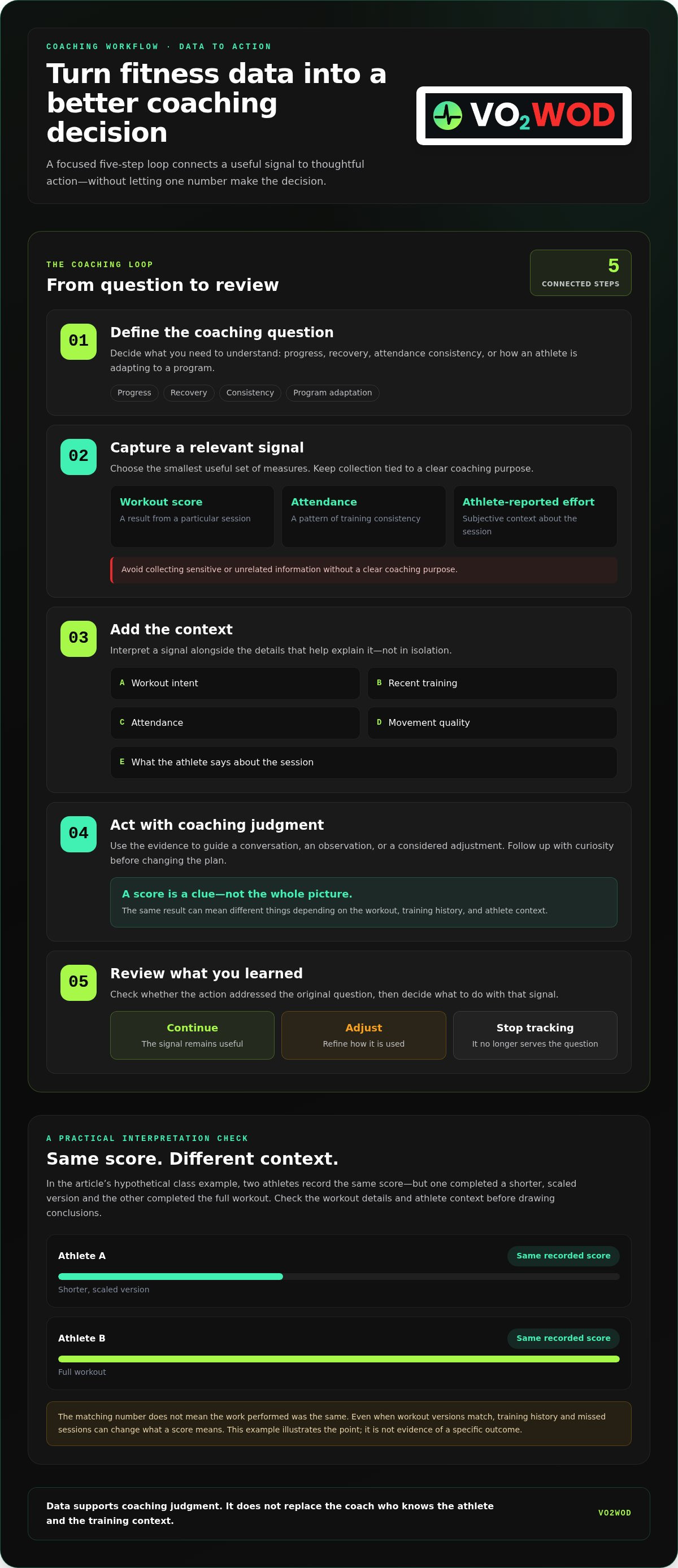
A dashboard can show what happened. Coaching begins when you ask what it means for this athlete today. Use a simple loop to keep data useful and human-centered:
- Define the coaching question. Are you checking whether an athlete is progressing, recovering, attending consistently, or adapting to a program?
- Capture a relevant signal. Choose the smallest useful set of measures, such as a workout score, attendance record, or athlete-reported effort. Avoid collecting sensitive or unrelated information without a clear coaching purpose.
- Add context. Consider workout intent, recent training, attendance, movement quality, and what the athlete says about the session.
- Act. Use the evidence to guide a conversation, an observation, or a considered adjustment. Don’t let a single number make the decision for you.
- Review. Check whether the action addressed your original question, then decide whether to continue, adjust, or stop tracking that signal.
Start with a coaching question, not a dashboard
Begin with what you need to understand. To explore progress, compare relevant workout results over time. To understand consistency, look at attendance alongside the athlete’s circumstances. To consider recovery, combine an appropriate training signal with the athlete’s own feedback. Each question calls for a focused view, not a larger pile of metrics.
Add context before changing the plan
A score or heart-rate reading is only part of the picture. The workout’s purpose matters, as do an athlete’s recent training, attendance, movement quality, and account of how the session felt. One intense reading might reflect the demands of the workout, not a reason to change the program. Follow up with curiosity, then decide together whether an adjustment makes sense.
Data supports coaching judgment. It doesn’t replace the coach who knows the athlete and the training context.
Hypothetical class example: Two athletes record the same score on a workout. One completed a shorter, scaled version; the other performed the full workout. The number matches, but the work performed doesn’t. Even if both did the same version, the score could mean something different for an athlete returning after missed sessions than for one with a steady training history. A coach would check the workout details and athlete context before drawing conclusions. This is an illustration, not evidence of a specific outcome.
In a group class, information needs to be easy to review without pulling the coach away from the room. Data driven fitness coaching tools can make workout information visible, but the coach still brings essential context through observation, conversation, and sound judgment. A connected workflow, such as VO2WOD gym performance tools, can bring workout data into the gym experience. Use the loop to keep information in service of coaching.
Compare Data-Driven Fitness Coaching Tools by the Job They Do
Tool names can blur together. A clearer way to compare data driven fitness coaching tools is to ask what job each one does in your gym, what useful information it makes accessible, and how easily coaches can use it during a normal class day.
| Tool category | Primary job | Useful output | Likely workflow fit |
|---|---|---|---|
| Workout scoring | Record athlete results for workouts | Scores that coaches and athletes can review | Useful when results are scattered across notes or manually tracked records |
| Live performance dashboard | Display athlete performance data in real time | A visible view of current performance information | Fits class workflows where coaches need to see results while athletes train |
| Centralized workout hub | Bring workout information together | A shared place for workout data and member engagement | Useful when coaches and members need a consistent way to access training information |
| General gym-management platform | Support gym operations, such as member records and payments | Operational information, with performance features where included | Fits gyms seeking to connect administrative tasks with their training workflow |
These categories can overlap. A gym platform may include scoring, a dashboard, and a workout hub, so separate systems aren’t automatically necessary. Compare the full workflow: where information is entered, where it appears, and whether coaches can use it without avoidable steps.
When are workout scoring tools or live dashboards useful?
Automated workout scoring can reduce reliance on records kept across paper notes, spreadsheets, or separate systems. A live dashboard makes performance information visible during class, giving coaches and athletes a shared point of reference. Visibility alone doesn’t guarantee motivation or improvement. Coaches still need to explain the workout’s intent and interpret results in light of each athlete’s circumstances.
Collecting a score creates a record. Actionable coaching insight comes from understanding what that score means in context.
When does a centralized gym platform make more sense?
A connected platform can bring workout information closer to the member and gym workflows around it. VO2WOD brings together automated workout scoring, a Live Athlete Performance Dashboard that displays athlete performance data in real time, and Vo2hub, which centralizes workout data and supports member engagement. This can make performance information easier to find within the broader gym experience.
For more on how connected systems can bring gym information together, explore centralized gym data platforms. A good fit helps coaches move from recorded results to meaningful conversations without making class flow more complicated.
How to Implement Coaching Data Without Adding Friction or Losing the Human Touch
New tracking can quickly become another task coaches have to squeeze between classes. Start small. Choose one coaching question, test a limited set of information, and see whether it helps your team make a clearer decision without interrupting the way athletes train.
Build a repeatable routine coaches can sustain
Pick a consistent point in the class or training cycle to enter and review information. For example, a coach might review selected workout scores during the existing programming check-in instead of trying to scan every result while supervising a class. Decide who records the information, who reviews it, and who follows up with the athlete. Keep each step simple enough to protect attention for coaching and safety.
A short pilot can reveal friction before a new process becomes a gym-wide habit. Use this implementation checklist:
- Choose one coaching question and only the measures that help answer it.
- Assign ownership for entering, reviewing, and discussing the information.
- Set a review point that fits an existing class or coaching routine.
- Tell athletes what is recorded, why it’s useful, and how coaches will use it.
- Review the pilot with coaches and athletes, then simplify or adjust the process before expanding it.
Before collecting athlete information, explain the purpose in plain language and invite questions. Be clear about what coaches will look at and how it may inform a conversation or training adjustment. Collect only information with a clear coaching purpose, and follow the privacy requirements applicable to your gym. A tool can organize information, but trust depends on how openly and thoughtfully the team uses it.
Protect context, trust, and useful interpretation
Make the numbers understandable. Explain what a measure can suggest and what it can’t tell you on its own. Invite athletes to share relevant feedback, such as how a session felt or whether circumstances affected their training. Public comparison shouldn’t be the default. Consider an athlete’s goals, experience, and individual circumstances before deciding how to discuss performance information.
As you assess the pilot, check whether the tool fits class flow and the ways coaches already communicate. If it requires constant manual updates or pulls attention away from athletes, revisit the setup. For related considerations when evaluating gym platforms, read this functional fitness gym software guide.
Choose data driven fitness coaching tools that support a routine your team can sustain. Explore VO2WOD gym management and performance tools to see how a connected platform can bring workout information into the gym workflow.
How VO2WOD Connects Workout Data With the Functional Fitness Gym Experience
Once a gym knows what it wants to track and how coaches will use the information, the next question is whether the workflow feels connected. VO2WOD brings workout performance tools and gym management together for functional fitness facilities, helping teams keep workout information within the wider gym experience instead of treating it as a separate task.
Where VO2WOD’s performance tools fit in a coaching workflow
Automated workout scoring makes workout results available in the platform, giving coaches and athletes a place to refer back to performance information. The Live Athlete Performance Dashboard displays athlete performance data in real time, so coaches can see results during workouts. Vo2hub centralizes workout data and supports member engagement.
Together, these tools carry information from a recorded result to a visible point of reference. A score or dashboard isn’t a coaching decision by itself. Coaches still explain the workout’s intent, consider the athlete’s context, and offer personal guidance. The platform organizes and displays information; the coach brings observation and judgment. That balance makes data driven fitness coaching tools useful in a group-training setting.
Plan a transition from scattered records to a connected system
Before changing systems, identify what the gym needs to carry forward. List the workout information coaches rely on, the records members need, and the workflows staff use to manage the gym. This gives you a practical starting point for deciding what to transfer and what to simplify, rather than moving every old process into a new setup.
VO2WOD’s data migration assistance supports transitions from legacy systems. Planning the change around useful information and daily routines can help staff understand how records fit into the new workflow. If you’re considering a software change, use this gym management software switching checklist to plan the transition.
The right platform makes workout information easier to access without crowding out the athlete-coach relationship. Explore the VO2WOD platform to see how performance tools and gym workflows can come together in one functional fitness experience.
Make Your Gym’s Data Work for Better Coaching
Useful data isn’t about filling another dashboard. It’s about choosing relevant signals, adding athlete and workout context, and using what you learn to guide a thoughtful coaching decision. Start with one clear question and a workflow your team can sustain. The best data driven fitness coaching tools support a coach’s judgment, not replace it.
For functional fitness gyms, connected tools can bring workout results into view without losing sight of the person behind each score. VO2WOD includes automated workout scoring, a Live Athlete Performance Dashboard for real-time performance visualization, and Vo2hub to centralize workout data and support member engagement. Coaches provide the interpretation, conversation, and personal guidance that make those records meaningful.
Ready to bring workout data into a clearer gym workflow? Explore the VO2WOD platform and bring your gym’s workout data into clearer view. Take the next step at a pace that fits your team, and keep the focus on helping athletes train with purpose.
Frequently Asked Questions
What are data-driven fitness coaching tools?
Data-driven fitness coaching tools are software or systems that capture, organize, display, or help interpret training information. Coaches may use workout scores, attendance, progress records, or relevant effort measures to spot patterns and decide what to discuss or adjust. Numbers are only part of the picture. Workout design, recent training, movement quality, and an athlete’s own feedback help give each signal meaning before deciding on a next step.
Which metrics should fitness coaches track?
Track metrics that answer a coaching question rather than trying to record everything. Workout scores can show results for a session, attendance can reveal consistency patterns, and progress records can show change over time. Depending on the goal, coaches might also consider heart rate or an athlete’s rate of perceived exertion. There’s no universal set. Interpret each measure alongside workout intent, athlete history, and personal feedback.
How can coaches use workout data to improve training?
Use a question-context-action-review cycle. First, decide what you want to understand, such as whether an athlete is adapting to a training block. Compare relevant workout results, then add context like session intent, attendance, recent training, and athlete feedback. Choose a considered action, perhaps a conversation or adjustment, and later review whether it addressed the original question. The coach interprets the evidence. A number alone shouldn’t prescribe a plan.
Can data-driven coaching tools replace a fitness coach?
No. Data-driven coaching tools can organize, display, and help track training information, but they can’t replace a coach’s understanding of movement, goals, experience, or individual circumstances. A score may point to a question worth asking. The coach observes, listens, and decides how to respond. Used well, tools make relevant information easier to access while coaches provide interpretation, encouragement, and personal guidance for each athlete.
Are live athlete performance dashboards useful in group fitness?
Yes, a live athlete performance dashboard can make workout information visible to coaches and athletes during a class. That shared view can help coaches follow results while staying engaged with the group. Visibility alone doesn’t explain what a score means or guarantee a particular response. Coaches still need to account for workout intent, athlete experience, and individual context, then decide whether a result calls for a conversation or further observation.
How do I choose a workout tracking tool for my gym?
Start with the coaching questions your gym wants to answer, then look for a tool that makes relevant data easy to enter, review, and discuss. Consider whether coaches can see useful results within their existing class workflow and whether athletes can understand how information is used. The best data driven fitness coaching tools fit the gym’s routines and make key information accessible without adding unnecessary steps or dashboards.
How can a gym start using performance data without adding more admin?
Begin with a focused pilot around one coaching question and a small set of relevant measures, such as workout scores or attendance. Set a consistent time to review the information, and decide who records it and who follows up with athletes. Check whether the routine fits existing class and communication habits. After the pilot, keep what helps coaches make informed decisions and simplify or remove steps that create extra work.


