

What if billing could do more than collect dues and give your team more room to focus on coaching and members? When payment follow-up lives in one tool and member details in another, even routine admin can feel scattered. A gym membership billing system can ease that load, especially when payment automation is part of a connected gym-management workflow.
It’s reasonable to want more than automatic charges. You need to understand how billing fits with member records and the daily rhythm of your gym, and how a software change will affect the people who use it.
This guide explains the role of membership billing software, what to evaluate in payment processes, and how to plan a manageable transition. You’ll see why the wider workflow matters, which questions help you assess a system, and how data migration assistance can support a move when records need careful handling. The aim is less administrative friction and more attention for the people who make your gym a community.
Key Takeaways
- See what a gym membership billing system handles, and how payment processing differs from member records and gym administration.
- Use the membership payment lifecycle to identify where your current process needs clearer oversight.
- Compare standalone payment tools with integrated platforms by looking at workflow visibility and operational context.
- Map recurring tasks, essential records, staff roles, and reporting needs before weighing system options.
- Explore how VO2WOD brings automated payments into gym management alongside Vo2hub and automated workout scoring.
What Is a Gym Membership Billing System, and What Should It Handle?
A gym membership billing system is software that helps organize recurring membership payments and the account information a gym uses to manage its members. It can bring payment activity and account details into a clearer workflow, rather than leaving staff to piece together updates across separate tools.
Payment processing is one part of the picture. A payment processor handles transactions, while membership records provide account context, such as who the member is and their membership status. Gym administration covers the wider work of keeping those details organized. These functions can sit in separate tools or within a broader platform, so identify what each system handles before deciding whether it fits your workflow.
Clear processes matter on both sides of the membership. Owners and staff need a consistent way to review accounts and follow up on exceptions. Members benefit when their payment status and membership details are handled clearly. The goal isn’t to eliminate every billing conversation. It’s to make routine oversight easier, so those conversations don’t get lost in administrative clutter.
Which parts of gym membership billing are software-assisted?
Software can support recurring payment administration and organize account information for staff review. The workflow depends on the system: one platform might bring payment activity and membership records together, while another tool might focus on transactions alone. When comparing options, trace what staff can do in the system and what still requires a separate process.
The gym still sets its membership terms, policies, and approach to account changes. Software supports those decisions; it doesn’t make them on the gym’s behalf. For example, a system can help organize account details, but the gym sets membership conditions and manages member communication.
Payment choices are also evolving. Wikipedia’s overview of Afterpay and gym membership subscriptions describes a buy-now-pay-later service entering subscription contexts. That’s an example of a broader payment trend, not a feature every gym billing platform provides.
Why does billing feel harder in a functional fitness gym?
Billing rarely happens in isolation. Coaches are leading sessions, answering member questions, and supporting people through training. Payment tasks still need attention, but they take more effort when staff have to pause and search for account details across disconnected records.
Imagine a member asks about their account between classes. If payment activity is in one place and membership information is somewhere else, staff may need to switch tools or ask a colleague to fill in the gaps. Small interruptions add friction to an already active day.
A more organized process gives staff a clearer view of routine account information and leaves more attention for coaching and member support. That’s the practical value of a gym membership billing system: not payment automation alone, but billing administration that fits into the wider work of running a gym.
How a Gym Membership Billing System Supports the Member Payment Lifecycle
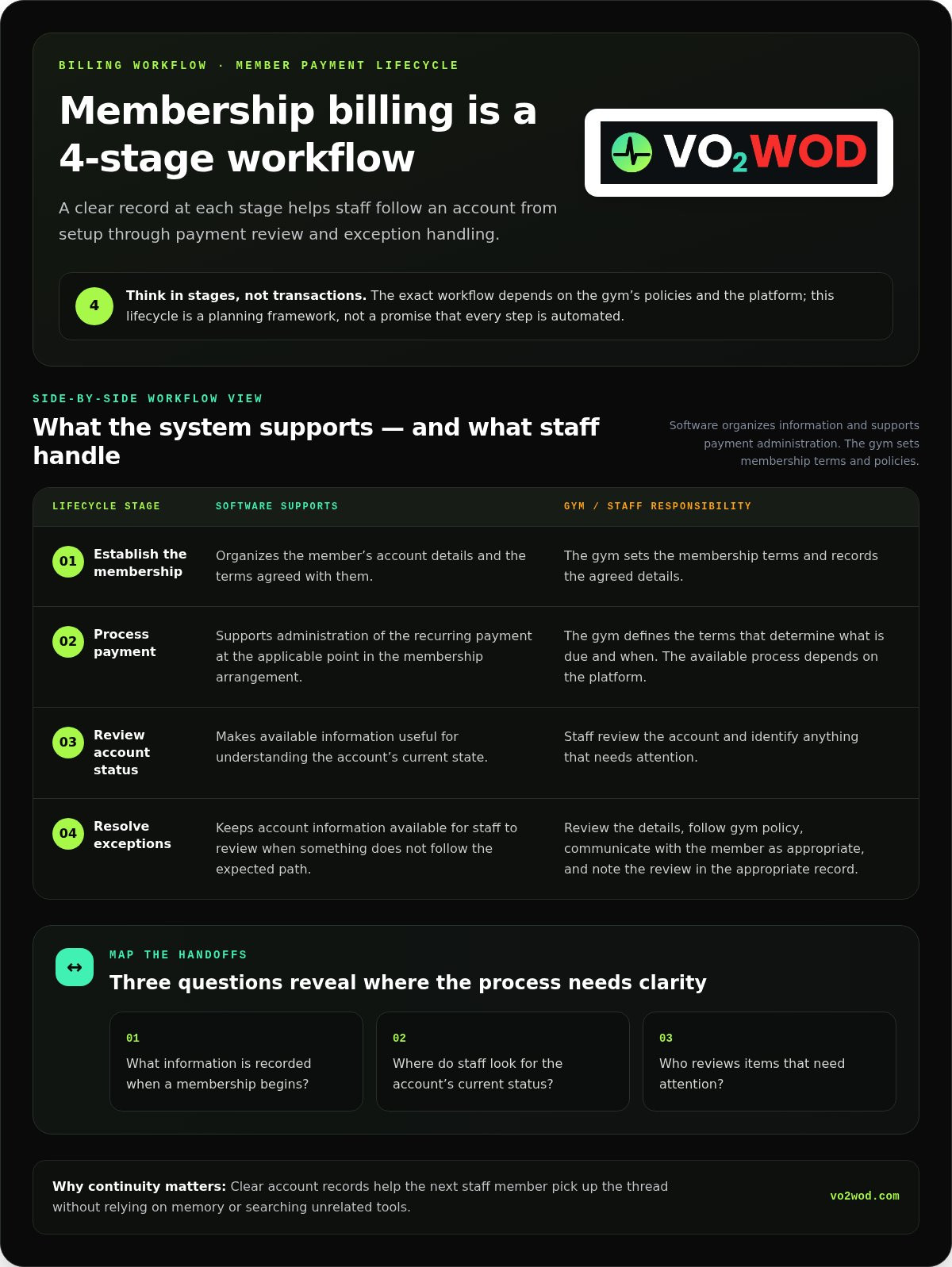
Membership billing is a sequence, not a single transaction. A gym membership billing system can help staff keep each stage organized, from setting up an account to reviewing its status and handling exceptions. The exact steps depend on the platform and the gym’s policies, so treat this lifecycle as a planning framework rather than a promise that every system automates every task.
- Establish the membership. Record the member’s account details and the terms agreed with them. The gym sets those terms; software helps organize the associated information.
- Process payment. At the applicable point in the membership arrangement, the system supports administration of the recurring payment. The available process depends on the platform.
- Review account status. Staff use the available information to understand the account’s current state and identify anything that needs attention.
- Resolve exceptions. If something doesn’t follow the expected path, staff review the details, follow gym policy, and communicate with the member as appropriate.
The value is continuity. When each stage leaves a clear account record, the next staff member can pick up the thread without relying on memory or searching unrelated tools. That matters in a functional fitness facility, where the person handling an account question may also be coordinating classes or supporting members on the floor.
What happens when a recurring membership payment is due?
A recurring payment is scheduled as part of a membership arrangement. The billing system supports its administration, while the gym defines the terms that determine what is due and when. Before relying on a workflow, confirm that staff know where to find the relevant account information and what to do when a payment needs attention. Clear records help staff connect payment activity to the right member account.
Map the handoffs: what information is recorded when a membership begins, where staff look for the account’s current status, and who reviews items that need attention. This quick exercise can reveal unclear ownership before it leads to a confusing member interaction.
How should a gym handle payment exceptions?
Start with the record, not an assumption. Review the account information and available payment details, then follow the gym’s policy for next steps. Keep notes of the review and any member communication in the appropriate record. A consistent approach helps staff respond respectfully and gives colleagues useful context if the question comes up again.
A platform shouldn’t be assumed to automate every exception. The gym remains responsible for its policies and member conversations. For facilities looking to connect payment administration with broader gym operations, VO2WOD’s gym-management platform brings automated payments and administrative tasks into one platform.
Standalone Payment Tools vs. an Integrated Gym Membership Billing System
A payment-focused tool and an integrated platform solve different operational problems. One centers on processing transactions. The other places payment administration alongside gym-management tasks, giving staff a broader operational context. Neither approach is automatically right for every facility. The better fit depends on how your gym manages memberships, where information lives, and what staff need to handle routine admin.
| What to compare | Payment-focused tool | Integrated gym-management platform |
|---|---|---|
| Workflow visibility | Payment activity is the main focus. Staff may use separate records for other gym tasks. | Payment administration sits alongside gym-management tasks within a broader workflow. |
| Administration | May suit a gym whose payment process is already simple to oversee. | Can bring more of the gym’s administrative work into one platform. |
| Operational context | Useful when staff mainly need to manage payment activity. | Offers a wider setting for day-to-day gym operations, depending on the platform. |
Use the comparison as a prompt, not a verdict. A broader overview of functional fitness gym software can help clarify how billing fits among the other tools a facility may use. The key question is whether your setup supports the actual workflow without adding unnecessary steps.
When can a payment-focused tool be enough?
A payment-focused tool may be a reasonable fit when membership administration is straightforward and staff can easily find the information they need elsewhere. If payment oversight is distinct from other daily tasks and the process is clear to everyone involved, a narrower tool may meet the need. To assess that, consider how much time staff spend locating records, answering account questions, and keeping information current.
When does connected gym management matter more?
A connected platform can be useful when staff routinely move between payment administration and other gym tasks. Workout scoring or member information can provide operational context, but they aren’t billing functions. Keeping these activities within a broader management environment may help staff see their work as a connected operation rather than a set of isolated processes. For a closer look at how information can be organized across operations, see this guide to centralized gym data platforms.
Before choosing a gym membership billing system, trace one ordinary administrative task from start to finish. Note which tools staff open, what information they need, and where handoffs occur. If the process feels clear and manageable, a payment-focused tool may be enough. If context is frequently scattered across gym operations, an integrated approach may better match the way your team works. Choose the setup that makes everyday steps easier to see and manage.
How to Evaluate a Gym Membership Billing System Before You Switch
Switching software can feel risky when member and payment records matter. Start with your own workflow, not a feature list. Map recurring tasks from the staff member’s point of view: what they do, what information they need, and where they find it. This gives you a practical way to judge whether a gym membership billing system fits your operation and what to plan before a transition.
Which billing requirements should a gym document first?
Write down the routine work your team handles and how it moves between people and tools. Note which records support each task, who needs to see them, and what would make the process easier to manage. This gives your evaluation a clear focus.
- Current processes: List membership setup, payment administration, account review, and follow-up tasks. Note where each step happens today.
- Essential records: Identify the member and account information staff rely on, where it lives, and how it’s maintained.
- Staff roles: Clarify who handles routine administration, who reviews account questions, and who needs visibility into member records.
- Reporting needs: Describe the information staff use to understand account activity and make operational decisions. Separate must-haves from useful extras.
Keep the first pass focused. Separate requirements that solve regular problems from optional capabilities that would be nice to have. This makes comparisons more meaningful and prevents a long feature list from obscuring your team’s actual needs.
How can a gym prepare for billing data migration?
Begin with an inventory. Identify the records that need to move, where they’re stored, who maintains them, and what formats they’re in. Flag information that may need review before the handover, such as duplicate or outdated entries. The goal is to understand what you’re bringing forward, rather than assume every record is ready as-is.
Next, assign transition ownership and plan the handover. Set out who will coordinate the work, when staff will learn the new process, and how member-account questions will be handled during the change. A written plan makes responsibilities visible and gives the team a shared reference point. VO2WOD offers dedicated data migration assistance to support gyms moving to its platform.
A gym software switching checklist can help structure that planning. Use it alongside your task map to connect data continuity with the day-to-day member experience. As you assess your next step, explore VO2WOD’s gym-management platform, which combines gym management with automated payments.
How VO2WOD Connects Automated Payments With Gym Management
For a functional fitness gym, billing is one part of a wider operating day. VO2WOD combines gym management, automated payments, and administrative tasks within its platform, alongside Vo2hub and automated workout scoring. These components let gym owners consider payment administration as part of the broader work of running a facility, rather than treating billing as the whole system.
That distinction matters. Automated payments address payment administration; workout scoring supports a different part of gym operations. Keeping their roles clear helps owners evaluate what the platform brings together without assuming workout or member data are billing features. A gym membership billing system should fit the way the team works, so consider each platform component in the context of staff responsibilities and daily routines.
What does VO2WOD bring together for functional fitness gyms?
VO2WOD is a gym-management platform subscription that includes automated payments and administrative tasks. It also includes Vo2hub and automated workout scoring. These components serve distinct purposes: payment administration sits alongside other operational tools, while workout scoring supports workout-related activity. This gives owners a clear basis for considering how the platform may fit their facility without confusing adjacent capabilities with billing functions.
- Automated payments: Part of the platform’s gym-management offering.
- Administrative tasks: Included alongside payment automation in the wider platform.
- Vo2hub and automated workout scoring: Additional platform components, separate from payment processing.
For owners, the practical question is how those pieces relate to the way staff already divide their attention. Payment administration belongs in the operational picture, but it doesn’t replace coaching, workout management, or member support. A platform that brings several gym-management components together gives owners a broader setting for considering the tools a facility uses, while each component retains its own role.
What can a smoother transition look like?
A transition starts with understanding what information the gym relies on and how staff use it. Reviewing records before a change helps the team plan what needs to move, who will oversee the handover, and how staff will adapt their routines. VO2WOD offers dedicated data migration assistance to support gyms moving systems. Include that assistance in a considered transition plan, rather than treating any software change as automatically disruption-free.
Owners can make the process more manageable by defining responsibilities, organizing the records they depend on, and setting aside time to orient staff to the new platform. This connects the software change to the actual work of the gym, not just the act of moving information. The goal is a thoughtful handover that keeps important operational context in view as the team adjusts.
If you’re assessing how automated payments could fit into your broader gym operations, explore the VO2WOD platform and consider how its components fit your facility’s needs.
Choose a Billing Workflow That Gives Your Team Room to Coach
The best next step isn’t choosing the system with the longest feature list. It’s deciding what a smoother workday would look like for your team. Which billing tasks should take less effort? What information should staff be able to find more easily? And what would help you move forward while keeping important member records in view?
Use those answers to judge whether a gym membership billing system fits the way your facility runs. VO2WOD brings automated payments into gym management, alongside Vo2hub and automated workout scoring, and offers dedicated data migration assistance for a platform transition. These elements help you consider billing as part of a wider operational workflow, with each tool’s role kept clear.
When you’re ready to explore how that approach could fit your gym, explore the VO2WOD gym management platform. A thoughtful choice can reduce administrative friction and give your team more space for the coaching and member connections at the heart of your gym.
Frequently Asked Questions
What is a gym membership billing system?
A gym membership billing system helps a fitness business administer member payments and keep related account information organized. It may be part of a wider gym-management platform or a payment-focused tool. For example, staff might use it to understand which account a payment relates to and what follow-up is needed. The system supports the gym’s process; the gym remains responsible for setting membership terms and communicating them to members.
How does a gym membership billing system work?
A gym records membership information and the payment terms agreed with each member. The system supports payment administration and gives staff a way to review relevant account information. If a question or exception arises, staff use their records and gym policies to decide what to do next. The precise steps depend on the platform and the gym’s process, so a useful test is whether your team can explain who handles each step.
Can a gym management system automate membership payments?
Yes. A gym-management system can include automated payments as part of its broader tools. VO2WOD’s platform combines gym management with automated payments and administrative tasks. Automation can reduce the need to manage every routine payment manually, but it doesn’t replace clear membership terms or staff oversight. Owners should understand how payment administration fits into the platform and which responsibilities remain part of the gym’s own procedures.
What should I look for in a gym membership billing system?
Look for a fit with your actual staff routines, not just a long feature list. Check whether the gym membership billing system supports the account information your team needs, makes responsibilities clear, and helps staff identify what needs attention. Walk through a realistic scenario, such as a member asking about their account while another staff member is covering the front desk. That can reveal gaps a product overview may not show.
How much does a gym membership billing system cost?
There isn’t one standard price. Costs depend on the platform and what’s included in its subscription or payment arrangement. Compare the recurring software charge, payment-processing costs, and any applicable setup, migration, or add-on charges. Look at the total cost for the tools your gym needs, not just the advertised starting price, and review what is included before making a decision.
Can I switch gym billing systems without losing member data?
A switch can preserve important records when the gym plans the transfer carefully, but no transition should be treated as automatic or risk-free. List the information your staff rely on, organize it in its current format, and decide who will oversee the handover. VO2WOD offers dedicated data migration assistance for gyms changing systems. After a transfer, review key records so staff can work from the information they expect.
Is a standalone payment processor enough for a gym?
It can be enough if payment activity is the main need and staff can manage membership details and other gym tasks clearly through existing processes. A broader gym-management platform may be a better fit if the team often needs payment administration in the context of other operational work. The decision comes down to how your staff use information each day and whether separate tools create extra steps for routine tasks.


