

The most powerful performance sensors in your gym aren't collecting dust in a charging cradle by the front desk. They're already strapped to your members' wrists. Yet every morning, coaches still lose precious floor time wrestling with dead chest straps, spotty signals, and disjointed dashboards. Implementing reliable apple watch gym display software changes the entire atmosphere. Instead of forcing athletes into proprietary wearables they constantly forget to charge, you can cast real-time heart rates straight to overhead screens using the devices they already trust.
You already know that live visual feedback sparks genuine camaraderie and keeps pacing honest during intense intervals. But managing separate timers and troubleshooting connection drops shouldn't pull your attention away from coaching movement. In this guide, you'll discover how to broadcast member Apple Watch metrics to gym TV screens seamlessly to boost community engagement without purchasing dedicated tracking hardware. We'll explore modern setup requirements, retention-building biofeedback methods, and practical ways to unify live floor energy with your daily gym operations.
Key Takeaways
- Eliminate the recurring cost and battery headaches of proprietary chest straps by leveraging the Apple Watches your members already wear.
- Understand the modern data relay that streams biometric metrics from watchOS to overhead screens with imperceptible latency during intervals.
- Discover what separates purpose-built apple watch gym display software from fragile consumer mirroring tools when scaling class-wide visibility.
- Design an uncluttered gym layout with clear sightlines and reliable network settings so coaches never lose class time to troubleshooting.
- Unify live floor biofeedback with automated workout scoring and central gym management to give your coaches their time back.
The Evolution of Gym Displays: Moving Beyond Proprietary Heart Monitors
Collective effort changes the energy of a room. When athletes push through high-intensity intervals together, shared metrics turn invisible exertion into tangible motivation. Group visual benchmarks keep pacing honest and elevate workout execution. For years, gyms relied on heavy, single-brand ecosystems to deliver this experience. Today, specialized apple watch gym display software transforms how fitness facilities capture and broadcast that floor energy, turning individual health metrics into a shared community pulse.
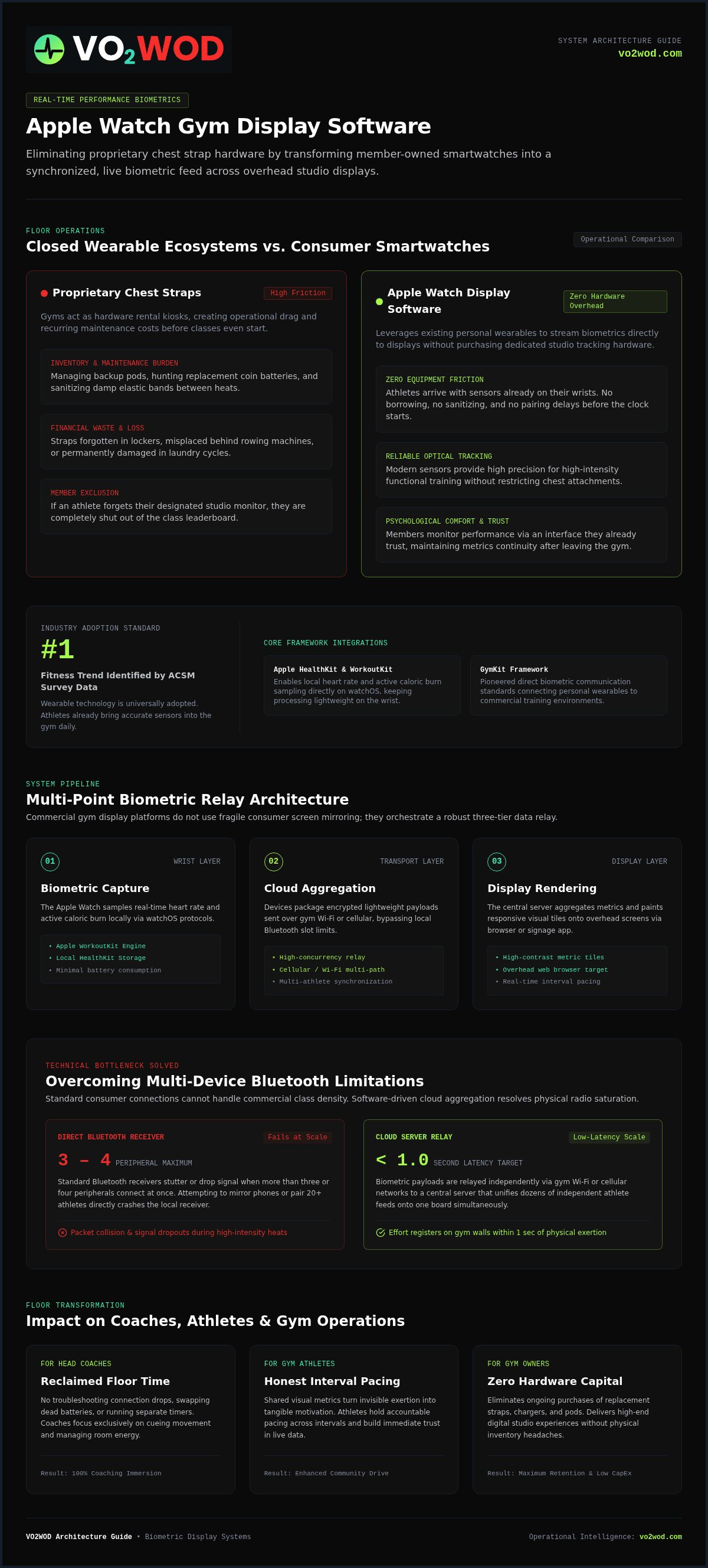
Rather than relying on isolated tracker screens, modern display platforms serve as a centralized hub. The software ingests local biometric feeds from consumer smartwatches, aggregates the signals across multiple athletes simultaneously, and paints clean visual performance tiles across overhead monitors.
The Problem with Closed Wearable Ecosystems
Proprietary chest straps carry hidden administrative baggage. Gym owners end up managing physical inventory: buying backup pods, hunting down replacement coin batteries, and wiping down damp elastic bands between classes. Beyond the operational friction, the financial waste adds up quickly. Straps get left in gym lockers, dropped behind rowers, or ruined in laundry cycles. When a member forgets their designated studio monitor, they're shut out of the class leaderboard entirely. These closed hardware solutions create an unnecessary wall around member metrics, rarely syncing effortlessly with the daily health ecosystems athletes check after they leave the building.
Tapping into the Wearable Athletes Already Trust
Fitness communities already wear the solution. ACSM survey data identified wearable technology as the number one fitness trend, reflecting how deeply athletes rely on their smartwatches. The shift away from siloed hardware started with tools like Apple's GymKit framework, which opened the door for direct biometric communication between personal devices and training environments.
Leveraging consumer smartwatches solves three core operational challenges at once:
- Zero equipment friction: Athletes arrive on the floor already wearing their wrist sensors. No borrowing, no sanitizing, and no pairing delays before the warm-up clock starts.
- Reliable optical tracking: Modern Apple Watch sensors deliver the precision required for fast-paced functional training without bulky chest attachments.
- Psychological comfort: Members monitor their own data using a familiar interface, building immediate trust in the numbers they see overhead.
Choosing purpose-built apple watch gym display software allows gym owners to stop operating as device rental kiosks. Coaches regain their time. Athletes stay fully immersed in the session, and your floor displays reflect real effort without hardware headaches.
How Apple Watch Gym Display Software Works: The Technical Architecture
Mirroring an individual iPhone to a TV works fine in a living room. It falls apart in a crowded fitness studio. Commercial apple watch gym display software does not mirror phone screens; it orchestrates a multi-point biometric relay that unifies dozens of independent athlete feeds onto a single visual board.
This process moves through three distinct layers:
- Biometric capture: The watch samples heart rate and active caloric burn locally through HealthKit and Apple's WorkoutKit framework, keeping processing lightweight on the athlete's wrist.
- Cloud aggregation: Instead of fighting for direct local Bluetooth slots, each device packages small biometric payloads and sends them to a central server relay via cellular or gym Wi-Fi.
- Display rendering: The server aggregates the incoming athlete data and paints high-contrast metric tiles across your studio TV screens via an overhead web browser or digital signage app.
True low-latency biofeedback relay means athlete effort registers on the wall within one second of physical exertion, preserving the natural flow of interval work.
Overcoming the Multi-Device Bluetooth Bottleneck
Direct hardware connections hit a wall fast. A standard Bluetooth receiver stutters or drops connections once more than three or four peripherals connect at the same time. If twenty athletes start sprint intervals together, point-to-point connections fail completely. Cloud-relayed software sidesteps this hardware ceiling entirely. By streaming lightweight data packets over local Wi-Fi or cellular networks, smart software maintains dozens of active biometric streams without signal bottlenecks. Smart buffer management holds the metric stream steady even if an athlete steps into a Wi-Fi shadow near the back chalk bucket.
Data Privacy and Member Security in watchOS
Coaches want performance data, not a member's private medical history. Commercial platforms separate workout effort from sensitive personal records by utilizing Apple's strict privacy sandbox. When an athlete checks into class, they approve a temporary session pass. The software reads live heart rate, zone percentages, and workout duration. It never accesses medical records, resting vitals, or daily step histories. Once the coach wraps up the cool-down, the session key expires automatically, detaching the watch from the gym screen until the next class.
When you want to broadcast group exertion without turning your warm-up into an IT support ticket, explore the Live Athlete Performance Dashboard from VO2WOD to see how unified display technology handles real-time floor energy with ease.
Key Evaluation Criteria: What Gym Owners Must Look for in Display Software
Consumer mirror tools fall flat in a commercial facility. While an individual runner might enjoy casting their metrics onto an iPad, a bustling training floor demands dedicated infrastructure. Commercial apple watch gym display software must balance instant readability with robust connection stability under intense metabolic stress. Big health chains proved the value of wearable-driven motivation through initiatives like the Apple Watch Connected program, but boutique facilities require visual tools that work out of the box without corporate-level engineering budgets.
The goal is effortless visibility. When members transition between barbell work and burpees, they shouldn't squint at cluttered layouts to understand their output.
Display Readability Across the Facility Floor
Gym lighting presents harsh conditions. High-bay LED panels and bright sunlight wash out low-contrast interfaces. Your display software must feature high-contrast color palettes designed to be read clearly from thirty feet away. Instead of forcing athletes to squint at small three-digit heart rate figures, dynamic color zoning maps raw beats per minute into clear intensity bands: blue for aerobic recovery, green for steady tempo, yellow for threshold intervals, and red for maximum output. The visual grid should also be responsive. If six athletes attend an early morning lifting block, their tiles should automatically expand. When thirty members fill an evening workout, the screen layout should smoothly reorganize into a clean matrix without clipping names or crushing metric values.
Platform Stability Under Intense Training Loads
High-intensity programming quickly exposes fragile software. During sprint intervals, athletes check the wall to confirm their recovery pacing. If the screen lags behind wrist output by five or ten seconds, trust breaks instantly. Reliable platforms feature sub-second data synchronization and self-healing connection logic. If a member's wrist moves away during barbell work or watchOS enters an energy-saving sleep state between movements, the software must seamlessly reconnect in the background without requiring coach intervention. Robust commercial systems also accommodate athletes utilizing alternative fitness wearables, ensuring that no member feels excluded from the shared screen experience.
Visual feedback reaches its highest value when connected directly to workout tracking. Exploring modern functional fitness gym software shows how leading gyms bridge live biometric exertion with daily automated scoring, eliminating manual whiteboard updates altogether.
Floor Setup Checklist: Deploying Live Displays Without Technical Friction
Coaches belong on the floor coaching athletes, not kneeling by audio receivers fixing connection drops. Deploying modern apple watch gym display software should lighten your staff's mental load, not complicate morning setup routines. A thoughtfully organized floor plan ensures metrics broadcast cleanly so coaches can focus entirely on form, movement quality, and motivation.
Getting your studio ready requires three practical execution steps before launch day:
- Audit line of sight: Map athlete eyes across all movement zones. Screens must stay visible whether an athlete finishes a set of wall balls or lies flat during burpees.
- Segregate internet traffic: Never let biometric streams compete with members streaming music in the lobby. Build an isolated wireless VLAN strictly for studio displays and timing hardware.
- Standardize athlete onboarding: Establish a simple sixty-second routine where new members connect their personal device once during class check-in, making future session logins entirely hands-off.
Optimizing TV Placement and Network Infrastructure
Screen angle dictates posture. Mount commercial monitors ten to twelve feet high, angled slightly downward to prevent neck craning during floor-based movements. If your training floor stretches beyond forty feet, position secondary repeater screens across opposite walls to eliminate visual dead zones. Network frequency management is equally vital. Separate your router into distinct bands. Push personal member phones and wearable biometric packets onto an isolated 5 GHz band. This step leaves the crowded 2.4 GHz spectrum free from the wireless noise created by dozens of member Bluetooth headphones. Where possible, hardwire overhead smart TVs or media players with Ethernet cables to remove presentation lag.
Coaching Protocols for Daily Class Management
Visual technology succeeds when coaches make it part of their natural rhythm. During the warm-up brief, prompt athletes to tap their class session card. Train your coaching team to read the overall room intensity distribution at a glance. If an entire group shifts into the red zone halfway through an aerobic conditioning block, the coach can immediately adjust pacing instructions before burnout strikes. Celebrating strategic pacing rather than raw speed builds an inclusive training space where every athlete feels seen and supported.
Tying live floor exertion into centralized gym data platforms keeps daily administrative records organized behind the scenes. If you are ready to eliminate fragmented screen tools and bring calm efficiency to your training space, explore how you can streamline your gym management with VO2WOD today.
Unifying Live Biofeedback with Complete Gym Operations via VO2WOD
Operating a fitness facility with isolated apps creates quiet chaos. When coaches toggle between a standalone screen mirror, a browser tab for attendance, and an external timer, their focus fractures. Members notice the distraction. Deploying commercial apple watch gym display software should never mean managing another disconnected login. VO2WOD brings this technology into a single operational home, aligning intense floor dynamics with calm backend administration.
Instead of juggling disjointed point solutions, gym owners gain a platform where live performance, scheduling, and billing speak the same language.
The Live Athlete Performance Dashboard in Action
Coaching becomes intuitive when visual data guides the floor. The Live Athlete Performance Dashboard acts as a shared command center, displaying live biometric output across overhead screens without requiring custom sensor hardware. Coaches spot fatigue curves immediately. When an athlete pushes into anaerobic strain too early or coasts through an interval, the visual tiles provide instant cues for scaling or encouragement. Once the final buzzer sounds, the system triggers Automated Workout Scoring. The numbers log directly into athlete history cards, eliminating post-class manual whiteboard entry.
Peaceful Administration Behind the High-Energy Floor
Real-time exertion shouldn't vanish when athletes wipe down their mats. Inside the VO2WOD ecosystem, Vo2hub centralizes live workout progress, attendance tracking, and member performance profiles automatically. Floor attendance immediately ties into member retention analytics, alerting staff when an athlete's class frequency slips. Automated payments process quietly in the background without pulling attention away from member relationships.
Making the leap away from legacy, fragmented systems doesn't have to disrupt your daily schedule. If you are reviewing our checklist for switching gym management software, our turnkey Data Migration Service transfers your member records, historical logs, and billing setups with zero downtime. You get to preserve your history while upgrading your community experience.
Modern apple watch gym display software delivers maximum impact when paired with comprehensive gym management. With VO2WOD, you bring energy to the training floor and clarity to the back office, giving your coaches the space to do what they do best.
Power Your Studio Floor with Connected Biofeedback
Broadcasting real-time effort shouldn't come at the cost of your coaching presence or financial peace of mind. By shifting away from dead chest straps and disjointed pairing routines, purpose-built apple watch gym display software lets you meet athletes where they already are. When members see their exertion reflected clearly overhead, collective accountability rises, pacing improves, and interval work turns into a truly shared achievement.
You don't need a tangled web of standalone apps to create this atmosphere. The VO2WOD Live Athlete Performance Dashboard visualizes multi-athlete workout metrics in real time, while Vo2hub quietly connects live floor effort to attendance tracking and automated workout scoring. If you're currently juggling disconnected management tools, our turnkey data migration service transitions your existing records with zero downtime. Ready to eliminate screen setup headaches and give your coaches their time back? Transform your floor energy with VO2WOD Live Athlete Performance Dashboard and create a training space where your community can truly thrive together.
Frequently Asked Questions
Can multiple members connect their Apple Watches to one gym display screen?
Yes, commercial apple watch gym display software aggregates dozens of individual wrist feeds simultaneously onto a single screen. Unlike simple consumer mirroring tools, the system relays lightweight biometric data packets through a central cloud processing hub. This architecture eliminates the multi-device Bluetooth bottleneck, allowing every athlete in a packed group class to view their live heart rate tile and intensity zone in real time.
Do members need their iPhones beside them on the gym floor while working out?
No, members can safely leave their phones locked in cubbies or locker rooms. Apple Watches stream biometric data directly through the facility Wi-Fi network or cellular connections without requiring a paired iPhone nearby. As long as the watch stays connected to the local network, heart rate updates flow steadily to the studio monitors, keeping workout zones completely free from personal phone clutter.
What screen hardware is needed to display Apple Watch gym software?
Any commercial monitor or consumer smart television equipped with an internet browser or HDMI input works. You don't need to purchase proprietary display hardware. Most gyms mount standard high-definition flat screens connected to media players, mini-PCs, or hardwired streaming sticks. Systems like the Live Athlete Performance Dashboard render high-contrast visual tiles directly inside web browsers, keeping your equipment overhead remarkably light.
How accurate is the Apple Watch heart rate monitor during intense functional workouts?
The optical sensors on modern Apple Watches provide excellent accuracy that closely mirrors clinical chest straps during interval training. The photoplethysmography sensors read blood flow changes rapidly during explosive metabolic conditioning. Ensuring athletes wear their bands snugly one finger above the wrist bone prevents movement artifacts during dynamic exercises like kettlebell swings or barbell snatches, maintaining steady data flow.
Does Apple Watch gym display software drain the watch battery during class?
Battery impact remains minimal over a standard sixty-minute session. Reliable apple watch gym display software leverages native watchOS background processing frameworks specifically designed to conserve power. Streaming lightweight numeric telemetry uses about the same battery life as a typical outdoor run, ensuring members leave class with plenty of power left to track the rest of their day.
Can live display software handle athletes using different wearable brands simultaneously?
Yes, versatile group display systems accommodate incoming signals from various fitness tracking ecosystems side by side. While Apple Watch represents a huge portion of gym members, modern group platforms let athletes stream metrics from multiple compatible devices onto the same visual screen. This open compatibility prevents exclusion, ensuring every member in the room participates in the shared visual energy.
How does live biofeedback on gym screens improve member retention?
Live visual feedback turns invisible physical effort into an immediate, shared victory. When members see their heart rates shift into target conditioning zones alongside classmates, training feels collaborative and purposeful. That visual pacing prevents early burnout and keeps athletes engaged. Tying that real-time floor data directly into automated workout scoring and member progress profiles keeps members motivated to return every week.


