

Walk onto your gym floor mid-workout, and you will likely see a familiar sight: athletes craning their necks down at glowing wrists instead of looking up at your coaches. Wearables were designed to elevate performance, but right now, they often isolate your community and pull focus away from the room. That disconnect is why wearable integration for gym owners has shifted from a flashy tech experiment into an essential coaching anchor.
You already know the frustration of competing against tiny screens. You shouldn't need a tangled web of disconnected fitness apps or a complex IT overhaul just to see who is redlining during a heavy workout. Tracking member effort should lighten your operational load, not bury your staff under administrative friction.
In this guide, you will discover how to seamlessly broadcast member biometrics onto your overhead displays, turning individual smartwatch data into collective momentum that drives retention. We will walk through how to centralize live telemetry and daily gym management onto one screen, keeping your athletes safe, engaged, and locked into your community.
Key Takeaways
- Explore how modern wearable integration for gym owners shifts member attention from private smartwatch screens to collaborative community coaching.
- Understand the wireless telemetry architecture, comparing ANT+ and Bluetooth Low Energy standards for smooth data transmission across your training floor.
- See how gamified overhead displays protect members from overtraining while rewarding target heart rate zone discipline.
- Follow a clear, four-step audit and implementation roadmap to deploy live biometrics without costly IT overhauls.
- Discover the operational relief of unifying real-time performance tracking and daily facility management onto a single platform.
Why Wearable Integration Is Redefining Functional Gym Operations
Most gym management software stops at the front door. It processes monthly dues, tracks keycard scans, and sends automated renewal emails. Those administrative tasks matter, but they don't inspire your members during an intense metcon. Retention isn't won in the back office. It is forged on the training floor through coaching, shared sweat, and measurable progress.
Modern wearable technology has already found its way onto your athletes' wrists. Your members track their heart rates, calories, and recovery scores every single day. The friction begins when that valuable data stays locked inside personal apps. Purposeful wearable integration for gym owners bridges that divide. It channels private biometric streams straight into gym-wide performance dashboards, transforming isolated personal tracking into shared community momentum.
Moving Beyond Disconnected Smartwatches on the Gym Floor
Siloed tracking fragments your training floor. When athletes constantly check their smartwatches mid-set, their attention drops away from movement cues and collective atmosphere. Unifying telemetry onto overhead displays brings their eyes back up to the room.
Coaches also gain an immediate advantage:
- Instant pacing visibility: See who is pacing correctly versus who blew through their threshold in round one.
- Objective safety signals: Identify redlining athletes before poor form leads to injury or burnout.
- Better class delivery: Eliminate the guesswork of subjective fatigue with real-time biometric feedback.
The Business Case: Retention, Accountability, and Community
Perceived plateaus drive churn. When members stop feeling progress, they stop showing up. Concrete biometric tracking removes that ambiguity by providing clear, undeniable proof of athletic development across weeks and months. They see their cardiovascular recovery quicken and their aerobic capacity expand.
Shared heart rate zones also create a powerful camaraderie. A master athlete and a rookie might lift vastly different weights, yet they can share the exact same physiological effort during a gruelling interval. Implementing smart wearable integration for gym owners turns individual exertion into unified, data-backed community milestones that keep athletes engaged long term.
How Wearable Tech Architecture Works in a Modern Fitness Facility
Broadcasting twenty athlete heart rates onto an overhead screen sounds complex. Many facility operators picture miles of cabling, fragile network bridges, or expensive enterprise IT specialists. The reality is much lighter. Modern wireless wearable systems rely on clean, robust telemetry that functions smoothly in dense functional fitness spaces.
At its core, wearable integration for gym owners hinges on gathering wireless signals from member chest straps, armbands, and smartwatches, then funneling that stream through a central receiver hub. The receiver aggregates the biometric packets and routes them to your display software with sub-second latency, avoiding gym Wi-Fi bandwidth congestion. To see how this fits into an overall operational ecosystem, explore our comprehensive guide on centralized gym data platforms to optimize your tech stack.
Wireless Protocols Explained: ANT+ vs. Bluetooth LE
Consumer fitness trackers broadcast biometric signals across two primary wireless standards:
- ANT+: Built on an open broadcast topography. A single ANT+ sensor can broadcast effort data to unlimited nearby receivers simultaneously, making it ideal for high-occupancy group classes.
- Bluetooth Low Energy (BLE): Employs secure, paired connections. BLE offers rapid data transfer speeds and connects directly with modern consumer smartphones and smartwatches.
A resilient gym setup utilizes dual-protocol receivers. Supporting both standards allows athletes using dedicated chest straps or standard consumer watches to pair effortlessly without administrative bottlenecks.
Network Hardware and Gym TV Display Setup
Physical layout dictates wireless reliability. Steel pull-up rigs, metal plates, and reinforced concrete walls can bounce radio frequencies, leading to signal drops. Mounting small USB or standalone receiver hubs high on central pillars establishes an unobstructed line of sight to athlete devices.
From the hub, telemetry flows directly into your display layer. Modern platforms project these metrics via compact plug-and-play media players attached to standard HDMI TVs. Effort percentages, real-time heart rate zones, and workout clocks update instantly without placing heavy demands on facility internet. If you want to simplify this hardware environment, you can evaluate how VO2WOD bridges wireless telemetry with complete facility oversight.
Live Biometrics vs. Isolated Tracking: Comparing the Member Experience
Personal fitness trackers create invisible silos. An athlete checks their watch, sees their calories burned, and remains trapped inside their personal bubble. Ten people can sweat through the same workout while feeling completely alone. When you project biometrics onto shared displays, that dynamic flips. The workout transforms from a solitary grind into a synchronized, community experience.
Coaching large classes presents serious physical limits. One coach cannot manually check the pulse, form, and fatigue of twenty athletes across multiple lifting stations. Color-coded overhead displays act as a peripheral coaching compass. A quick glance across the room reveals who is thriving, who is pacing conservatively, and who is about to hit a physical wall. Strategic wearable integration for gym owners expands a trainer's field of vision without adding friction to their floor delivery.
Preventing Overtraining Through Real-Time Biofeedback
Athletes often mistake extreme exhaustion for productive training. Visual biofeedback provides immediate reality checks:
- Catching redline spikes early: Coaches spot heart rates spiking into max-effort thresholds during warm-up or early rounds, stepping in before form breaks down.
- Protecting recovery intent: When the whiteboard calls for aerobic Zone 2 endurance, live telemetry ensures athletes actually stay in conversational effort bands rather than spiking into threshold fatigue.
- Defending longevity: Training smart builds sustainable fitness, helping members stay healthy and injury-free year after year.
Gamification and Community Motivation Without Toxic Competition
Traditional workout whiteboards often reward only the fastest or strongest athletes. That dynamic can quietly intimidate newer members who might never top a raw score leaderboard. Zone-based biometric scoring changes the game by measuring personal exertion rather than sheer physical output.
Under this model, a dedicated beginner maintaining their assigned target zone earns equal recognition alongside a seasoned competitor. The collective energy shifts toward mutual encouragement. Members rally around shared effort targets, celebrating collective minutes spent in high-output zones. Thoughtful wearable integration for gym owners replaces toxic comparison with honest accountability, building an inclusive environment where every athlete feels seen and valued.
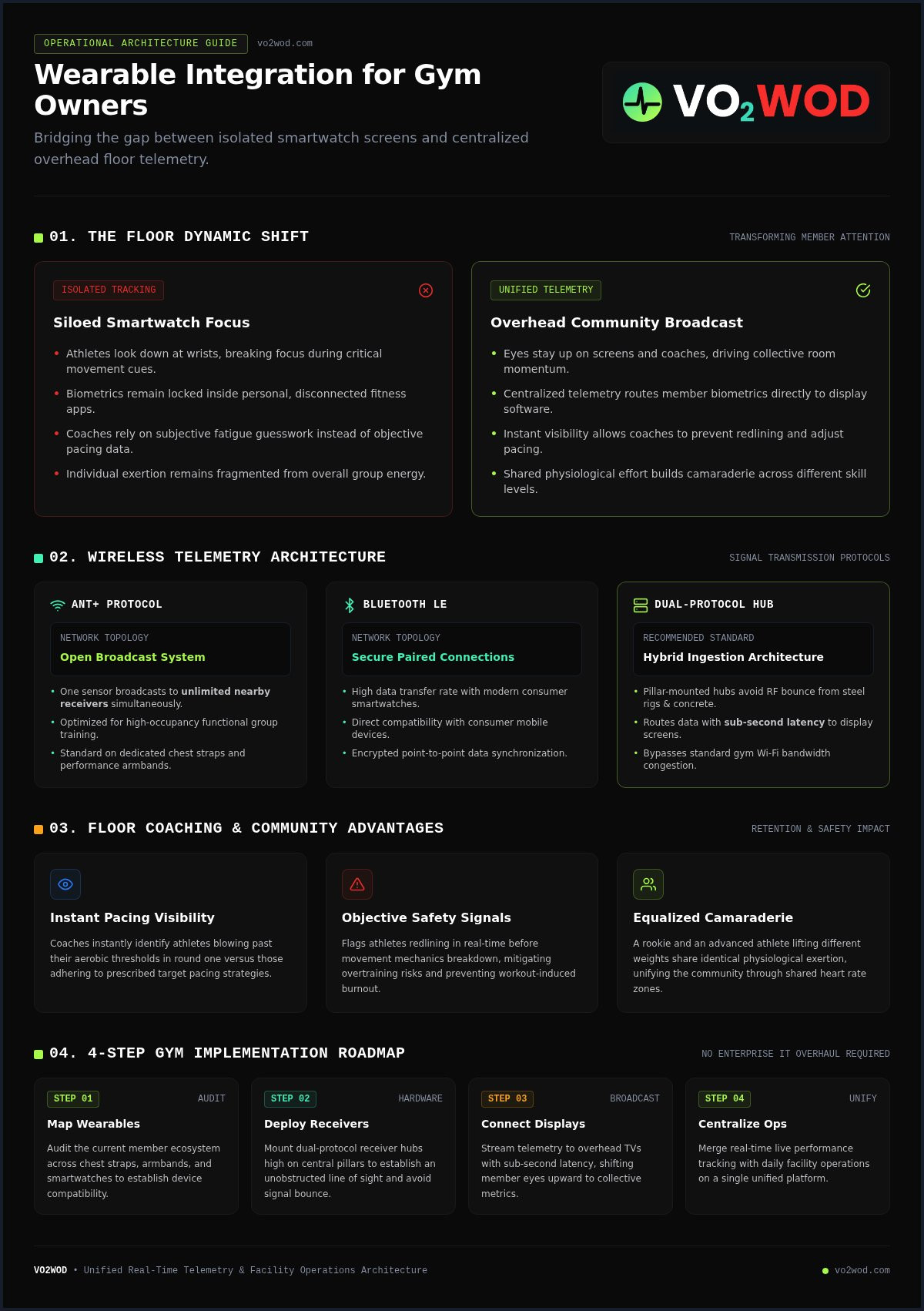
4 Steps to Implement Wearable Integration in Your Gym
Adopting new training floor technology should feel like an operational upgrade, not an IT headache. The goal is simple: capture biometric data smoothly without interrupting class flow or burdening your staff. Before jumping in, review our functional fitness gym software guide to ensure your core systems are ready for a live data upgrade. Here is your four-step blueprint to bring live biometrics to your facility.
Step 1 & 2: Platform Selection and Sensor Interoperability
Start by auditing your software stack. Avoid closed ecosystems that force athletes to buy a single proprietary brand of heart rate monitor. Members already own Garmin watches, Apple Watches, Whoop straps, and generic ANT+ chest belts. Your system must welcome them all.
Focus on two technical criteria:
- Unified architecture: Choose a platform that marries live performance screens directly with member accounts, class check-ins, and automated billing.
- Background sync reliability: The software should maintain steady connections across heavy classes without dropping signals or crashing mid-workout.
Seamless wearable integration for gym owners means zero tech friction during warm-ups.
Step 3 & 4: Coach Training and Athlete Onboarding
Hardware without coaching context falls flat. During your launch phase, educate coaches to incorporate physiological target zones into every workout brief. Instead of prescribing vague efforts like "push hard today," coaches should tell athletes to cap warm-ups in Zone 2 and hold Zone 4 during threshold intervals.
Next, introduce your community through a structured launch week:
- Add step-by-step sensor pairing instructions into your new member onboarding email sequence.
- Host a low-stakes benchmark workout focused on pacing discipline rather than max reps.
- Demonstrate live on screen how tracking heart rate recovery between sets builds long-term aerobic capacity.
When athletes experience how real-time biofeedback improves their training, adoption takes care of itself. Ready to modernize your facility floor? Explore the VO2WOD platform to integrate live biometric tracking with effortless gym management.
Unifying Live Telemetry and Facility Operations with VO2WOD
Running a fitness facility often feels like managing digital clutter. You might have one tool for membership billing, another for class check-ins, and a separate third-party plugin for heart rate graphics. Every disconnected tab adds friction to your day. True wearable integration for gym owners should not add another subscription layer to your tech stack. It should simplify it by bringing your coaching floor and administrative operations under one roof.
VO2WOD eliminates software fragmentation. By housing real-time biometric telemetry alongside automated payments, workout scheduling, and roster management, the platform restores a sense of calm efficiency to your operations. If you are preparing to upgrade your facility stack, consult our switching gym management software checklist for a smooth transition.
The Live Athlete Performance Dashboard in Action
The Live Athlete Performance Dashboard streams real-time biometric telemetry straight to your facility displays. As athletes move through barbell complexes or interval sprints, their exertion levels and pacing zones illuminate overhead screens instantly. Coaches no longer need to manually log scores or shout split times across a loud room.
Everything moves automatically. When the workout buzzer sounds, the system immediately archives performance data. It feeds completed scores directly into automated leaderboards and member workout histories, giving your athletes instant validation for their hard work.
Complete Administrative Relief: Vo2hub and Automated Scoring
Beyond the training floor, the Vo2hub functions as your community's digital home. It brings together automated workout scoring, athlete attendance records, and member communication in one clean environment. Your administrative routine suddenly feels much lighter:
- Automated payments: Collect recurring membership dues without awkward collection conversations or manual invoice reconciliations.
- Unified profile tracking: Review athlete development, attendance frequency, and workout output without opening multiple dashboards.
- Dedicated Data Migration Service: Move member rosters, payment profiles, and historical performance logs from legacy software without operational downtime.
Adopting unified wearable integration for gym owners turns your technology into a quiet, reliable partner. You get more time to do what you do best: coach your athletes, nurture your coaches, and cultivate a resilient fitness community.
Bring Connection and Clarity Back to Your Gym Floor
Fitness tech should never pull athletes away from the energy of the room. When you lift biometric tracking off private wrists and project it onto facility screens, workouts become shared achievements rather than isolated efforts. Your coaches gain the objective signals they need to guide intensity safely, while members stay engaged through transparent, effort-based progress.
Modern wearable integration for gym owners doesn't require juggling separate apps or wrestling with fragmented systems. VO2WOD brings your training floor and administrative desk into one clean ecosystem. The Live Athlete Performance Dashboard visualizes real-time telemetry overhead, while the Vo2hub automates workout scoring and recurring billing behind the scenes. With our dedicated Data Migration Service handling your historical records safely, upgrading your facility has never been smoother.
Explore the VO2WOD platform and transform your training floor today, and build a connected gym culture fueled by shared effort and undeniable progress.
Frequently Asked Questions
Do gym owners need to sell proprietary wearable devices to use live performance tracking?
No, you don't need to sell or inventory proprietary devices. VO2WOD operates on an open framework that connects with standard ANT+ and Bluetooth consumer devices athletes already own. Forcing members to buy studio-specific hardware creates unnecessary financial resistance. Instead, athletes simply wear their preferred chest strap or compatible watch, allowing your facility to focus entirely on coaching rather than device retail.
How do live heart rate monitors connect to gym TV screens during busy group workouts?
Heart rate monitors broadcast low-latency wireless signals directly to a central receiver hub connected to your facility displays. Using ANT+ or Bluetooth Low Energy protocols, sensors stream raw heart rate packets continuously without burdening your standard Wi-Fi network. The Live Athlete Performance Dashboard processes this data in real time, translating telemetry into color-coded effort tiles that update every second on your overhead TVs.
What happens if an athlete wears an incompatible smartwatch or fitness tracker?
Athletes using unsupported standalone devices simply participate without live screen projection, while still logging their workout results through standard platform check-ins. Modern wearable integration for gym owners focuses on open-protocol standards, capturing the majority of ANT+ chest straps and common fitness bands. For athletes without compatible heart rate monitors, their scores and completed repetitions still log directly into the Vo2hub, preserving full community workout tracking.
Can wearable integration prevent members from overtraining or burning out?
Yes, real-time biofeedback gives coaches objective visibility into athlete fatigue before overtraining leads to burnout or injury. When an athlete's heart rate stays pinned in the red zone during what should be an aerobic recovery piece, coaches can immediately cue them to back off. Visualizing physiological effort helps athletes honor intended stimulus, protect joint integrity, and sustain consistent, long-term training without hitting physical walls.
Will managing wearable tech on the gym floor distract coaches from teaching movement mechanics?
No, seamless wearable telemetry actually frees your coaches to spend more time observing movement and refining athlete mechanics. Rather than manually checking stopwatches, scribbling split times, or asking athletes how hard an interval felt, coaches take in the entire room with a single glance at the overhead dashboard. The technology works quietly in the background, removing administrative distraction so coaches can provide hands-on tactile cues and personal encouragement.
How does integrating live athlete biometrics improve gym member retention rates?
Live biometrics increase retention by turning subjective, invisible effort into concrete, gamified progress that keeps members committed. Studios utilizing real-time effort displays often see double-digit retention gains because members visibly experience their fitness improving week over week. When athletes see that effective wearable integration for gym owners rewards personal consistency over raw genetic output, intimidation vanishes, and communal accountability takes root.
How difficult is it to migrate existing gym member records to VO2WOD?
Switching your gym records is fast and stress-free with our dedicated Data Migration Service. We handle the heavy lifting of importing member profiles, historical performance data, and payment details from your existing platform. Your team experiences zero operational downtime, avoiding the headache of messy spreadsheets or manual data entry so you can open your doors with complete confidence.


