
How many hours of your life have you traded for the sake of a spreadsheet that no one actually trusts? It's a scene played out in gyms every single day. You're hunched over a screen long after the final buzzer, spending thirty minutes fixing typos and chasing down members who forgot to log their reps. You do it because you value accuracy. But the truth is, this manual friction is a heavy tax on your coaching energy. It's time to stop manual workout scoring and bring some much-needed light back into your facility.
We understand the frustration of subjective data and the quiet chaos of fixing scores while you should be connecting with your community. You want your athletes to feel the weight of their progress without the friction of a keyboard. This article will show you how to transition to a seamless, automated performance environment that finally runs itself. We'll explore why the accuracy myth is holding your business back and how a set it and forget it approach allows you to spend more time coaching and less time typing.
Key Takeaways
- Challenge the "Accuracy Myth" and discover why manual entry is actually less precise than automated tracking.
- Learn how to stop manual workout scoring to reclaim hours of staff time lost to the "Admin Tax" each month.
- Compare the impact of real-time biofeedback versus post-workout guesswork to improve member results and retention.
- Audit your current "Data Friction Points" to create a more fluid, seamless experience for your athletes.
- Explore how the VO2WOD Platform and Vo2hub automate the movement of data, allowing you to focus on coaching rather than typing.
The Myth of the "Perfect" Manual Scoreboard
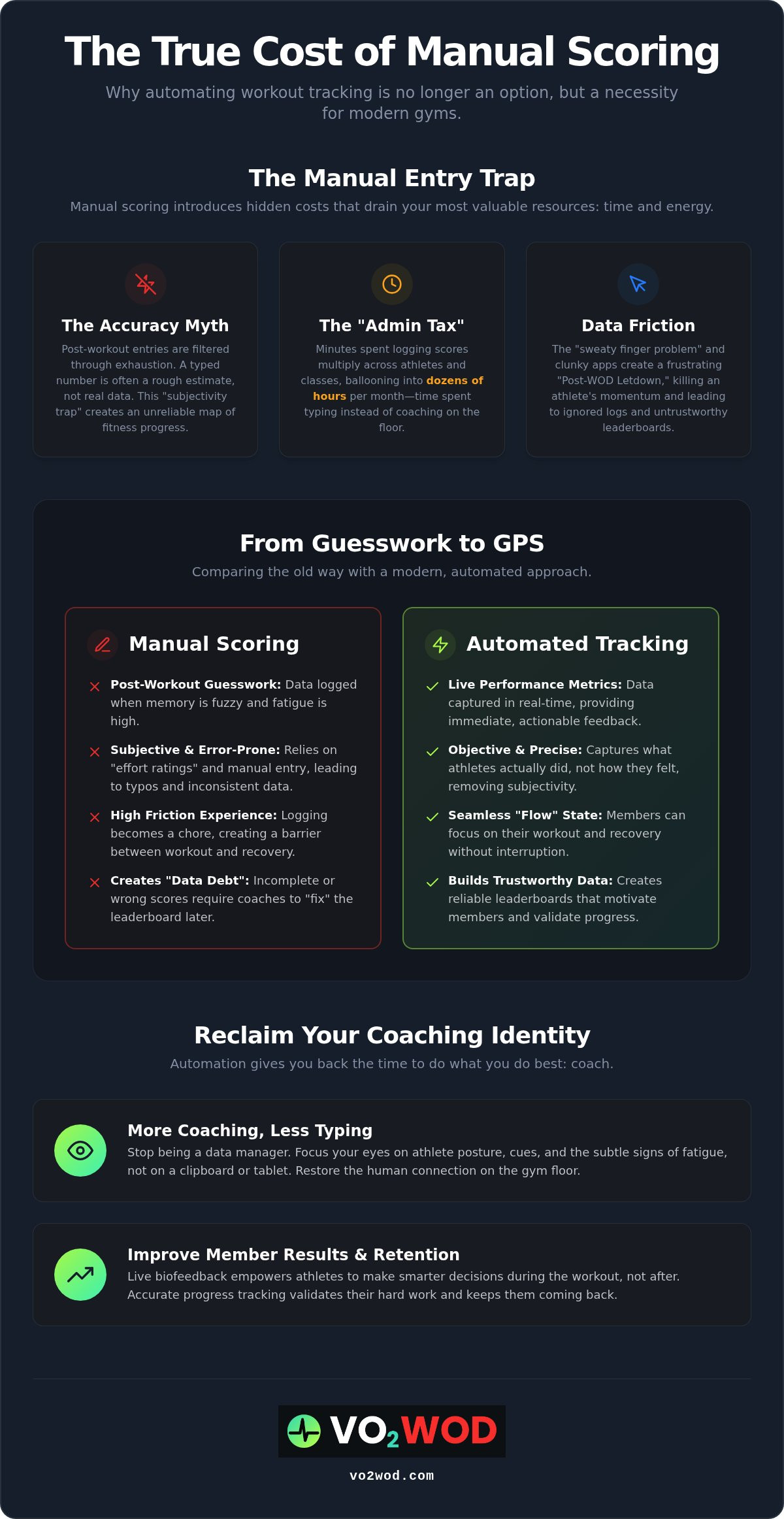
Manual workout scoring is often framed as a badge of honor. It's the process where an athlete, still catching their breath, navigates an app to type in a score. Or perhaps a coach stands at a whiteboard, marker in hand, scribbling down numbers shouted over loud music. We tell ourselves this is the most accurate way to capture performance. We call it "real data." But this is the Accuracy Myth in action. In reality, a typed number is often just a rough estimate filtered through exhaustion. It's time to stop manual workout scoring and embrace a lighter way of working.
When you finally decide to stop manual workout scoring, you realize how much friction you've been tolerating. The "sweaty finger" problem is real. Asking a member with shaking hands to tap precise buttons on a screen is a recipe for frustration. It creates a barrier between the workout and the recovery. Even worse, it builds "data debt." When members skip the log, coaches spend their weekends "fixing" the leaderboard. It's a heavy, administrative weight that pulls you away from the floor and back into a spreadsheet.
Why Manual Input Feels Like a Chore
The psychological burden of manual entry is heavy. After a grueling session, the last thing anyone wants is a homework assignment. Many modern tools, including the standard Fitness tracker, often prompt users for "effort ratings" or manual confirmations. These reminders are well-intentioned but usually result in spurious data. Members often click whatever button is closest just to clear the notification. When you're managing multiple workout types in one hour, the friction of switching categories manually becomes a chore that most people eventually ignore.
The Subjectivity Trap in Performance Data
Subjective data is a shaky foundation for a gym. A "7 out of 10" effort on a sunny Monday morning isn't the same as a "7" on a rainy Friday afternoon after a long work week. Manual-heavy apps also struggle with "pauses" or "backpedaling," where the clock keeps running but the movement stops. Without automated tracking, these nuances are lost. You end up with a scoreboard that reflects how people felt rather than what they actually did. This subjectivity prevents you from building a reliable, long-term map of fitness progress because the data points are moving targets.
The Hidden Cost of Every Manual Entry
Every manual entry carries a weight. It's a small, invisible tax on your gym’s productivity. You might think it takes only a minute to log a result, but multiply that by twenty athletes and six classes a day. This "Admin Tax" quickly balloons into dozens of hours every month. It's time spent in a dark office rather than on the bright gym floor. When you decide to stop manual workout scoring, you aren't just changing a process. You're buying back your time and your sanity.
Inaccurate data is worse than no data. Manual errors lead to "data decay," where leaderboards become untrustworthy and members stop looking at them. A Systematic Review of the Literature suggests that while technology has its own variances, human-led input is often the primary source of operational friction. If your athletes don't trust the numbers on the screen, they won't value the progress they see in the mirror. Automation ensures the truth of the effort is captured without the filter of post-workout fatigue.
Reclaiming Your Floor from the Clipboard
There is a profound difference between being a data manager and being a performance coach. When your eyes are fixed on a clipboard or a tablet, you miss the subtle shift in an athlete’s posture or the moment their pace begins to falter. Reducing the admin workload allows you to stop manual workout scoring and focus on the cues that actually prevent injury and drive results. Administrative friction is a direct competitor to gym community growth. By removing the need to type, you restore the human connection that defines your facility.
Member Experience: From Friction to Flow
Athletes come to your gym to find a "flow" state. They want to work hard, feel the burn, and then enjoy the endorphin high. Forcing them into a "Post-WOD Letdown" where they must navigate a clunky app to log scores kills that momentum. They eventually stop using tools that require too much work. Automation replaces that staccato frustration with a sense of organized tranquility. If you want to see how this looks in practice, the VO2WOD Platform offers a glimpse into a world where data moves as fast as your athletes.
Live Performance Metrics vs. Post-Workout Guesswork
Imagine the difference between checking a map after you're already lost and using a live GPS while you're driving. Manual entry is the paper map you check too late. Live performance metrics are the GPS. When you stop manual workout scoring, you replace post-workout guesswork with immediate, actionable truth. Seeing a score during the workout changes the psychology of the room. It's not just a number on a screen; it's a mirror reflecting an athlete's current capacity. This real-time biofeedback allows coaches to adjust intensity on the fly. It ensures every member stays in the ideal zone for their specific goals without the need for a post-WOD interrogation.
Visualizing Gains in Real-Time
The energy in a group fitness class shifts the moment you move from logging a score to watching a performance. When the Live Athlete Performance Dashboard glows on a TV screen, the environment feels more alive. It becomes a shared, community experience. Athletes aren't just staring at their own sweat; they're engaged with a live leaderboard that updates without human input. This isn't about creating "whiteboard anxiety" or making people feel judged. It's about healthy, visible progress that fuels motivation. These live metrics also serve as a vital safety net. If a coach sees a heart rate spiking too early or power output dropping sharply, they can intervene before over-training occurs. It's a proactive way to manage recovery before the athlete even leaves the floor.
Why "Effort Ratings" are Obsolete
We've spent years asking members, "How hard did that feel?" on a scale of one to ten. It's a flawed question. Subjective effort ratings are often clouded by ego, mood, or sheer exhaustion. Moving toward Automated Workout Scoring means moving from "I think I worked hard" to "My heart rate confirms I worked hard." Centralized scoring provides an objective truth that manual prompts simply can't match. When the data moves automatically into the Vo2hub, the need for "effort reminders" or manual pings vanishes entirely. The system captures the power output and the physiological response simultaneously. This creates a reliable record of fitness that isn't dependent on a member's memory or their willingness to type into an app while they're still gasping for air. It replaces the staccato rhythm of admin with a fluid, continuous stream of performance insight.
How to Transition Your Gym to Automated Scoring
Transitioning your facility to a "set it and forget it" environment is a journey from friction to fluidity. It starts with an honest look at your current workflow. Most owners don't realize how much administrative weight they carry until they finally set it down. When you decide to stop manual workout scoring, you aren't just changing your software. You're changing the culture of your gym. You're moving from a world of manual "touches" to one of automated truth. It's an emotional shift that replaces the chaos of the whiteboard with the calm of a centralized system.
Step 1: The Data Audit
Begin by mapping every "touch" a workout score requires. From the athlete finishing their final rep to the eventual leaderboard update, how many times is that data manually handled? Ask yourself a simple question: "Does this score exist if the athlete doesn’t type it?" If the answer is no, your data is constantly at risk of human error or simple forgetfulness. You need a system where the performance itself generates the record. For practical tips on the physical infrastructure needed to support this change, explore our Functional Fitness Gym Software: 2026 Guide.
Step 2: Streamlining the Tech Stack
Fragmented systems are the enemies of organized tranquility. Using one app for billing, another for class booking, and a third for scoring creates a digital house of mirrors. An all-in-one system ensures that your gym management tools sync perfectly with your performance data. This integration means you don't have to chase members for payments or scores. Your role as a coach is to guide this transition with confidence. Explain to your athletes that they're moving from "typing" to "tracking." This isn't about adding more technology; it's about removing the work that gets in the way of the workout.
The physical setup is often the most rewarding part of the process. Mounting TV screens and installing sensors creates a tangible shift in the gym's energy. The Vo2hub acts as the central brain, pulling in data from the floor and pushing it to the Live Athlete Performance Dashboard. This setup allows your members to stay in the zone. They don't need to touch their phones with chalky, sweaty hands. They just perform, and the system handles the rest. If you're ready to see how a professional Data Migration Service can move your legacy records into a brighter future, explore the VO2WOD Platform today.
Reclaiming Your Coaching Identity with VO2WOD
When you choose to stop manual workout scoring, you aren't just buying a subscription. You're reclaiming your identity as a coach. For years, the fitness industry has accepted a staccato rhythm of administrative tasks as the inevitable price of doing business. You coach a set, then you type a score. You encourage an athlete, then you fix a typo. The VO2WOD Platform removes this friction, replacing the heavy lifting of data entry with a fluid, automated experience that feels like a natural extension of your gym floor.
At the heart of this transition is the Vo2hub. It acts as a centralized, quiet space where performance data moves without the need for human intervention. Imagine the emotional relief of knowing that every rep, every second, and every watt is captured accurately in real-time. You no longer have to be the gatekeeper of a spreadsheet. Instead, you can be the visionary leader your community needs, moving toward a unified future where the technology supports the human element rather than distracting from it.
The Live Athlete Performance Dashboard Advantage
The Live Athlete Performance Dashboard provides more than just numbers on a screen. It offers real-time data visualization that builds your authority as a coach. When an athlete can see their performance metrics without having to touch a chalky screen or a phone, they stay fully immersed in the workout. This creates a tangible, inviting space for performance data. It's a digital environment that feels physical and real, allowing members to engage with their progress in a way that feels like a reward rather than a chore. It replaces the urgency of manual logging with a sense of organized tranquility.
Seamless Migration: Leaving the Whiteboard Behind
One of the biggest fears in switching systems is the weight of the past. You don't want to lose the "gains" your athletes have recorded over the years. VO2WOD’s Data Migration Service handles the heavy lifting of the switch, ensuring that your legacy data is moved safely into its new home. We understand the value of that history, and we ensure no data is left behind in the transition. It's time to stop manual workout scoring and embrace a lighter, more organized way of managing your community. Experience the calm of automated scoring with VO2WOD.
Restore the Human Element to Your Gym
You didn't start a gym to become a data entry clerk. Every minute spent chasing scores or fixing typos is a minute lost to your athletes. When you decide to stop manual workout scoring, you replace the weight of administrative debt with the lightness of automated flow. This transition isn't just about software. It's about reclaiming your floor. You move from the guesswork of subjective ratings to the objective truth of the Live Athlete Performance Dashboard.
We built the VO2WOD Platform specifically for functional fitness communities that value connection over paperwork. Through our seamless Data Migration Service, you can leave the chaos of the whiteboard behind without losing a single rep of your history. It is a path toward organized tranquility and better results for every member. The data moves quietly in the background, allowing you to focus on the human beings in front of you.
Automate your gym scoring with VO2WOD and get back to what you do best. Your athletes deserve your full attention, and you deserve a system that works as hard as they do. Step into a future where the data is live, the coaching is personal, and the administrative burden is finally gone.
Frequently Asked Questions
How do I stop my members from having to manually rate their effort?
Transition to automated scoring using a system like the VO2WOD Platform. Instead of asking athletes to reflect on their fatigue, the system captures real-time physiological data. This removes the "sweaty finger" friction. Members just focus on the movement. The software handles the interpretation. It's a shift from subjective guesswork to objective truth. You'll find it creates a much lighter atmosphere in the gym after the final buzzer sounds.
Is automated workout scoring more accurate than manual entry?
Yes, because it removes human bias and post-workout exhaustion from the equation. Manual entry often suffers from "data decay" where members guess their numbers. When you stop manual workout scoring, you capture the raw performance as it happens. This ensures your leaderboards reflect actual work capacity rather than just who remembered to type in their reps. It provides a reliable map of fitness progress that stays consistent over time.
Can I still have a leaderboard if I stop manual workout scoring?
Absolutely, and it will likely be more engaging. When you stop manual workout scoring, the leaderboard updates in real-time on your Live Athlete Performance Dashboard. Athletes can see where they stand during the WOD. This drives healthy competition without the "whiteboard anxiety" of scribbling numbers by hand. It feels more like a professional sporting event and less like an administrative chore. The data flows automatically into the Vo2hub for long-term tracking.
Will automated scoring work with my existing gym heart rate monitors?
Most modern systems are designed to be inclusive. VO2WOD integrates with standard performance hardware to pull data directly into the Live Athlete Performance Dashboard. This means your members don't need to buy new proprietary gadgets. The system acts as a hub, gathering signals from various devices and translating them into a unified score. It's a way to make your existing investment in tech feel more valuable and integrated.
How long does it take to migrate my old workout data to an automated system?
The timeline is usually quite brisk when using a professional Data Migration Service. We handle the heavy lifting of moving your legacy records from old spreadsheets or apps into the VO2WOD Platform. Most gyms see their historical "gains" restored within a few business days. This ensures a seamless transition where no athlete's history is lost. You get to keep your community's story while moving into a much more efficient future.
Does automated scoring prevent athletes from "gaming" the system?
It significantly reduces the opportunity for "bro-reps" or inflated scores. Because the system tracks actual physiological output and power, it's much harder to fudge a result than it is with a manual whiteboard. Automation brings a sense of integrity to the leaderboard. Athletes know the numbers are earned through effort rather than just typed in. It builds a culture of trust where the data matches the physical reality on the floor.
What equipment do I need for a Live Athlete Performance Dashboard?
The physical requirements are surprisingly light. You generally need a smart TV or a monitor mounted in your workout space to display the dashboard. This connects to the VO2WOD Platform via a standard internet connection. The system then pulls data from athlete sensors or wearables into the Vo2hub. It's about creating a tangible, inviting space for performance data without cluttering your gym with expensive hardware or complicated wiring.
Is automated scoring too complicated for beginner gym members?
It's actually much simpler for beginners than manual logging. New members often feel overwhelmed by the need to learn workout terminology just to record a score. With automated systems, they don't have to do anything except show up and work. The software handles the "scoring" part. It removes the barrier to entry, making the gym feel like a more welcoming, human-centric space where they can focus on their fitness journey instead of an app.


