

Imagine a coach standing in the center of a buzzing gym, eyes fixed on a cluttered clipboard instead of the athletes moving right in front of them. It's a common scene, but it feels heavy. This friction between manual data entry and actual coaching is exactly why performance tracking for strength and conditioning has undergone a radical transformation. You likely feel the weight of chasing down notebooks or deciphering messy handwriting just to see if a member is actually improving. It's exhausting for you. It's demotivating for them.
We agree that your energy belongs to your community, not to a spreadsheet. You deserve a workspace that feels like a sanctuary of growth rather than a dusty filing cabinet. This article reveals how modern functional fitness facilities are replacing manual logs with real-time biofeedback and automated scoring to drive member retention. We'll explore the transition to a unified dashboard that turns fragmented data into a fluid stream of progress. You'll see how automated systems sync effort directly with billing and keep your athletes inspired through live leaderboards that celebrate every win as it happens.
Key Takeaways
- Replace the heavy burden of manual notebooks with a fluid data ecosystem that prevents progress from slipping through the cracks.
- Focus on the vital signs that matter, including volume and heart rate recovery, while reclaiming your time for hands-on coaching.
- Discover how modern performance tracking for strength and conditioning uses live dashboards to turn every workout into a visible win.
- Audit your current "data leaks" to create a seamless environment where automated scoring keeps members deeply connected to their goals.
- Move toward a unified future where athlete metrics and gym management live together in one light, organized space.
Beyond the Notebook: The Evolution of Strength and Conditioning Tracking
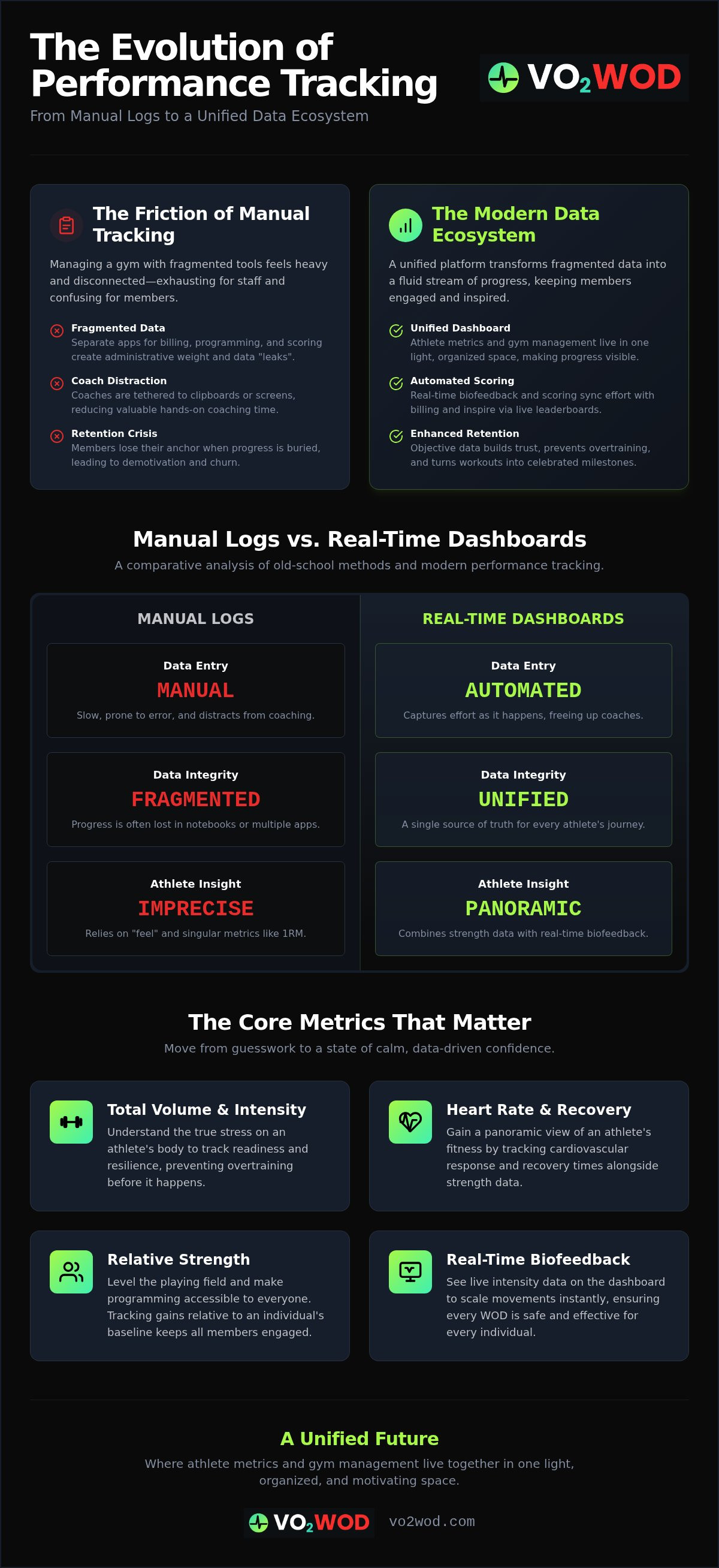
In the old days, we lifted by feel. A coach would watch a set, nod, and maybe scribble a number in a spiral notebook. It felt personal, but it was imprecise. By 2026, performance tracking for strength and conditioning has evolved into a holistic data ecosystem. It's no longer just about logging reps; it's about the environment. Modern facilities are moving toward automated spaces where the gym itself captures the effort. This shift removes the "friction gap," that awkward space where data decays because it's simply too hard to record in the heat of a workout. When tracking is fluid, the gym feels lighter and more focused.
The Problem with Fragmented Data
Managing a functional fitness facility shouldn't feel like moving heavy furniture. When you use one app for billing, another for programming, and a third for scoring, you create a massive amount of administrative weight. It's exhausting for the staff and confusing for the members. Coaches end up tethered to clipboards or glowing screens while their athletes are left waiting for a cue. This fragmentation leads to a quiet crisis of retention. If a member can't see their long-term progress clearly because it's buried in three different places, they lose their anchor. The data becomes a chore rather than a celebration of their hard work.
Performance Tracking as a Retention Tool
Data is the narrative of an athlete's journey. It transforms a random Tuesday workout into a milestone on the path from beginner to elite. When performance tracking for strength and conditioning is integrated into the daily flow, it acts as a protective shield. Objective metrics like volume trends and recovery times help coaches spot overtraining before it leads to a forced break or injury. This level of precision builds immense trust.
Beyond safety, integrated tracking fuels the heart of the gym: the community. Shared leaderboards and visible milestones create a healthy, competitive pulse that keeps members coming back. They aren't just paying for access to equipment; they're investing in a story they can actually see unfolding. A unified dashboard makes that story easy to read, turning a chaotic pile of numbers into a clear, inviting path forward. It replaces the stress of "not knowing" with the calm confidence of measurable growth.
The Core Metrics: What Modern Coaches Should Actually Measure
Measuring progress shouldn't feel like a math test. It should feel like a map. For years, coaches relied on a single 1RM to define success. It was a heavy, singular metric. Today, performance tracking for strength and conditioning is about the vital signs that pulse beneath the surface. We look at total volume and intensity to understand the true stress on an athlete's body. These numbers tell the story of a member's readiness and resilience. When you track heart rate zones and recovery times alongside lifting data, you gain a panoramic view of fitness. It's about moving from guesswork to a state of calm, data-driven confidence.
In 2026, the standard for competitive boxes has shifted toward Automated Workout Scoring. Manual entry is a relic. It's too slow. It's too prone to error. Automated systems capture the heartbeat of the workout as it happens, allowing coaches to focus on the humans in the room. This shift toward real-time biofeedback ensures that every session is both safe and effective. If you're interested in exploring a more unified system, the transition is often smoother than you'd expect.
Strength Metrics vs. Conditioning Output
Balancing absolute strength with functional capacity is an art form. While hitting a new deadlift PR is a victory, tracking "Relative Strength" is what makes your programming accessible to everyone. It levels the playing field. Whether it's a collegiate athlete or a grandparent, seeing gains relative to their own baseline keeps them engaged. You can find more on this in our guide to WOD Tracking Software for Gyms: Visualizing Athlete Gains in 2026. This approach turns data into a welcoming community narrative rather than a sterile list of numbers.
The Rise of Real-Time Biofeedback
The coaching dynamic changes the moment you see live intensity data. You no longer have to wonder if an athlete is sandbagging or redlining. You see it on the dashboard. This clarity allows you to scale movements instantly, ensuring that a high-intensity WOD stays within a safe threshold for every individual. It's a supportive way to lead a group. For a deeper look at this technology, read about Beyond the Stopwatch: The Rise of Real-Time Biofeedback for Group Workouts in 2026. This level of precision replaces the frantic energy of a stopwatch with the quiet efficiency of a well-monitored floor.
Manual Logs vs. Real-Time Dashboards: A Comparative Analysis
The traditional "Post-Workout Entry" model is a heavy anchor on a gym's momentum. It asks athletes to recall their effort after the adrenaline has faded, often leading to "ego-scoring" or simple forgetfulness. In contrast, the Live Dashboard model captures data in the moment. This shift in performance tracking for strength and conditioning ensures that every rep and every heartbeat is recorded with clinical precision. It replaces the friction of manual entry with a fluid, automated stream of information. When the data flows naturally, coaches are free to move. They can spend their energy correcting a squat or offering a word of encouragement rather than hovering over a clipboard.
The Friction Factor: Why Automation Wins
Consider the "time cost" of manual entry in a typical 20-person class. If each member spends just two minutes logging their scores into an app, that's forty minutes of collective focus lost to a screen. It's a significant drain on the room's energy. Automation removes the "I forgot my phone" excuse entirely. It creates an environment of organized tranquility where the facility itself takes care of the administrative weight. Data is no longer a separate task; it's a byproduct of the work. This seamless integration allows the community to stay present in the workout, trusting that their progress is being safely held and recorded.
- Eliminates the delay between performance and recording.
- Reduces administrative "noise" during high-intensity sessions.
- Ensures 100% data compliance across the entire member base.
Visualizing Success on the Big Screen
There's a psychological spark that ignites when an athlete sees their name on a live display. This gamification effect is a powerful driver for personal records. It turns a solitary struggle into a shared experience. However, the true value of a dashboard lies in its inclusivity. A modern system doesn't just celebrate the fastest times; it highlights effort, consistency, and relative gains. It makes the beginner feel as seen and valued as the elite competitor.
Setting up this visual hub is a straightforward way to boost member engagement instantly. If you want to transform your floor, learning how to set up a gym leaderboard for TV screens is an excellent starting point. It moves the data from a hidden app to the center of the room, making success visible to everyone. This transparency fosters a culture of advocacy where members cheer for each other's measurable growth, creating a bond that manual logs simply cannot replicate.
Implementing a Performance Culture: A Guide for Gym Owners
Building a culture of excellence isn't about imposing strict rules. It's about removing the obstacles that keep your members from seeing their own potential. To transition your facility into a data-driven powerhouse, start by auditing your current "data leaks." Look for the gaps where athlete information disappears. It might be a coach forgetting to log a modification or a member losing their notebook. Once you identify these leaks, choose a unified platform that merges gym management with performance tracking for strength and conditioning. This single source of truth replaces the heavy, fragmented systems of the past with a light, organized digital environment.
Training your staff is the next vital step. Coaches should be comfortable using live dashboards to scale movements actively during a session. When the data is visible, the coaching becomes more precise. Finally, launch a centralized community space like the Vo2hub. This allows you to use real-time metrics for personalized member check-ins. If a member's intensity has dropped over the last three weeks, you'll know before they even consider canceling. This proactive care is the ultimate retention tool. To see how this looks in practice, you can book a demo of our Performance OS today.
Onboarding Your Athletes
The secret to high adoption is framing. Introduce tracking as a benefit that celebrates their journey rather than a chore they have to complete. Within the Vo2hub, members can engage with digital high-fives and community milestones, making the data feel social and supportive. If the thought of moving years of historical data feels overwhelming, don't worry. A dedicated Data Migration Service is critical for existing gyms. It ensures that your members' hard-earned PRs aren't left behind during the transition, making the move feel like a fresh start rather than a burden.
Coaching with Precision
Modern coaching is about more than just being a loud cheerleader. It's about being a data-informed expert. By using the Live Athlete Performance Dashboard, you can identify struggling members before they fail a lift or redline too early. This visibility allows for "stealth scaling," where you can suggest a weight change based on real-time effort levels. It builds deep trust. For a complete look at the tools required for this shift, explore our Functional Fitness Gym Software: 2026 Guide. This approach transforms your staff from floor managers into elite performance guides who truly understand the needs of every athlete in the room.
Case Study: How VO2WOD Revolutionizes Strength and Conditioning
Managing a gym shouldn't feel like a second job in data entry. For many owners, the weight of fragmented admin is a constant drain on their energy. VO2WOD was built to lift that burden. It's a Performance OS that gathers the scattered pieces of your business and brings them into one light, organized space. The Vo2hub acts as the central nervous system for athlete gains, pulsing with real-time data that both coaches and members can trust. It replaces the chaos of multiple apps with a single, welcoming sanctuary for your gym's data.
One facility recently decided to leave their clipboards behind. Before the switch, their coaches spent hours every week manually logging scores and chasing billing errors. After implementing the VO2WOD platform, they reduced their administrative time by 40%. The result was immediate. Coaches returned to the floor with more presence. Members felt more seen. This shift in performance tracking for strength and conditioning didn't just save time; it drove a surge in personal records. When effort is visualized in real-time, the community's energy shifts from "getting through it" to "conquering it."
Automated Scoring and Payments
The ripple effect of automated scoring is profound. When a workout ends, the score is already there. No one has to chase down results or decipher messy handwriting. This data flows directly into your management system, allowing for automated membership tiering or rewards based on consistency. It eliminates the "billing headache" by integrating the work done on the floor with your financial backend. This level of automation provides professional confidence. Your business runs on reliable, cloud-based infrastructure that feels as solid as the foundation of your gym.
The Seamless Transition
Switching software often feels like a heavy, risky lift. The fear of losing years of athlete history keeps many owners stuck in outdated, high-friction loops. Our Data Migration Service removes that weight. We act as your "Friendly Guide," moving your data with care so you don't lose a single PR. We handle the technical friction; you handle the coaching. It's a promise of ease. We're here to help you move toward a unified, automated future where your gym feels as light and energized as your members after a breakthrough session. Step into the future of gym management today.
Stepping Into a New Era of Gym Efficiency
The weight of clipboards and fragmented apps is a burden you no longer have to carry. We've explored how transitioning to a unified system transforms performance tracking for strength and conditioning from a chore into a competitive advantage. By choosing a platform that integrates everything from the workout floor to your billing, you reclaim your energy for what matters most: your members. You've seen how real-time visualization and automated systems don't just organize your data; they ignite your community's passion.
It's time to replace administrative noise with organized tranquility. With tools like the Live Athlete Performance Dashboard and Automated Workout Scoring, you can lead your facility with absolute clarity and professional confidence. Our Expert Data Migration Service ensures that making the switch is as smooth as a well-executed lift. You don't have to navigate this change alone.
Experience the future of gym management, book a VO2WOD demo today.
Your gym is more than just a collection of equipment; it's a sanctuary for growth. We're here to help you protect that space by providing the precision and support you deserve. Let's move toward a lighter, more connected future together.
Frequently Asked Questions
What is the best way to track strength and conditioning for large groups?
The most effective way to manage large groups is through performance tracking for strength and conditioning that removes the need for individual manual entry. When you have twenty athletes moving at once, clipboards create a bottleneck. A unified platform captures reps and intensity levels as they happen, allowing the coach to remain present on the floor. This approach turns a chaotic class into a synchronized environment where every member's effort is visible and valued instantly.
Can I track both strength gains and metabolic conditioning in one app?
Yes, you can centralize your entire programming within a single digital space. VO2WOD is designed to bridge the gap between heavy lifting and high-intensity conditioning. It tracks your 1RM trends alongside heart rate zones and workout times. This holistic view provides a panoramic look at an athlete's development. You don't have to juggle multiple apps to see how strength gains are fueling better conditioning performance; it's all visible on one dashboard.
How does real-time performance tracking improve member retention?
Real-time tracking creates a visible narrative of success that keeps members coming back. Athletes stay when they can see their growth clearly. When a member sees their effort reflected on a live display, it validates their hard work in the moment. This transparency fosters a sense of belonging and advocacy within the gym. It replaces the feeling of being just another face in the crowd with the confidence of a tracked, measurable journey.
Is it difficult to migrate my existing gym data to VO2WOD?
Transitioning to a new system shouldn't feel like a heavy lift. We provide a dedicated Data Migration Service to handle the technical weight of moving your historical records. Whether you're coming from spreadsheets or another platform, we ensure your members' PRs and history arrive safely in their new home. This professional support allows you to focus on your community while we organize the digital foundation behind the scenes with quiet efficiency.
Do I need special equipment to use a live athlete performance dashboard?
You don't need a complex or expensive hardware overhaul to get started. A standard internet connection and a display screen, like a smart TV or tablet, are usually all it takes to bring the Live Athlete Performance Dashboard to life. The software does the heavy lifting by aggregating data from member devices and projecting it clearly. It's about turning the equipment you likely already have into a visionary tool for coaching precision and engagement.
How does automated workout scoring save time for coaches?
Automated workout scoring removes the administrative friction that often eats up the last ten minutes of every class. Instead of coaches deciphering messy handwriting or waiting for athletes to find their phones, the system captures results instantly. This efficiency gives coaches back hours every week. They can use that reclaimed time for personalized check-ins or refining their programming. It replaces the frantic energy of data entry with a calm, organized transition between sessions.
What metrics are most important for functional fitness athletes in 2026?
In 2026, the focus has shifted toward a blend of absolute strength and metabolic readiness. Key metrics include 1RM trends and total volume, but heart rate recovery and intensity zones are equally vital. These vital signs tell a deeper story than a simple score. By monitoring how quickly an athlete's heart rate drops after a workout, coaches can assess true fitness and readiness. It's about measuring the human beneath the movement with precision.
Can I display a live leaderboard on my gym TVs with VO2WOD?
Yes, projecting a live leaderboard onto your gym TVs is a core feature of the platform. This visual hub turns every workout into an interactive experience. It celebrates the top performers while also highlighting the consistency and effort of the entire group. This transparency drives engagement and fosters a healthy, competitive pulse. It makes the gym feel like a modern, tech-forward sanctuary where every athlete's progress is celebrated in the light of the community.


