

What if gym software’s biggest return isn’t a lower bill, but the hours and member capacity tied up in your current systems? A useful ROI calculator for gym management software turns that hard-to-see value into a business case built on your own numbers, not a vendor’s best-case claims.
It’s reasonable to want clear evidence before switching. Admin tasks take time, payment processing affects costs, and retention can be difficult to assess when records are scattered. Rather than guess, start with the information you have, make assumptions visible, and compare them carefully.
In this guide, you’ll build a practical model using your software costs, staff hours, billing, and member data. You’ll compare conservative, expected, and upside scenarios, then separate potential gains from saved admin time, recovered capacity, and additional revenue. You’ll also identify what to measure before choosing or changing platforms, so your decision reflects the realities of your gym.
Key Takeaways
- Use the ROI calculator for gym management software to compare benefits and costs over the same period, using figures from your gym.
- Include subscription and related operating costs, then separate direct cash savings from potential revenue gains.
- Compare current, conservative, expected, and upside scenarios. Change one assumption at a time to see what drives the result.
- Track baseline measures such as staff admin hours, payment outcomes, and revenue assumptions before changing platforms.
- Assess whether capabilities such as automated payments, administrative tools, and workout scoring could improve the processes you’ve measured.
Why calculate ROI for gym management software before choosing a platform?
Before choosing a platform, compare its full investment with the financial and operational value it could create for your gym. A feature list shows what software does, but not whether those capabilities are worth the cost in your operation. An ROI calculator for gym management software gives you a structured way to answer that question using your own baseline, rather than broad claims about efficiency or growth.
Return on investment (ROI) expresses net benefit as a percentage of investment over a defined period. Subtract the costs for that period from the benefits, then divide the result by those costs. The Return on Investment (ROI) principles provide a useful foundation, but your inputs need to reflect your gym. A positive estimate is not a guarantee of future results. It’s a decision aid built on evidence and assumptions you can explain.
What does ROI mean for a gym software decision?
Count recurring subscription costs and relevant one-time transition costs, such as data migration or setup, within the period you’re evaluating. Compare them with documented savings or additional contribution. Gross revenue alone can overstate the return: if improved follow-up helps retain a member, estimate the contribution left after relevant costs, not the full membership payment.
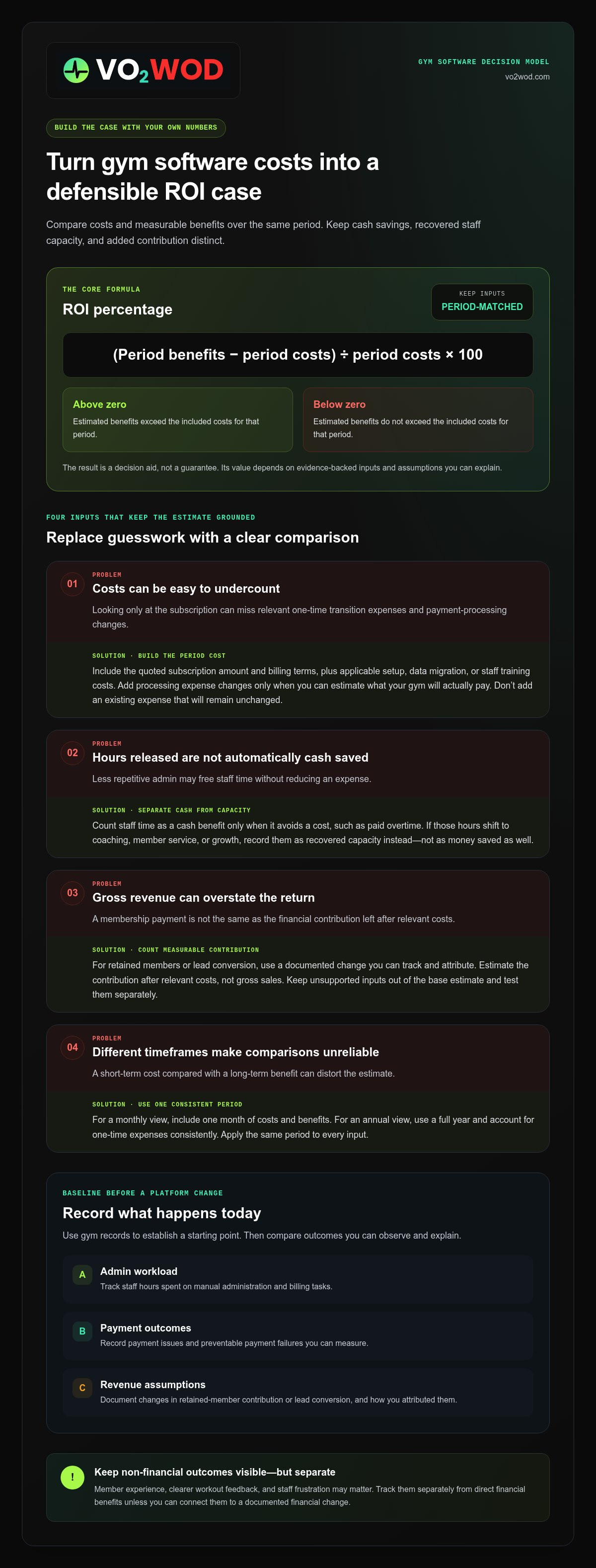
Use the same period for both sides of the calculation. For a monthly view, include one month of costs and benefits. For an annual view, use a full year and account for one-time expenses consistently. This avoids comparing a short-term saving with a long-term revenue estimate.
Which gym outcomes belong in an ROI estimate?
Start with outcomes you can observe or document. For payment administration, track time spent handling billing tasks and recording payment issues. Staff time can include hours spent on manual admin that a new process might reduce. Revenue inputs could include a measured change in retained-member contribution or lead conversion, provided you can track the change and explain how you attributed it.
Keep cash impact separate from capacity released. If a team member spends fewer hours on repetitive admin, that time has operational value. But it isn’t automatically a cash saving unless it reduces an expense, such as paid overtime. If the hours go toward coaching, member service, or growth, record them as recovered capacity instead of money saved. Counting them both ways would inflate the estimate.
Some outcomes matter without fitting neatly into the ROI percentage. A smoother member experience, clearer workout feedback, or less staff frustration may be worth tracking, but keep these indicators separate from direct financial benefits unless you can connect them to a documented financial change. Functional fitness gyms can also compare how software fits their coaching and admin workflows when exploring functional fitness gym software.
ROI estimates depend on your gym’s baseline and assumptions, not on a vendor’s benchmark. Record what you currently spend, how work gets done, and which outcomes you can reliably measure. That gives you a sound starting point for comparing platforms and assessing whether a projected return is credible.
How to calculate gym management software ROI with a simple formula
Once you’ve chosen a measurement period, put its costs and benefits on the same footing. Use this formula:
ROI percentage = (period benefits − period costs) ÷ period costs × 100
A result above zero means the estimated benefits exceed the included costs for that period. A result below zero means they don’t. Either way, the number is only as useful as its assumptions. For an ROI calculator for gym management software, enter your own figures and note where each one came from.
- Period: The consistent timeframe for every input, such as twelve months.
- Period costs: Software-related expenses within that timeframe, including relevant one-time costs.
- Period benefits: Verified cash savings and additional financial contribution within the same timeframe.
Which costs should the calculator include?
Use the subscription amount and billing terms in the quote for the platform you’re assessing. Add applicable setup, migration, or staff training costs when you know them. Include a change in payment-processing expense only if you can estimate how the new arrangement affects what your gym actually pays. Don’t count an existing expense as a new cost if it will stay the same after switching.
How should a gym estimate measurable benefits?
Use records, not guesses. Compare payment administration hours or preventable payment failures before and after a change, then count only the portion you can reasonably attribute to the software. Staff time is a cash benefit when it avoids an expense; otherwise, report released hours separately as capacity. For additional memberships, count estimated contribution after relevant costs, not gross sales.
Keep every input visible. Your worksheet might include subscription costs, transition expenses, avoided admin expense, recovered payment contribution, and additional membership contribution. If you can’t support an input with a record or a clear assumption, leave it out of the base estimate and test it separately.
Illustrative example only, not a benchmark or a software quote: Suppose a gym enters twelve months of subscription costs as $2,400, one-time transition costs as $600, and an estimated $300 increase in processing expenses. Period costs total $3,300. The gym estimates $1,200 in avoided overtime, $900 in contribution from fewer preventable payment failures, and $2,400 in additional membership contribution. Period benefits total $4,500.
Applying the formula gives ($4,500 − $3,300) ÷ $3,300 × 100, or an estimated ROI of about 36%. This example assumes the gym can support each benefit with its records and avoid double-counting. Replace every figure with your own data, and keep unverified gains out of the main result. If you’re assessing a functional fitness platform, VO2WOD’s gym management platform can be evaluated against the processes and costs you’ve measured.
Compare scenarios without overstating gym software returns
A single ROI result can look precise while resting on uncertain assumptions. Build four views: your current process, a conservative case, an expected case, and an upside case. Use the same measurement period and cost categories in each. Enter your own figures, and label estimates that aren’t supported by records as assumptions, not expected outcomes.
Scenario ranges are more credible than a single forecast because they show how the decision changes when uncertain assumptions change.
| Case | What to enter | How to treat uncertain benefits |
|---|---|---|
| Current process | Your existing costs, staff hours, payment outcomes, and documented revenue contribution | Use it as the baseline, not as a software-return claim |
| Conservative | Proposed costs and only benefits you can support with strong evidence | Leave uncertain retention or new-revenue gains out, or use a restrained assumption based on your records |
| Expected | The same costs, with the operational changes you reasonably anticipate | Mark estimates clearly and explain what evidence supports them |
| Upside | The same costs with more favorable, plausible outcomes | Treat unverified retention and revenue increases as possibilities, not promises |
Keep the comparison honest by changing one assumption at a time. For example, hold costs and payment outcomes steady while testing different estimates of staff hours saved. Then restore that assumption and vary only the payment outcome. This sensitivity check shows which inputs have the greatest effect on the ROI calculator for gym management software, and where better records would make the estimate more dependable.
How should owners value staff time and administrative capacity?
Track recurring tasks such as payment follow-up, member record updates, and other administrative work. Estimate time saved only for tasks the software could affect. If you assign a dollar value, state its basis, such as a documented wage or an explicit opportunity-cost assumption. Released hours aren’t cash savings unless they reduce an expense or replace paid work. Otherwise, report them separately as capacity for coaching, service, or growth.
How can retention or payment improvements be attributed fairly?
Compare gym records across consistent periods, using the same definitions for missed payments, cancellations, and retained members. Count recovered payments only when records show they were recovered, and estimate retained-member contribution only when your data supports the link. Label projections as uncertain if the evidence is incomplete.
Be careful about cause and effect. Coaching changes, seasonality, pricing, and other business decisions can influence retention or revenue alongside a software change. Don’t credit the platform with the full improvement by default. If you can’t separate its effect, use a conservative estimate, leave the gain outside your core ROI, or track the outcome after implementation before revising the model.
Use this gym management software ROI calculator template
Use the worksheet below to gather your figures before comparing platforms. Keep the same measurement period throughout, such as the twelve months used for your baseline. Enter actual records where available, and label estimates so they don’t quietly become facts. This ROI calculator for gym management software makes the assumptions visible as well as the result.
What information should owners gather before filling in the template?
Gather recent software invoices, administrative task logs, payment records, and membership or revenue reports. Choose a baseline period and note unusual seasonal changes, pricing changes, or staffing shifts that could affect comparisons. For each process you expect to change, identify the relevant software function and the measure you’ll track. A switching gym management software checklist can help organize transition tasks alongside the financial inputs.
- Measurement period: Start date, end date, and any seasonal context.
- Current costs: Existing subscription costs and related expenses that may change.
- Proposed costs: Quoted subscription costs for the period, plus known setup, migration, or training costs.
- Administrative hours: Current hours spent on recurring tasks, expected hours released, and the task log used as evidence.
- Payment outcomes: Current payment-related admin, failed or delayed payments, and any recovered amount you can document.
- Revenue assumptions: Any expected change in memberships, retention, or contribution, with the source and confidence level noted.
Cash savings: $________, from expenses actually avoided.
Additional contribution: $________, from documented payment recovery or revenue after relevant costs.
Nonfinancial operational benefits: ________ hours redirected, ________ processes improved, and any member-experience indicators tracked separately from cash.
How can owners check whether the result is credible?
Add a source note beside every input, such as an invoice, task log, payment report, or clearly labeled estimate. Then recalculate using lower benefit assumptions. If the decision only works under the upside case, treat it as uncertain and decide what additional data to collect before committing. Keep operational benefits visible, but don’t add them to the financial total unless they translate into measurable savings or contribution.
Before relying on the result, check that benefits aren’t counted twice, uncertain retention or revenue assumptions are clearly marked, and costs and benefits cover the same period. Also distinguish fewer admin hours from actual expense reductions. These checks make the worksheet easier for another owner or decision-maker to review.
Once your baseline is in place, compare it with the processes a platform could affect. VO2WOD supports gym administration, automated payments, and workout scoring, which may relate to the tasks you’ve measured. See how VO2WOD supports gym operations as you assess fit against your own assumptions.
Evaluate VO2WOD against your gym’s ROI assumptions
Your worksheet is most useful when it guides a capability-by-capability review. Start with the processes you measured, then ask whether a platform feature addresses a real source of cost, workload, or operational friction. The goal isn’t to assign a dollar value to every feature. It’s to distinguish potential value from a result your gym has yet to verify.
Which VO2WOD capabilities may match the costs in your worksheet?
Compare VO2WOD’s capabilities with specific baseline measures, rather than treating a feature as a financial return by itself:
- Automated payments: Compare the payment administration time and outcomes you recorded with the billing tasks this capability addresses. Include a projected saving or recovered payment in your ROI estimate only when you can support the assumption.
- Administrative tools: Map the tasks you logged to the gym management processes you want to improve. Estimate staff time released only for those workflows, and keep cash savings separate from capacity for other work.
- Automated workout scoring: Compare the current time and steps involved in workout scoring with your documented staff workflow. Treat any projected time change as an estimate until you measure it in practice.
- Vo2hub and the Live Athlete Performance Dashboard: Consider how workout performance data, including real-time data displayed through the dashboard, relates to your coaching and engagement goals. These capabilities can inform a member-experience assessment, but they don’t guarantee improved retention or revenue.
This keeps the calculation grounded. For example, if payment administration is a major source of staff workload, automated payments may be relevant to that input. If workout scoring already takes little staff time, its direct financial effect in your model may be small, even if the capability supports your gym’s coaching workflow.
How can a gym plan its next step with confidence?
Review the scenarios with people who understand different sides of the decision: operations, coaching, and finances. They can check whether the selected workflows match day-to-day practice, whether revenue assumptions are defensible, and whether costs cover the same period as benefits. Keep nonfinancial goals visible without folding them into cash returns.
Include transition details in the cost review. VO2WOD’s data migration service supports transitions from existing software. Treat migration as a transition consideration in your evaluation, not as a quantified saving unless your own records establish a financial effect.
Before deciding, revisit your ROI calculator for gym management software. Compare actual platform costs with validated assumptions, and keep uncertain gains clearly labeled. If the decision depends on an unverified retention or revenue increase, gather more evidence rather than presenting it as a certain return.
Explore the VO2WOD platform for your gym and assess its capabilities against the workflows and baseline measures you’ve identified.
Turn your ROI estimate into a confident next step
Your calculator is a decision tool, not a promise. Keep it useful by checking assumptions against real operating results as they emerge, then update the model when you have better evidence. That turns today’s estimate into a clearer way to assess future software decisions.
As you compare options, focus on the workflows that matter most to your gym. Consider how automated payments, gym administration, and workout scoring align with the processes you’ve measured. Vo2hub and the Live Athlete Performance Dashboard can support coaching and performance goals, while data migration support is a transition consideration to weigh separately from projected financial gains.
Use your ROI calculator for gym management software to guide a practical conversation with your team. Compare actual costs with validated assumptions, keep uncertain benefits visible, and decide based on the value your gym can reasonably expect to measure.
Explore the VO2WOD platform for your gym and see how its capabilities fit the needs you’ve identified. A thoughtful, evidence-led decision can make the next step clearer and more grounded.
Frequently Asked Questions
What is a good ROI for gym management software?
There’s no single ROI percentage that’s good for every gym. A useful result meets your business’s investment threshold and still holds up when you lower uncertain benefit estimates. Use an ROI calculator for gym management software to compare realistic scenarios, then weigh the percentage alongside operational goals, such as freeing staff to support members. A high estimate built on unverified retention gains is less dependable than a modest one based on records.
How long should I measure gym software ROI?
Choose a period that captures recurring costs and the benefits you can reasonably observe. A twelve-month view can help account for seasonal membership patterns, while monthly tracking can show whether operational changes are taking hold. Keep the baseline and post-change windows comparable, and note unusual events such as a pricing change or extended closure. You can review early indicators sooner, but don’t treat a short snapshot as proof of a lasting return.
Should I include software setup or data migration in an ROI calculation?
Yes, include applicable setup or data migration expenses in the period when they affect your decision. Keep one-time transition costs separate from recurring subscription costs so you can see their impact rather than blending them into ongoing operations. If a cost is already part of your current setup and won’t change, don’t count it as a new expense. This makes the comparison useful for both the first year and later periods.
Can I calculate ROI if I do not know exactly how much time my team spends on admin?
Yes. Start with a simple task log rather than waiting for perfect time records. Ask staff to note how long recurring admin tasks take across representative working days, including payment follow-up, record updates, or workout scoring. Use a cautious range if workloads vary, and identify it as an estimate. Until you know whether saved time reduces payroll expense or enables other work, report hours released separately from cash savings.
Should increased member retention count as software ROI?
It can count when your records support a credible connection between the software-related change and retained membership contribution. Compare similar member groups or time periods, and account for factors such as coaching, seasonality, and pricing that may also affect cancellations. Use contribution after relevant costs, not the full membership payment. If the link is uncertain, track retention as a business outcome or scenario assumption instead of including it in your core estimate.
What is the difference between ROI and payback period for gym software?
ROI expresses net benefit relative to the investment as a percentage over a defined period. Payback period estimates how long it takes for cumulative benefits to recover the initial investment. A gym could have a short payback but a modest longer-term ROI, or the reverse, depending on ongoing costs and benefits. Use ROI to compare overall return across a chosen timeframe, and payback to understand how quickly the initial outlay may be recovered.


