

What if the most useful heart rate reading in class isn’t the highest one, but the one that gives you more context for coaching? Group fitness heart rate monitoring can offer a clearer view of effort across the room. But when you’re guiding a full class, it’s difficult to read every participant, and one target won’t suit every fitness level.
Heart rate data works best as a coaching cue, not a verdict. It can help you spot effort patterns and adjust your prompts, but it can’t tell you the whole story of how someone feels or what they’re ready for. Live numbers should support the session, not distract from it.
This guide explains what heart rate monitoring can and can’t tell you, how to use readings without making one number the goal, and how to build an inclusive class around different effort levels. You’ll also learn how to connect in-class observations with broader performance tracking afterward. VO2WOD’s Live Athlete Performance Dashboard and automated workout scoring help organize performance data, complementing your coaching without replacing what you see and hear in the room.
Key Takeaways
- Use group fitness heart rate monitoring to inform coaching decisions, not dictate how every participant should train.
- Understand how sensors, compatible systems, and live displays work together, and why readings can vary by device.
- Compare heart rate with perceived effort and workout performance to build a fuller picture of how a session is going.
- Set clear expectations about participation and display choices, then use readings as one cue among several while coaching.
- Keep sensor readings distinct from workout scores and member records, so class observations can support an organized performance-tracking workflow.
Why group fitness heart rate monitoring can make coaching more responsive
Leading a group means making quick decisions while your attention moves between the clock, the workout, and people across the room. A glance can show who is moving confidently or pausing, but it may not reveal how effort is changing across the class. Group fitness heart rate monitoring adds another view: participants’ readings can help you notice broad effort patterns and decide when a cue or check-in may be useful.
Definition: Group fitness heart rate monitoring is the collection and display of participants’ heart-rate readings to inform coaching decisions. It does not dictate how someone should train or evaluate their fitness on its own.
A heart-rate reading measures beats per minute, and exercise intensity is only one influence on it. Individual responses vary with factors such as age, fitness, and the activity being performed. The Heart Rate: Definition and Significance overview offers background on heart rate and its relationship to exercise. In class, the practical point is simple: a number gains meaning from its context, including the movement, the interval, and how the participant feels.
What heart rate monitoring adds to a group class
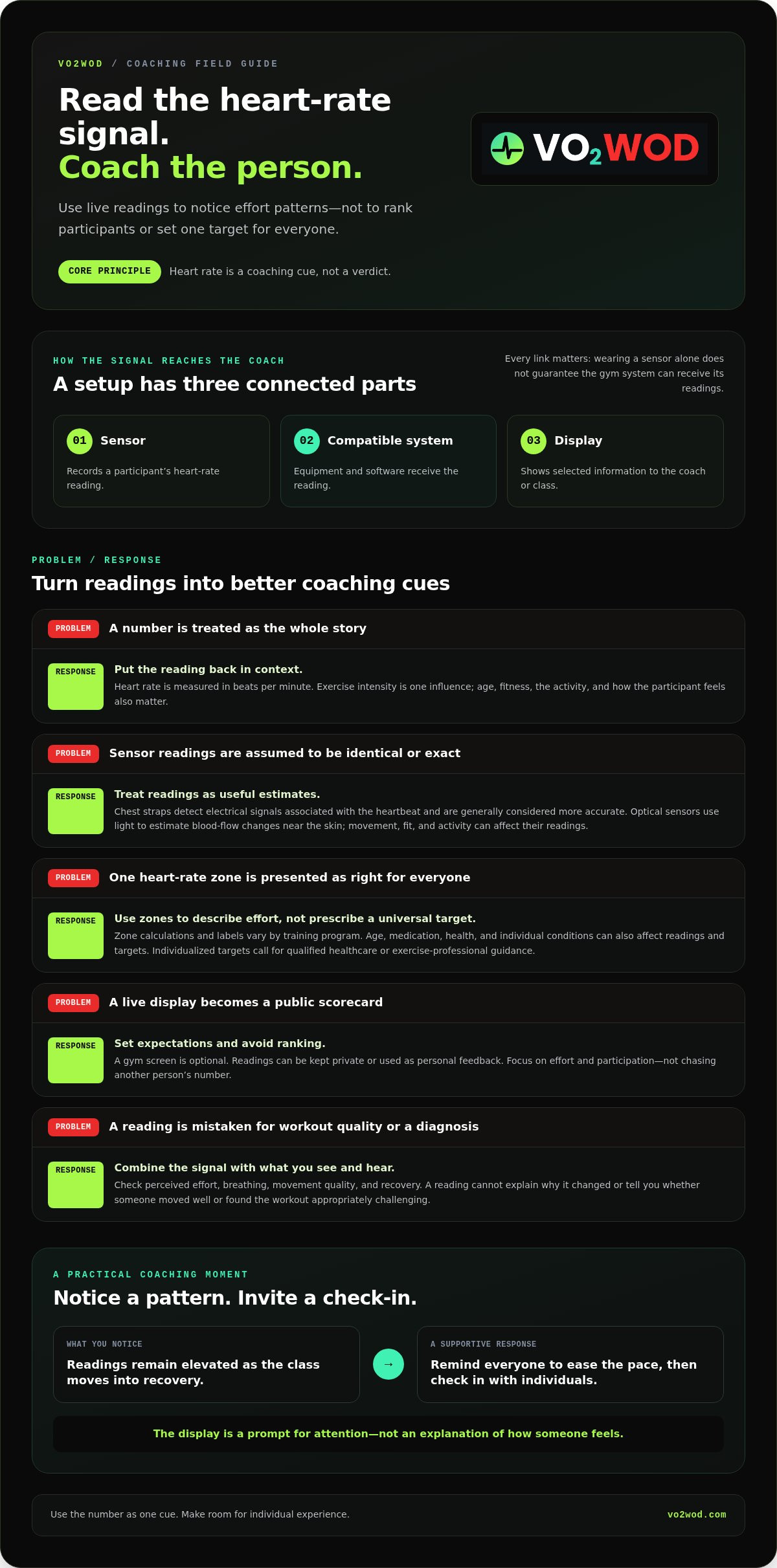
Occasional visual checks give you snapshots. A shared overview can help reveal how effort shifts through repeated work and recovery intervals. For example, if readings remain elevated as the class moves into recovery, you might remind everyone to ease the pace, then check in with individuals rather than assume the same cause for each person. The display is a prompt for attention, not a diagnosis.
Use visible data to guide supportive coaching, not public ranking. A zone or number shouldn’t become a scorecard, and participants shouldn’t feel pressured to chase someone else’s reading. Simple questions such as “How does that pace feel?” connect the display with each person’s experience. That keeps the class focused on effort and participation rather than comparison.
Who benefits from seeing effort data
For a coach managing several participants, a class-wide view can make changes in effort easier to notice without replacing observation. A reading may prompt you to offer a modification, encourage recovery, or ask whether someone feels comfortable continuing. It can’t explain why a participant’s number has changed, so combine it with what you see and hear.
Participants can treat their readings as one feedback point alongside breathing, perceived exertion, and how the movement feels. This can be useful for people with different training experience, abilities, and comfort with intensity. One person may be learning to pace intervals; another may be adapting a movement or building consistency. Neither needs to match a shared target to belong in the class. Responsive coaching uses data to open a conversation, then leaves room for individual judgment.
How group heart rate monitoring works: sensors, zones, and live displays
A group monitoring setup has three parts: a sensor records a participant’s heart-rate reading, compatible equipment and software receive it, and a display shows selected information to the coach or class. Each link in that chain matters. A sensor can collect readings without sending them to the system a gym uses, and a display can only show the data it receives. Group fitness heart rate monitoring therefore depends on compatible equipment, not just wearing a sensor.
What sensors and live displays do
Chest straps detect electrical signals associated with the heartbeat, while optical sensors use light to estimate changes in blood flow near the skin. Chest straps are generally considered more accurate, while optical readings can be affected by movement, fit, and activity. Neither sensor type produces identical readings across all devices or people. Treat readings as useful estimates, and avoid interpreting a sudden change without considering the exercise and how the participant feels.
Once readings reach a compatible system, a coach may view individual values, zones, or a class-wide display. A gym screen is one option, not a requirement. Some coaches may prefer to keep readings private or use them as personal feedback rather than project them for the room. Polar’s How Group Heart Rate Monitoring Works in Practice describes one example of a system presenting live class data. The setup and information shown depend on the equipment and software in use.
Heart rate reflects the body’s physiological response to exercise, not workout quality on its own. A reading can provide context, but it can’t tell you whether someone moved well, followed the intended pacing, or found a workout appropriately challenging.
How to interpret heart-rate zones without overclaiming
Heart-rate zones are ranges used to describe relative exercise intensity. The calculations and labels vary by training program, so a zone shown on one system may not match another system’s framework. Zones can help a coach describe a session’s intended effort, but they aren’t universal targets for every participant. Avoid presenting one range as the right answer for a whole class.
Readings and targets may also be affected by age, medication, health, and individual conditions. If a participant needs an individualized heart-rate target, encourage them to seek guidance from a qualified healthcare or exercise professional. In class, make room for other cues, including perceived effort, breathing, movement quality, and recovery. If the number conflicts with what a participant reports, don’t dismiss their experience to preserve a zone goal.
Coaches who want to keep workout performance information organized separately from sensor readings can explore VO2WOD’s performance-tracking tools. Its Live Athlete Performance Dashboard and automated workout scoring support performance data workflows. They complement in-class coaching but are not heart-rate monitoring tools.
Heart rate, RPE, or workout scores: what should guide group coaching?
Each measure answers a different question. Heart rate shows a physiological response. Rating of perceived exertion, or RPE, captures how hard the participant feels they’re working. A workout score records an outcome defined by the workout, such as completed work or time. None tells the whole story, and the highest heart rate doesn’t automatically mean the best performance.
For group fitness heart rate monitoring to support good coaching, choose the measure that fits the session’s goal. Use heart rate to observe response, RPE to hear the participant’s perspective, and the workout score to understand the programmed result. Bring them together rather than looking for one universal winner.
Heart rate and perceived exertion answer different questions
A heart-rate reading reflects the body’s response to activity; RPE is a participant’s own assessment of effort. The two can align, but they don’t have to. During intervals, heart rate may continue rising after a participant has eased their pace. In strength work, brief efforts and rests may make a heart-rate reading a poor summary of how challenging the session feels.
Ask a simple check-in: “How hard does this feel right now?” A participant might report high effort while their displayed reading seems modest, or feel comfortable despite a higher number. Neither account is automatically wrong. The difference gives you context to ask a better question, offer a pacing cue, or discuss a modification. It isn’t a reason to dismiss what the participant says.
Workout scores add performance context
A workout score captures performance according to the workout’s scoring method. It isn’t a heart-rate measurement, a direct measure of effort, or a complete evaluation of the person. For example, a participant could achieve the intended workout result while reporting that the effort felt demanding; their heart-rate pattern might tell a different part of the session’s story. The score describes the outcome, while RPE and heart rate offer separate context.
That distinction matters during recovery, too. A score may reflect completed work, while a participant’s perceived effort helps you understand how sustainable it felt. A heart-rate reading may show a changing physiological response, but it doesn’t explain whether someone is ready for another interval. For broader context on how performance information fits into gym operations, explore live athlete performance metrics.
Before class, decide what you want to learn. For a pacing-focused interval session, heart rate and RPE may help you discuss effort and recovery. For a workout scored on completed work, the score can show the result, while RPE adds perspective. In strength sessions, prioritize movement quality and participant feedback over chasing a heart-rate target. The best coaching picture uses measures that suit the task, interpreted with the person in front of you.
How to run a group fitness heart rate monitoring session
A smooth session starts before anyone begins moving. Decide what you want the readings to help you notice, make display choices clear, and prepare a simple plan for responding to what you see. Group fitness heart rate monitoring should make coaching more attentive, not make participants feel watched or obliged to hit a number.
A responsible monitoring session has five stages: explain the purpose, prepare the equipment, check the display, coach from useful patterns, and review what you learned.
- Explain the purpose. Tell the class what readings may be shown, who can see them, and how you’ll use them to guide coaching. Clarify that the numbers aren’t a health assessment or a measure of personal worth.
- Prepare the equipment. Give participants time to set up their sensors according to the equipment instructions. Make participation voluntary, and explain how someone can take part without sharing a reading publicly.
- Check the display. Before class, confirm that the intended information appears and that the display is set up as planned. If readings are missing or unclear, coach without relying on them.
- Coach from patterns. Use changes during work and recovery periods to guide prompts and check-ins. Keep the workout plan, movement, and participants’ feedback in view.
- Review the session. After class, consider whether the readings helped you make a useful coaching decision. Keep the review focused on learning, not comparing participants.
Prepare the class and set expectations
Be specific and calm. For instance, tell participants whether the screen will show a group overview or individual readings, and who will be able to see it. Offer a private or no-display option where the system allows it; opting out of a public display shouldn’t mean opting out of coaching. Set display rules in advance, showing only what supports the session goal and avoiding personal details that add noise.
Before the warm-up, check that the display is ready and the equipment is functioning as intended. Build in time for setup rather than troubleshooting once the workout is underway. If the system doesn’t show useful readings, don’t let the screen take over the class. Coach using your plan, observation, and participant feedback instead.
Coach from patterns, then review the session
During class, treat readings as prompts for attention, not medical judgments. If a pattern differs from what you expected, check in with the participant and consider the work interval, recovery, and their reported effort. Don’t assume a number explains how someone feels, and don’t make public comparisons part of the coaching.
Afterward, note what the data helped clarify. Perhaps a recovery cue landed well, or the display didn’t add much to a strength-focused session. Use that observation to refine the next class. To organize gym performance information beyond the live session, explore VO2WOD’s gym management platform, which includes performance tracking and workout scoring as complementary tools.
Connect group heart rate monitoring with a calmer performance-data workflow
A class can generate several kinds of useful information, but they don’t all belong in the same bucket. Sensor readings describe heart-rate response during activity. Workout scores record results according to the programmed scoring method. Member management supports the day-to-day running of the gym. Treating these as distinct functions helps coaches use each for its purpose instead of searching through scattered notes after class.
Group fitness heart rate monitoring can give you an in-the-moment view of effort patterns. After the session, organized workout records can help you revisit what participants completed and follow performance over time. The two views can complement each other, but one should not be mistaken for the other: a workout result doesn’t contain heart-rate data, and a heart-rate reading doesn’t explain a workout score.
Where VO2WOD fits in a gym’s performance workflow
VO2WOD’s Live Athlete Performance Dashboard gives coaches a real-time view of athlete performance. Automated workout scoring helps centralize workout results, while the Vo2hub is another part of the platform’s performance-tracking offering. These tools support broader gym performance records. They don’t provide heart-rate readings or replace the equipment and systems used for sensor monitoring.
A coach might use a live class view to support decisions in the room, then revisit workout results later to understand what participants completed. Keeping these activities distinct can make it easier to find the right information at the right time. Organized performance data can help coaches avoid piecing together results from separate notes and create a clearer routine for reviewing class outcomes and member progress.
Make the next step manageable for your gym
Before adding another data process, take stock of the one you already have. Consider how coaches currently record scores, where those results are stored, and what they want to review after class. A workflow review can reveal whether the friction comes from collecting information, finding it later, or managing several systems at once.
Then decide what role each type of information should play. Keep heart-rate observations within the monitoring process used during class. Keep workout results in the scoring workflow. Use member-management tools for gym operations. Clear boundaries make records easier to interpret and help prevent a coaching cue from becoming a misleading performance judgment.
If you’re exploring ways to bring gym operations and performance tracking into a more organized workflow, explore functional fitness gym software. VO2WOD brings together gym management, performance tracking, workout scoring, and the Vo2hub. Explore the VO2WOD platform to see how these tools can support a more orderly way to manage your gym’s performance information.
Make your next coaching decision clearer
The next step doesn’t have to be a bigger screen or more data. Choose one coaching question you want group fitness heart rate monitoring to help you explore, then decide how you’ll respond to what you observe. A clear purpose keeps the process grounded in the class and leaves room for each participant’s experience.
From there, consider how you’ll keep workout results and other performance records easy to revisit. VO2WOD’s Live Athlete Performance Dashboard provides real-time athlete performance visibility, while automated workout scoring and Vo2hub support broader performance tracking. These tools complement a gym’s workflow; they don’t display or integrate heart-rate readings.
A thoughtful data workflow can help you spend less time piecing together information and more time applying what you learn to future coaching. Start by reviewing how your gym currently tracks performance, then identify what would make that process clearer for your team.
Ready to bring more clarity to gym performance tracking? Explore the VO2WOD platform to see how its gym management and performance-tracking tools can support a more organized workflow.
Frequently Asked Questions
Is heart rate monitoring useful in group fitness classes?
Yes, group fitness heart rate monitoring can help a coach notice when class effort shifts and decide when to check in. For example, during a circuit with stations at different paces, a group view may highlight a change that’s easy to miss while coaching one movement. Use it as an extra observation, not a verdict on effort or fitness. Its value comes from pairing the reading with the workout plan and participant feedback.
Can you monitor multiple people’s heart rates during a group workout?
Yes, a group tracking setup can receive readings from multiple participants and present selected information through compatible equipment and software. Each person typically needs a supported sensor, and the system needs to receive and display its readings. Before class, test the setup with the expected number of participants and decide what the coach needs to see. If a reading doesn’t appear, continue coaching without assuming the participant is doing anything wrong.
How accurate are heart rate monitors during group fitness?
Accuracy depends on the sensor, fit, activity, and individual. Chest straps measure electrical signals from the heartbeat and are generally considered a reliable option for exercise readings. Optical sensors estimate heart rate using light and can be less dependable during vigorous movement, especially when the arm is moving a lot. Treat a sudden or unexpected value cautiously. Check the participant’s comfort and sensor placement rather than making a coaching decision from one number.
What is the difference between heart rate and RPE in a group workout?
Heart rate is a measured physiological response; rating of perceived exertion, or RPE, is how hard an individual says the activity feels. The two can offer different clues. For example, a participant may report that a familiar workout feels unusually difficult even if their reading looks typical for them. Ask about perceived effort instead of assuming the screen captures the whole experience. Neither measure alone describes workout quality or readiness.
Do heart rate zones work the same way for everyone?
No. Zone ranges and the methods used to set them differ, and a shared zone color doesn’t mean every participant is experiencing the same effort. Age, medication, health conditions, and individual responses can affect heart-rate readings. Avoid treating a class-wide zone as a personal prescription. If someone needs an individualized target, they should seek guidance from a qualified healthcare or exercise professional rather than relying on a general group display.
Can a coach use heart rate monitoring to prevent overtraining?
Heart-rate monitoring alone can’t prevent overtraining or determine whether someone is medically safe to continue. It may provide one clue to discuss alongside training load, recovery, performance, and how the participant feels over time. If someone reports unusual symptoms or feels unwell, don’t use a reassuring-looking reading to dismiss that concern. Pause the workout as appropriate and encourage them to seek qualified medical guidance for health questions.
Should group heart rate data be shown on a gym screen?
Only if the display serves a clear coaching purpose and participants understand what will be visible. A coach might show broad class patterns while keeping individual values private, or choose not to use a public screen. Explain display choices before the workout and give participants a way to take part without sharing readings publicly. Avoid leaderboards that turn physiological responses into rankings, and don’t make public display a condition of receiving coaching.


