
What if tracking progress didn’t mean adding another job to a coach’s class? An athlete performance tracking platform should make workout results easier to use, not leave coaches sorting through scattered spreadsheets, apps, and handwritten scores. In a busy functional fitness gym, collecting more numbers isn’t the goal. Turning useful information into better coaching conversations is.
If member workout histories live in several places and coaches have little time to interpret them between classes, you’re not alone. A practical system brings performance information into a workflow coaches can use and helps members stay engaged with their progress and the gym community.
This guide shows you how to evaluate platforms for your gym, coaches, and members. You’ll learn which tracking capabilities matter, how to weigh ease of use against a growing list of metrics, and how to assess fit with daily gym operations. We’ll also look at how VO2WOD brings together live athlete performance visualization, automated workout scoring, and gym management, with data migration support for the transition.
Key Takeaways
- Bring workout scores, training notes, and progress into a clear workflow so coaches can find useful information without chasing scattered records.
- Separate workout results, progress context, and readiness information to keep coaching conversations focused.
- Compare an athlete performance tracking platform by workflow fit, scoring, coach visibility, member access, and operational integration, not by feature count alone.
- Define a coaching need first, then test the platform with a representative class before expanding its use across the gym.
- Consider how live performance visualization and automated workout scoring can fit within a wider gym operations platform.
What an Athlete Performance Tracking Platform Does for a Functional Fitness Gym
Scores go on the whiteboard, training notes in a coach’s notebook, and member progress in spreadsheets or separate apps. In a functional fitness gym, each record may tell part of the story, but piecing them together takes time and makes it harder to review an athlete’s training consistently.
An athlete performance tracking platform is software that captures, organizes, and presents workout information so coaches, athletes, and gym owners can use it during training and facility operations. It can structure workout scores, make results easier to review, or display performance as a class works through a session. The aim isn’t to collect every possible metric. It’s to make relevant information easier to find and use.
A concise definition: An athlete performance tracking platform helps gym coaches, members, and owners record and review workout data to support coaching decisions, personal progress, and consistent gym workflows.
It differs from tools that may contribute to an athlete’s record. Wearable devices are hardware that can collect information such as movement or physical responses; this overview of wearable technology in athlete tracking explains the broader category. A standalone personal training app is generally organized around an individual’s workouts. Gym performance tracking software focuses on making athlete and class performance information useful within a facility’s coaching and operating routines. These categories can overlap, but they serve different roles.
How athlete tracking fits into a functional fitness class
A class workout produces a result worth revisiting: a time, load, repetition count, or another score relevant to the session. Recording it answers, “What happened today?” It doesn’t automatically answer, “What does this mean for the athlete?” Interpretation takes context, including earlier results, the workout’s demands, and what the coach observed. A tracking workflow keeps the record accessible, so coaches can compare results and ask useful follow-up questions instead of relying on memory alone.
That distinction matters in everyday classes. A faster time may reflect progress, a different strategy, or a change in conditions. The platform can organize the result; the coach brings judgment to the conversation. Tracking should support attention in the room, not compete with it.
Who uses the platform and what each person needs
Each person needs a different view of the same training history. Coaches need performance information they can review without losing focus on the class. Athletes want a clearer picture of effort and progress over time, not a score without context. Owners need a consistent system that fits facility operations and supports reliable record-keeping across coaches and members.
When these needs meet in a practical workflow, scores become easier to revisit, discuss, and learn from. That’s the foundation: shared information that supports coaching and community without turning every workout into a data-entry exercise.
Which Performance Data Helps Coaches Make Better Training Decisions?
More data can mean more to sort through, not more insight. Start with the coaching question: What do we need to understand about this workout, this athlete’s progress, or their readiness to train today? If a metric won’t help answer a real question or guide a conversation, collecting it may add noise without value.
Useful performance data is relevant to a coaching question, consistent enough to compare, and actionable in the gym. That doesn’t mean every athlete needs the same measures. Choose information that fits the workout, the member, and the decisions coaches actually make.
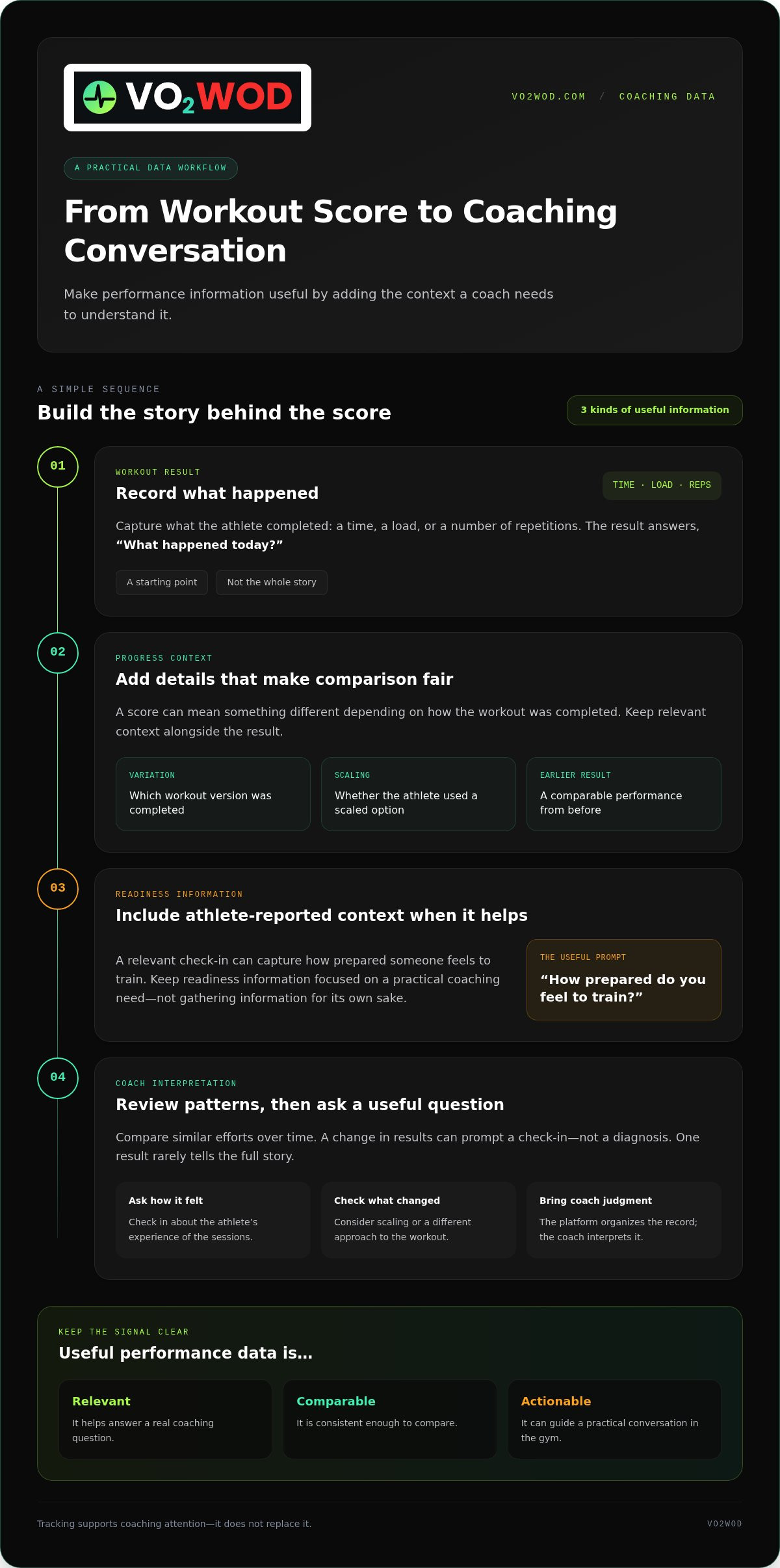
It can help to think in three categories:
- Workout results: What the athlete completed, such as a time, load, or number of repetitions.
- Progress context: Details that make a result easier to interpret, such as a workout variation, scaling choice, or comparable earlier performance.
- Readiness information: Relevant athlete-reported context, such as how prepared someone feels to train. Keep this focused on a practical coaching need rather than gathering information for its own sake.
Start with workout results and meaningful context
A score is a starting point, not the whole story. A recorded time may mean something different if one athlete completed the prescribed version and another used a scaled version. Keeping the relevant variation or scaling context alongside the result helps a coach make a fair comparison. It also gives the athlete a more useful record than a number on its own.
There’s no universal set of metrics for every class or athlete. Start with the results your coaches already use, then add context only when it helps them understand what changed or what to ask next.
Turn a visible result into a coaching conversation
A pattern can prompt a check-in, not a diagnosis. If an athlete’s results shift across similar workouts, a coach might ask how the sessions felt, whether the workout was scaled, or what changed in their approach. One result rarely tells the full story. Reviewing comparable efforts over time can reveal a pattern worth discussing without overreacting to a single day.
Tracking supports a coach’s judgment; it doesn’t replace it or guarantee a particular performance outcome. The athlete’s experience and the coach’s observations still matter. A platform is most useful when it grounds those conversations in shared information.
For gyms considering how tracking can fit into daily operations, VO2WOD’s gym-focused platform connects performance tools with broader facility workflows.
How to Compare Athlete Performance Tracking Platforms Without Chasing More Features
A longer feature list doesn’t guarantee better coaching. If scores take too many steps to enter, coaches can’t quickly see useful results, or members don’t know how to revisit their history, added capabilities may create more work than value. Compare platforms by how well they support your gym’s routines, not by how much data they promise to collect.
Start by mapping a normal training week. How are scores recorded? How do coaches review them between classes? How do members access results? Use those everyday tasks to assess workflow fit, scoring, coach visibility, member access, and operational integration.
| Comparison area | What to assess | A useful sign of fit |
|---|---|---|
| Workflow fit | How results are recorded during and after group classes | The process fits the class routine without adding avoidable steps |
| Scoring | How workout scores and relevant variations are captured | Records are clear enough to review and compare in context |
| Coach visibility | How coaches view performance information during training | Useful results are easy to see without pulling attention from the class |
| Member access | How athletes revisit their workout history | Members can engage with results in a way that supports progress conversations |
| Operational integration | How tracking fits with wider gym processes | The platform reduces disconnected tasks rather than adding another silo |
Evaluate fit for classes, coaches, and members
A group class moves at its own pace: coaches brief the workout, guide athletes through it, and manage the transition into the next session. A platform should fit that rhythm. Consider who enters results, when they do it, and how a coach can find the information later. A workflow that looks simple in a demo still needs to feel manageable during an ordinary training week.
Member access matters too. Results should be understandable enough to support an athlete’s reflection and a coach’s follow-up. For broader selection criteria, this guide to functional fitness gym software offers context for evaluating tools against facility needs.
Compare tracking tools with an integrated gym platform
Different categories solve different problems. Wearable-centered monitoring focuses on information gathered through devices. Workout-score tracking centers on recording and reviewing session results. A broader gym platform brings performance tools into a wider facility workflow. None is automatically the right choice for every gym.
Consider the trade-off. A specialist monitoring tool may suit a gym with a clear need for device-based data. A score-focused system may fit a facility that mainly wants consistent workout records. An integrated platform may be more practical if the goal is to connect performance tracking with gym operations. An athlete performance tracking platform earns its place when its scoring, visibility, and connected workflows address needs your coaches and members actually have. Choose the setup that solves your current friction, not the one with the longest feature list.
How to Evaluate and Introduce a Performance Tracking Platform in Your Gym
A platform can look straightforward in a presentation and feel very different during a packed class. Judge fit by testing the real workflow with the people who’ll use it and the training routine it needs to support. Keep the evaluation focused: look for a practical improvement, not a perfect set of features.
- Define the coaching need. Write down the current point of friction. Are scores hard to record consistently? Do coaches struggle to review past results? Do members have trouble following their training history? Identify who is affected, then describe what a better day-to-day process would look like. This gives your evaluation a clear purpose.
- Choose a representative class. Select a session that reflects your usual class flow, including how athletes enter results and how coaches oversee the workout. Avoid testing only an unusually quiet or simple session. A realistic class reveals whether the platform fits your gym’s pace and whether recording scores distracts from coaching.
- Follow one result through the whole workflow. Test the process from entering a workout result to coach review and member access. Notice where people pause, need help, or repeat work. Check whether the result can be understood in the context coaches need, such as the workout variation. A smooth workflow makes the next step clear to each user.
- Gather feedback and set a few measures. Ask participating coaches and members what felt clear and what added friction. Keep success measures simple: Are scores being recorded consistently? Can coaches use the system without losing attention to the class? Can members find and understand their results? These checks help you decide whether to adjust the workflow or extend the test.
- Plan the rollout and assign ownership. Map existing performance records, then decide what information is useful to carry forward. Set a manageable starting point, such as introducing the workflow to one class before expanding it. Clarify who handles setup, who supports consistent scoring, and who reviews how the process is working. A named owner keeps small issues from becoming everyone’s problem.
Transitions need care. Rather than moving every old record and changing every routine at once, prioritize the history that will help coaches and members understand future results. If you’re changing broader facility systems at the same time, use this gym management software switching checklist to plan the move in an orderly way.
A considered rollout gives an athlete performance tracking platform room to become part of the gym’s routine. VO2WOD includes data migration support to help gyms transition from legacy systems, alongside automated workout scoring. Explore VO2WOD’s platform for functional fitness gyms as you consider a tracking workflow that fits your facility.
How VO2WOD Connects Athlete Performance Tracking With Gym Operations
Performance tracking works best when it fits the way a gym runs, rather than sitting apart as another task to manage. VO2WOD is a subscription platform for functional fitness facilities that brings performance tools into a broader gym operations offering. Alongside gym management and automated payments, the platform includes a Live Athlete Performance Dashboard, automated workout scoring, and Vo2hub.
Collecting a workout result is only one part of the routine. Coaches need a practical way to view performance, while the gym needs tools that fit day-to-day facility workflows. Bringing these capabilities together can reduce the friction of switching between disconnected systems. For a wider look at organizing information across gym operations, explore centralized gym data platforms.
Bring scoring and live performance visibility together
Automated workout scoring supports the process of recording member performance. During a workout, the Live Athlete Performance Dashboard gives coaches real-time visualization of athlete performance. This makes it possible to see what’s happening in the session, rather than relying only on a later review of scores.
Display is not interpretation. A dashboard presents performance information, but coaches still apply their knowledge of the athlete, workout, and class to decide what it means. The tool supports attention and review; it doesn’t replace coaching judgment. Automated scoring and Vo2hub are also part of the platform, bringing performance tracking tools into the broader facility offering.
Make a platform transition feel more manageable
Moving from legacy systems can feel like a heavy lift, especially when performance information and gym workflows are spread across different places. VO2WOD provides data migration support to help gyms transition from legacy systems. This helps owners account for existing records while bringing performance tracking and gym operations into one subscription.
Before making a change, consider how the tools will fit together in practice: how workout scores are recorded, how coaches view live performance, and how gym management supports the facility’s wider routine. A gym-focused athlete performance tracking platform should make those connections more straightforward, while leaving coaches room to interpret information and guide members.
VO2WOD brings together live performance visualization, automated workout scoring, Vo2hub, gym management, and automated payments. Explore the VO2WOD platform to connect athlete tracking with your facility’s operations.
Make Your Next Tracking Step Practical
Your next move doesn’t have to be a full-system overhaul. Choose one coaching need, involve the people who’ll use the system, and look for a workflow that makes their week simpler. That’s how an athlete performance tracking platform becomes part of the gym’s routine instead of another tool competing for attention.
For gyms looking to connect workout tracking with facility operations, VO2WOD brings performance tools into a gym-focused platform. Its Live Athlete Performance Dashboard visualizes athlete performance for coaches during workouts, and the platform includes Vo2hub and automated workout scoring.
Let your coaches’ experience in real classes guide the next step. With a clear purpose and a manageable rollout, performance information can support grounded coaching conversations and help members stay connected to their training.
Explore the VO2WOD platform to take a practical step toward a more connected gym workflow.
Frequently Asked Questions
Can a gym track athlete performance without wearable devices?
Yes. Coaches can record workout outcomes without wearable hardware. A gym might track an athlete’s completed load, repetitions, or time, then add a short self-reported effort score if that helps guide a conversation. Start with information athletes and coaches can record consistently. Wearables may provide additional inputs, but they aren’t a prerequisite for building a useful training history or discussing how a session went.
How often should coaches review athlete performance data?
Review it often enough to support the decisions coaches need to make, without turning every score into a lengthy analysis. A coach might check relevant results around a class to answer an immediate question, then set aside regular time to look for patterns across sessions. The right rhythm depends on the gym’s schedule and coaching approach. A simple recurring routine is easier to maintain than constant monitoring.
Does an athlete performance tracking platform prevent injuries?
No. Tracking software can organize information, but it can’t guarantee injury prevention or diagnose what’s causing discomfort. If an athlete reports pain or a marked change in how training feels, treat that as a reason for a human check-in, not as a conclusion drawn from a score. Coaches can use records as one source of context, alongside the athlete’s account and appropriate professional guidance.
Is athlete performance tracking useful for recreational athletes?
Yes. Recreational athletes can use tracking to stay connected to personal goals, such as completing a workout with a chosen load or building consistency in class attendance. The value isn’t comparing every member against a high-performance standard. It’s helping each person notice information that matters to their own training. Keep the focus on individual goals and encouraging conversations, so tracking feels supportive rather than like a test.
Can one platform combine performance tracking with gym management?
Yes. Some platforms bring workout tracking and facility administration together rather than leaving a gym to coordinate separate tools. VO2WOD provides a gym management and performance tracking platform for functional fitness facilities. When comparing options, map the tasks coaches and owners need to handle, then consider whether a shared system could simplify those routines. An integrated platform is useful when its connected workflows fit how the gym operates.
How can a gym keep athlete performance data private?
Make privacy part of the gym’s everyday process. Explain to members what performance information is recorded and how it supports coaching. Limit access to people who need the information for their role, avoid displaying personal details publicly without permission, and handle exported records carefully. As part of platform selection, consider the privacy information and access controls available. Clear expectations help members feel respected and make responsible data use easier to maintain.


