
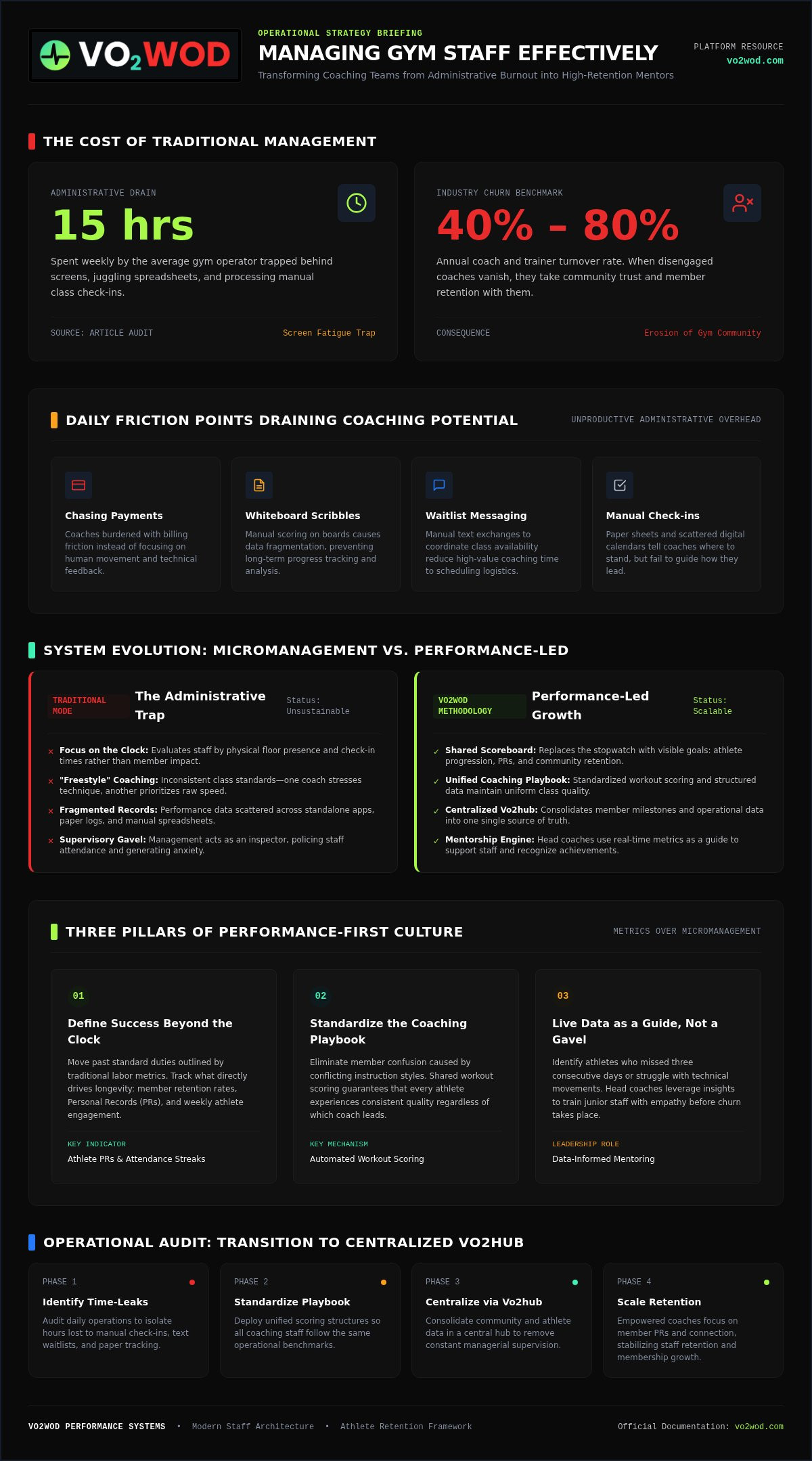
Did you know that the average gym operator spends up to 15 hours every week trapped behind a screen, juggling spreadsheets and manual class check-ins? It is a heavy, invisible weight that pulls you away from the floor and turns visionary leaders into tired desk managers. You didn't start this journey to police clock-ins or fix scheduling fires. You started it to build a thriving community. Managing gym staff effectively should feel like a natural extension of your mission, not a source of constant friction.
We understand the exhaustion that comes with high coach turnover and inconsistent class experiences. It feels like you're constantly rebuilding from scratch. This article promises to help you shed that administrative burden. You'll learn how to transform your coaching team into a data-driven powerhouse that fuels athlete retention and long-term growth. We're moving past the era of micromanagement. We're stepping into a future where automated systems and performance metrics provide the clarity you need to lead with confidence and reclaim your time for strategic growth.
Key Takeaways
- Learn why traditional management creates a burnout trap and how to break the cycle by shifting focus from administration to coaching.
- Discover how managing gym staff effectively means replacing micromanagement with a shared scoreboard centered on athlete progress and community results.
- Identify the common time-leaks in your business and see how automated workout scoring can restore hours to your coaching team's week.
- Follow a practical audit to standardize your coaching playbook and eliminate the daily friction of manual data entry.
- Explore how centralizing your community data through the Vo2hub empowers your coaches to drive higher member retention without constant supervision.
The Coaching Burnout Trap: Why Traditional Gym Management Fails
The "Coaching Burnout Trap" is a heavy reality in high-intensity functional fitness. It starts when your best coaches, the ones who live for the community, become buried under a mountain of manual tasks. They are chasing payments. They are scribbling scores on whiteboards. They are texting members about waitlists. Eventually, the weight becomes too much. This leads to occupational burnout, where the passion for movement is replaced by administrative fatigue. Managing gym staff effectively requires more than a digital calendar; it requires a system that empowers their art.
Many owners think a basic scheduling app is the solution. It isn't. Scheduling software tells a coach where to stand, but it doesn't tell them how to lead. When a coach feels like a cog in a machine rather than a mentor, they disengage. This disengagement is expensive. With annual trainer turnover rates ranging between 40% and 80%, the cost of replacing staff is a constant drain on your resources. Every time a coach leaves, a piece of your gym's soul goes with them. Members bond with their instructors, and when those instructors vanish, member retention often follows.
Effective management is the transition from supervising to mentoring. Instead of checking if a coach arrived on time, you should be looking at how they are helping your athletes progress. It is about creating a space where coaches feel supported, not watched. When you remove the friction of manual tracking, you give your team the breathing room to do what they do best: change lives.
The Disconnect Between Admin and Art
Coaches are artists of human movement. They hate administrative paperwork because it feels like a barrier between them and their athletes. When data is fragmented across different apps or paper logs, a coach can't provide the personalized feedback that keeps members coming back. They lose the ability to see the small wins that drive long-term commitment. Performance-Led Management is the deliberate choice to strip away administrative weight so coaches can focus entirely on athlete results and community connection.
Identifying Inconsistency in the Class Experience
Without a centralized system, you often get "freestyle" coaching. One coach focuses on strict technique; another just wants the class to go fast. This inconsistency confuses members and dilutes your brand. Standardized scoring and shared workout data create a unified playbook for your team. It ensures every member gets the same high-quality experience, regardless of who is holding the stopwatch. By using member feedback loops and performance data, you can identify staff training gaps early. This allows you to address issues with empathy and clarity before they turn into larger problems.
Building a Performance-First Culture: Metrics Over Micromanagement
Micromanagement is a heavy burden. It creates friction between you and your team. When you manage by the clock, you treat your coaches like hourly workers instead of community leaders. Managing gym staff effectively means trading the stopwatch for a scoreboard. It is about shifting the focus from "hours on the floor" to the actual impact those hours have on your members. You are moving from a world of oversight to a world of empowerment.
Defining Success Beyond the Clock
Traditional metrics often miss the heart of what makes a gym thrive. While the Bureau of Labor Statistics occupational outlook outlines standard duties and growth for fitness professionals, it doesn't capture the magic of a member's first pull-up or the warmth of a welcoming community. To build a culture that lasts, you need to track what truly matters: member retention, Personal Records (PRs), and athlete engagement.
Using centralized gym data platforms allows you to monitor these wins without hovering. It makes the invisible visible. When a coach sees their impact through data, they feel a sense of ownership. They aren't just running a class; they are winning a game of human progress. This transparency builds buy-in because the goals are objective and shared. It replaces the anxiety of being watched with the pride of being recognized.
The Role of Live Data in Staff Development
Live data acts as a guide, not a gavel. It helps your team identify athletes who need immediate attention. Perhaps a member has missed three days in a row; maybe someone is struggling with a specific movement. This transforms the "head coach" from a supervisor into a mentor. They become a data analyst who uses insights to lift the whole team. It is a transition from policing behavior to empowering excellence.
Encouraging friendly competition among staff based on member participation can turn a routine shift into a mission. It creates a steady, encouraging pulse throughout the facility. By focusing on community growth goals that coaches actually care about, you replace the weight of oversight with the lightness of shared purpose. If you are ready to lead with clarity, you can see how a live performance dashboard simplifies leadership.
Administrative vs. Performance Management: A Comparison
Traditional gym management often feels like wading through thick mud. You are stuck in the "Admin-Heavy" model, where your day is consumed by chasing missed payments, correcting attendance logs, and manually tallying workout scores. It is a reactive way of working. You are putting out fires instead of building a future. Managing gym staff effectively requires a shift toward a "Performance-Led" model. This approach replaces manual friction with automated fluidity. It moves the center of your business from the front desk back to the training floor.
When you automate the heavy lifting of scoring and billing, you create a lighter environment for everyone. Integrated systems allow data to flow seamlessly between the business office and the athlete's experience. This reduces the friction that often exists between administrative staff and coaches. Instead of a disjointed collection of tasks, your gym becomes a unified engine. This model is also built for scale. Whether you have two coaches or twenty, a performance-led framework ensures that every staff member is measured by the same clear, objective standards.
The Efficiency Gap in Gym Operations
Industry benchmarks show that facility operators often spend 10 to 15 hours per week on manual administrative tasks before they switch to automation. That is nearly two full workdays lost to spreadsheets and WhatsApp messages. Manual workout scoring is a primary culprit. It forces coaches to spend their time with a clipboard rather than providing cues to their athletes. Modern gym management software for functional fitness bridges this gap by linking billing directly to athlete performance and PRs. It reduces the "mental load" for your team. When coaches don't have to worry about the logistics of data entry, they can pour all their energy into movement quality and member safety.
Tools of the Trade: What Your Staff Needs to Succeed
To lead effectively, your staff needs tools that feel like a natural extension of their coaching. A mobile-first hub is essential. It allows coaches to manage their classes on the fly, checking waitlists and confirming attendance without leaving the floor. This accessibility keeps them present and engaged with the community. Visual dashboards on gym TVs serve a dual purpose. While members love seeing their names on the board, these displays are actually a vital management tool. They provide a "visual scoreboard" that lets coaches see exactly who is struggling or succeeding in real-time. Finally, integrating payment processing with attendance ensures that your staff is paid accurately and on time. It removes the stress of payroll errors and builds a foundation of trust and professional respect.
How to Implement an Effective Staff Management System
Transitioning to a performance-first model isn't an overnight switch. It's a deliberate journey toward lightness. Managing gym staff effectively requires a structured path that moves from chaos to calm efficiency. You're not just changing software; you're evolving your culture. Follow these steps to build a team that thrives on data and community.
- Step 1: Audit the weight. Identify your time-leaks. Track every minute spent on manual billing or chasing scores. This is where the friction lives.
- Step 2: Standardize the playbook. Use centralized workout data to ensure every coach speaks the same language. This eliminates "freestyle" confusion.
- Step 3: Dashboard mastery. Train your team to use real-time displays. These aren't just for show; they're windows into athlete engagement and class energy.
- Step 4: The Weekly Win. Establish a data review. Celebrate PRs and retention milestones. Address gaps with empathy, not urgency.
- Step 5: Automate the mundane. Let the system handle billing and scoring. Protect your coaches' energy for the floor where it belongs.
Onboarding Coaches for Long-Term Success
A new coach shouldn't feel thrown into the deep end. Use a 30-60-90 day plan to ground them in your data-driven culture. In the first 30 days, focus on shadowing combined with dashboard metrics. Let them see how performance data informs coaching cues in real-time. By day 60, they should be leading segments while you assess their readiness through athlete engagement trends. Data literacy is the essential modern skill that allows fitness professionals to translate cold numbers into warm, human encouragement. By day 90, they should be fully integrated, using the hub to manage their community with ease.
Continuous Feedback Loops
The annual review is a relic of the past. It's too slow and too heavy. Modern leadership thrives on real-time, constructive feedback. Use athlete performance trends to validate how well a coach's programming is landing. If PRs are climbing, celebrate that success immediately. Empower your team to lead community challenges using automated scoring tools. This gives them a sense of advocacy and ownership over member results. When you replace the friction of manual oversight with the fluidity of live data, you create a space where everyone wins. You can start building your performance-first team today.
Leveraging VO2WOD to Centralize Staff Accountability
Managing gym staff effectively requires a central point of truth. It needs a space where performance data and community connection intersect. VO2WOD provides this through a unified platform that replaces fragmented chaos with calm efficiency. By centralizing every workout, payment, and performance metric, you give your team the shelter they need to lead without distraction. It is the transition from a scattered, manual way of working to a unified, automated future.
The VO2WOD Platform Subscription is more than just a tool; it is the remedy for gym owner burnout. It automates the "boring stuff" that drains your team's energy. When you remove the weight of administrative minutiae, you allow your coaches to show up fully for their athletes. This isn't just about efficiency. It's about creating a professional environment where everyone knows exactly how to win.
The Visual Scoreboard for Coaching Excellence
The Live Athlete Performance Dashboard is the heart of this framework. It acts as a visual scoreboard that keeps coaches active and engaged throughout the entire hour. When real-time scores and biofeedback are visible to everyone, the data doesn't lie, but it always supports the athlete. This transparency creates a culture of excellence. It ensures a unified coaching voice across all time slots. Whether it's the first class at sunrise or the final evening rush, the standard remains the same. Coaches are empowered by data to intervene exactly when needed, turning a routine workout into a high-level coaching experience.
Seamless Transitions and Administrative Peace
Administrative peace is found in the Vo2hub. This central nervous system of your gym makes it easy for staff to stay connected to member progress and community milestones. Automated workout scoring removes the friction that often exists between coaches and members during busy sessions. No more whiteboards. No more manual entry errors. The movement of data is fluid and silent, allowing the human element of your gym to take center stage.
VO2WOD's administrative tools, including automated payments, ensure the financial health of both your staff and your facility. You can finally lead from the training floor rather than the back office. If you're worried about the weight of switching systems, the Data Migration Service makes it easy to upgrade your management framework overnight. It is a seamless shift toward a lighter, more profitable way of doing business. Discover how VO2WOD can transform your team and your gym.
Reclaim Your Floor and Lead Your Community
Managing gym staff effectively is about more than just filling a schedule. It is about creating a lighter, more fluid environment where coaches are empowered to do their best work. By shifting to a performance-first model, you replace the weight of manual admin with the clarity of real-time data. You have seen how a Live Athlete Performance Dashboard provides immediate accountability. You know how the Vo2hub centralizes engagement. Most importantly, you understand how automated workout scoring reclaims hours of coaching time every week.
These systems aren't just digital tools. They are the foundation of a thriving, data-driven community. They allow you to step away from the desk and back into the heart of your gym. When your team has the right framework, they don't just coach classes; they drive athlete results and gym growth. It is time to leave the burnout trap behind and embrace a future of organized tranquility. You have the vision to lead. Now, you have the system to support it.
Ready to lead a high-performance team? Explore the VO2WOD Platform.
Frequently Asked Questions
How do I deal with a gym coach who resists using new management software?
Listen to their concerns first. Often, resistance comes from a fear of more administrative work. Show them how the platform actually removes weight from their day. Focus on the benefits to their athletes, like real-time feedback and better results. When they see the Live Athlete Performance Dashboard in action, they usually realize it's a tool for coaching excellence, not just a digital chore. This shift turns a skeptic into an advocate.
What are the most important KPIs to track for gym staff performance?
Shift your focus from hours on the floor to member-centric outcomes. The most vital KPIs include member retention rates, class utilization, and the frequency of athlete Personal Records (PRs). Tracking these metrics helps in managing gym staff effectively by highlighting who is truly driving community growth. Use a centralized hub to monitor these wins automatically so you can reward impact rather than just attendance. It's about making leadership objective and fair.
How can I automate gym staff scheduling without losing the personal touch?
Automation should handle the logistics, not the relationships. Use a platform that automates tasks like shift confirmations and waitlist management. This frees up your coaches to spend more time on the floor, where the real human connection happens. When the administrative burden is light, your team has more energy to greet members by name and provide the personalized cues that define your culture. It's about using tech to be more human.
Is it possible to manage a gym team remotely using data dashboards?
Yes, you can lead with confidence from anywhere when you have a visual scoreboard. A live dashboard gives you a window into every class, showing you attendance, athlete performance, and coach engagement in real-time. You don't have to be physically present to see if standards are being met. This transparency allows you to provide constructive feedback based on objective data rather than guesswork. It replaces the anxiety of absence with calm control.
How often should I hold staff meetings in a functional fitness gym?
Aim for a steady, purposeful rhythm rather than long, draining sessions. A monthly deep-dive for strategic alignment is usually enough if you are using real-time data for daily communication. Supplement these with quick, weekly huddles to review the visual scoreboard and celebrate community wins. When data is centralized in the Vo2hub, everyone stays informed without the need for constant, manual updates or excessive meetings. It keeps the energy high and the focus sharp.
What is the best way to prevent coach burnout in a busy CrossFit box?
Burnout often stems from administrative fatigue rather than the coaching itself. To protect your team, automate the heavy tasks like payment processing and workout scoring. This allows coaches to stay in their flow state on the training floor. Managing gym staff effectively means ensuring they don't spend the bulk of their time on admin. A lighter workload outside the class leads to a longer, more vibrant career for your best talent. It protects your most valuable asset.
Can performance data really improve member retention rates?
Data is a powerful tool for building belonging. When a coach uses a performance dashboard to recognize an athlete's progress or notice a dip in attendance, it makes the member feel seen. People stay where they are winning and where they're known. By tracking PRs and engagement automatically, your staff can provide the timely encouragement that keeps members committed to their fitness journey. It's about turning cold numbers into warm, human connections.
How do automated payment systems help with staff management and payroll?
Automated payment systems remove the friction and uncertainty that can damage staff trust. When billing is integrated with attendance and class logs, payroll becomes a seamless, accurate process. It ensures your coaches are paid correctly and on time without the need for manual tallying or endless spreadsheets. This professional reliability builds a foundation of security, allowing your team to focus entirely on athlete results rather than their next paycheck. It's how you create a culture of respect.


