

What if your profit and loss statement felt less like a heavy chore and more like a clear window into your gym’s future? For most owners, gym revenue reporting feels like lifting a maximum load with cold muscles. It’s heavy. It’s fragmented across three different apps and a dozen messy spreadsheets. You started this journey to coach athletes and build a community. You didn’t sign up to drown in manual data entry or wonder which services are actually keeping the lights on.
We understand that the weight of administrative chaos is the fastest way to burn out. You want to focus on the 81 million Americans now seeking fitness spaces, not on reconciling bank statements. This guide will show you how to transition from chaotic paperwork to a streamlined, automated system that protects your time and your bottom line. We’ll explore the essential P&L categories for 2026, highlight new tax advantages like the 100% bonus depreciation, and show you how to turn raw numbers into a performance dashboard that breathes life back into your business.
Key Takeaways
- Learn why a clear P&L is the heartbeat of your gym, turning financial uncertainty into calm confidence.
- Discover how to categorize recurring memberships and retail income to see exactly where your profit lives.
- Compare the hidden cost of manual templates against the speed and accuracy of automated gym revenue reporting.
- Connect your financial data with athlete performance metrics to predict and prevent member churn.
- Trade the heavy weight of fragmented spreadsheets for a unified system that clears your path to growth.
Why Your Gym’s Financial Pulse Starts with a Clear P&L
A gym isn't just a collection of barbells and bumper plates. It's a living organism. If your classes are the muscles, your profit and loss (P&L) account is the heartbeat. It tells you exactly how much oxygen is reaching your business. Without it, you're just guessing. You might feel like you're winning because the 6:00 AM class is full, but your bank account might tell a different story. Proper gym revenue reporting shines a light into the dark corners where money often hides. It reveals the leaks in recurring memberships. It identifies the high-friction tasks that are stealing your time. It moves you from a state of scattered manual mess to organized tranquility.
The Emotional Cost of Financial Chaos
Chaos has a physical weight. It’s the stack of crumpled receipts on your dashboard. It’s the mountain of unread emails from your payment processor. When your data is fragmented across five different apps, you can't lead with vision. You're stuck in the trenches. This administrative clutter doesn't just waste minutes; it drains your creative energy. You can't be a Bold Innovator for your athletes when you're terrified to open your banking app. Transitioning to an automated system brings immediate relief. It replaces the heaviness of manual entry with the lightness of digital clarity. You deserve a workspace that feels like a shelter, not a storm. Moving toward calm efficiency allows you to show up fully for your community.
What a P&L Reveals About Your Community
Your financial data is a story about member commitment. It’s not just cold math. When you look at your P&L, you see which programs truly resonate with your people. Is your specialized Olympic lifting class actually profitable? Or is it a passion project that costs more than it earns? Accurate gym revenue reporting helps you distinguish between popular classes and profitable ones. It allows you to see the movement of effort and the tracking of data in real time.
- Track recurring revenue: See the long-term health of your membership base.
- Analyze retail sales: Discover what supplements or apparel your athletes actually value.
- Justify expansion: Use profit margins to prove you're ready for that new row of air bikes.
Data gives you the permission to grow. It provides the evidence you need to expand your space or hire that next coach. You move from a place of uncertainty to a position of strength. You stop managing by feel. You start leading by fact. This isn't just about accounting; it's about building a sustainable home for your athletes.
Breaking Down the Revenue and Expense Categories That Matter
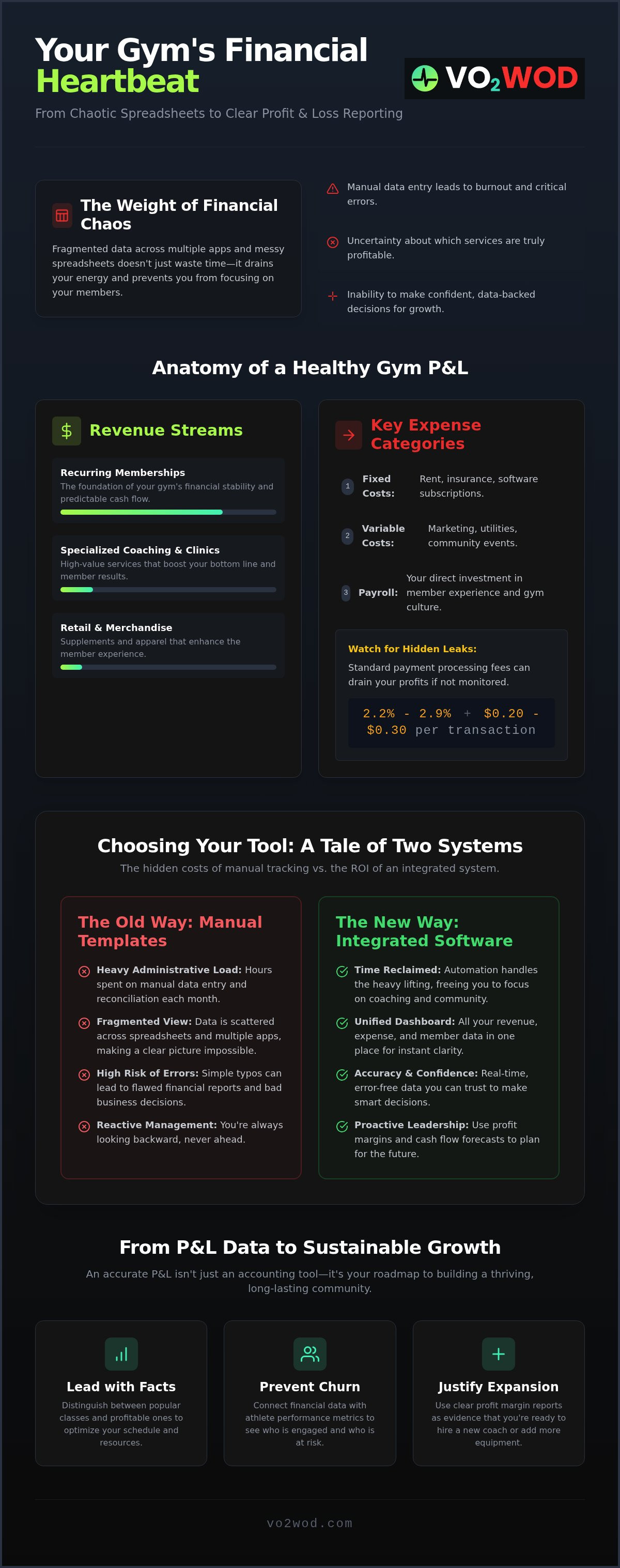
Think of your P&L as the blueprint of your facility. It needs to be organized so you can find what you need without digging through piles of digital debris. Effective gym revenue reporting starts by separating the steady pulse of memberships from the occasional spikes of retail sales. When every dollar has a specific home, the "weight" of your finances begins to feel much lighter. You move from a place of chaotic guessing to a position of organized tranquility.
Revenue: Beyond the Monthly Membership Dues
Recurring memberships are your foundation. They provide the financial shelter your business needs to survive and grow. But don't overlook specialized coaching or one-time clinics. These are high-performance additions that significantly boost your bottom line. Tracking these separately allows for accurate cash flow forecasting. It helps you see if that new yoga track is actually paying for itself. When you use the Vo2hub to centralize workout scoring, you create a tangible record of athlete progress. This data makes it easier to sell premium services. Athletes who see their numbers improve are far more likely to invest in specialized coaching. It turns a simple gym visit into a high-value, measurable experience.
Expenses: Identifying the Friction in Your Budget
Expenses often feel like a heavy friction in your day to day operations. Some are fixed, like your rent, insurance, and software subscriptions. These are the costs of keeping the lights on and the doors open. Others are variable, like marketing or community events. One area where many owners lose money is in the fine print of payment processing. In 2026, standard merchant fees typically range from 2.2% to 2.9% plus a transaction fee of $0.20 to $0.30. These small leaks add up quickly if they aren't monitored. Using automated payment systems helps you track these costs with precision, replacing administrative stress with calm efficiency.
Then there is payroll. Don't view this as a mere drain on resources. It's a direct investment in your gym’s culture. Your coaches are the primary drivers of the athlete experience. By balancing staffing data with class attendance metrics, you can ensure your team is supported without overextending your budget. Finally, remember to plan for one-time expenses. With the 2026 tax year offering 100% bonus depreciation on qualifying equipment under the OBBBA, those new power racks or rowers might be more accessible than you think. Proper planning ensures these upgrades feel like an exciting evolution for your community, not a burden on your wallet.
Choosing Your Tool: Static Templates vs. Integrated Management Software
A free template feels like a gift. It’s a clean spreadsheet with empty cells waiting for your data. But for most gym owners, that "free" file quickly becomes a source of friction. You find yourself spending hours every Sunday migrating data from your payment processor to your sheet. It’s a heavy, manual cycle that pulls you away from your athletes. When you choose your tools, you aren't just choosing a file format. You're choosing how you spend your life. You're deciding between the weight of admin and the lightness of automation.
Static templates are snapshots of the past. They don't reflect the "live" nature of a functional fitness community. If a member cancels on a Tuesday, your spreadsheet doesn't know until you manually update it on Saturday. This delay creates a fog in your gym revenue reporting. You’re always looking in the rearview mirror. Modern gym management software for functional fitness resolves this by creating a bridge between your floor and your finances. It replaces the static sheet with a live, breathing dashboard.
The Hidden Weight of Manual Spreadsheets
Manual data entry is a silent time-thief. Many owners spend upwards of five hours a month just reconciling bank statements and membership lists. This is a heavy administrative burden. Fragmented data lives in silos. Your attendance app doesn't talk to your billing app. Your retail sales are on a different platform entirely. This fragmentation leads to human error. A single typo in a cell can distort your entire profit margin for the quarter. These small mistakes pile up. They create a sense of unease that follows you home. You’re never quite sure if the numbers are true. When your gym revenue reporting is built on a foundation of manual entry, you're building on sand.
The Fluidity of an Integrated Platform
Imagine a digital environment that feels like a tangible, inviting space. An integrated platform offers a Live Athlete Performance Dashboard that feeds directly into your business health. It’s a unified future. When an athlete records a PR, that engagement is tracked. When a payment is processed, it appears instantly on your dashboard. This is the peace of mind that comes with automated workout scoring and billing. You know your profit margin on the first of the month, not the fifteenth. The weight of admin is replaced by the fluidity of real-time data. It’s calm efficiency. You move from the trenches of manual entry to the visionary role of a leader. You finally have the shelter of a system that works as hard as you do.
How to Use Your Financial Data to Drive Athlete Results
Numbers are often treated as cold artifacts of the past. In a functional fitness community, however, your financial data is a proxy for athlete success. When you look at your gym revenue reporting, you aren't just looking at bank balances. You're looking at the pulse of your membership. By connecting your P&L to the gym floor, you can turn abstract figures into actionable coaching strategies. It’s about moving from guessing to knowing. It’s about replacing the weight of uncertainty with the clarity of data.
Start by syncing your attendance data with your membership revenue. This reveals who is paying but not showing up. These individuals are your highest churn risks. Next, correlate workout scoring frequency with member churn rates. The data is clear: athletes who track their progress stay longer. Finally, analyze your Net Owner Benefit alongside athlete gain metrics. If your profit is rising but your athletes' PRs are stagnating, your community's long-term health is at risk. Adjust your coaching schedules based on these peak performance and profit windows to ensure every hour spent on the floor delivers maximum value.
Retention: The Most Profitable Metric
It is significantly cheaper to keep an existing athlete than to recruit a new one. Retention is your most profitable metric. Tools like the Vo2hub keep members engaged by making their progress visible and social. When members see their names on a Live Athlete Performance Dashboard, they feel a sense of belonging. This "stickiness" is the direct result of a vibrant, competitive culture. A live community leaderboard isn't just a fun feature. It is a financial engine that drives member commitment and reduces the heavy burden of constant marketing. Consistent gym revenue reporting helps you see exactly how much this engagement is worth to your bottom line.
Coaching Efficiency and the Bottom Line
Not all coaching hours are created equal. Identify which classes provide the highest return on coaching effort by comparing attendance with staff costs. Using real-time biofeedback can also prevent member burnout. It helps you keep athletes in the "green zone," ensuring they stay healthy and paying. If you're worried about switching systems, our professional Data Migration Service ensures you never lose an athlete’s history. You keep their PRs, their attendance records, and their trust. Transitioning to a unified system clears the administrative fog. It allows you to see the movement of data as a flow of human effort. You move from the trenches of manual entry to the visionary role of a leader. This is how you build a gym that is both financially robust and athlete-centric.
Reclaiming Your Time with Automated Financial Tracking
The journey from a cluttered desk to a clear mind begins with a single choice. You’ve seen how manual templates can weigh you down. You’ve felt the friction of fragmented data across multiple apps. Now, imagine a future where your gym revenue reporting happens in the background while you focus on your athletes. It’s about more than just software. It’s about reclaiming your role as a visionary leader. You didn't start this business to be an accountant. You started it to change lives. A unified, automated future isn't just a dream; it's a practical necessity for the modern gym owner in 2026.
Moving from the trenches of admin to the helm of your business requires a supportive partner. VO2WOD acts as that partner, observing the small details that cause friction in your day. We believe your digital workspace should be a shelter from the storm of paperwork. When your systems are integrated, you stop fighting against your data. You start moving with it. This is the transition from a scattered, manual way of working to a unified, automated future. It’s a path toward organized tranquility.
The VO2WOD Advantage: More Than Just a Template
VO2WOD is a tangible, inviting space for your business to grow. We centralize your community, your workouts, and your finances in one place. This isn't just about efficiency; it's about belonging. SaaS doesn't have to feel cold or sterile. It can feel like a home. By combining high-level performance data with business management, we offer a bold innovation that most templates ignore. The Vo2hub brings everything together. Your members' PRs and your monthly profit margins live in the same digital environment. It’s a sophisticated mix of sensory metaphors and high-level performance tracking. You see the movement of data as a direct reflection of human effort.
Your Next Step Toward Organized Tranquility
The weight of manual entry is a burden you no longer have to carry. Transitioning to an automated system is the fastest way to find emotional relief. With automated payments and workout scoring, your P&L stays updated without a single keystroke from you. You get to step out of the trenches. You get to breathe. The lightness of a Live Athlete Performance Dashboard provides a sense of organized tranquility that spreadsheets simply cannot match. You finally have the time to focus on what matters most: your athletes and your community. Take the next step toward a lighter, more focused experience today.
Experience gym management without the headache with VO2WOD.
Step Into a Unified Future of Growth
Mastering your numbers isn't about becoming a bookkeeper. It's about building a sustainable home for your athletes. We've explored how a clear P&L identifies hidden leaks. We've seen how modern gym revenue reporting connects your bank account directly to the gym floor. You've seen the contrast between the heavy friction of manual spreadsheets and the light fluidity of an integrated platform. The weight of administrative chaos doesn't have to be your daily reality. You can choose a path of organized tranquility instead.
We're here to help you move from the trenches of admin to the visionary role of a leader. With our Live Athlete Performance Dashboard, you'll drive higher retention by making progress visible and social. We handle the heavy lifting through automated payments and workout scoring. If the thought of switching feels daunting, our seamless data migration service ensures your athlete's history remains intact. It's time to replace the fog of uncertainty with the clarity of real time data.
Stop drowning in spreadsheets and automate your gym’s profit with VO2WOD
You deserve to focus on the community you've built. Let's make 2026 the year your business finally feels as strong as your athletes.
Frequently Asked Questions
What is the difference between a P&L and a cash flow statement for a gym?
A P&L tracks your profitability over a specific period, while a cash flow statement tracks the actual movement of money in and out of your bank account. You might show a profit on paper but still lack the cash to buy new barbells. Understanding both is essential for a healthy business. It moves you from guessing to knowing your true financial position. This clarity replaces uncertainty with professional confidence.
How often should a gym owner review their profit and loss statement?
Review your statement at least once a month to stay ahead of business trends. Waiting until tax season is like checking the scoreboard after the game is finished. Monthly reviews allow you to spot leaks in your gym revenue reporting before they become crises. You can adjust your marketing or staffing levels in real time. It brings a sense of organized tranquility to your daily operations.
What is a healthy profit margin for a functional fitness facility in 2026?
A healthy profit margin for a functional fitness facility typically ranges between 20% and 30%. This varies based on your specific model and location. High-end personal training studios may see higher margins, while large group facilities often operate on volume. Tracking this number helps you justify expansion or equipment upgrades. It’s the difference between just surviving and truly thriving in a competitive 2026 fitness market.
Should I include my own salary in the gym’s P&L statement?
Yes, you should include your salary as a line item to see the true profitability of your business. If the gym can't pay you a fair wage, it isn't truly profitable. Many owners make the mistake of only taking what’s left over. This creates a heavy emotional burden. Treating your pay as a fixed expense ensures you're rewarded for your leadership and coaching effort. It’s about building a sustainable future.
How do I track personal training revenue separately from group class memberships?
Separate these into distinct revenue categories on your P&L to see which service is more efficient. Group classes offer scalability, while personal training provides high-margin individualized care. By categorizing these, you can see if your coaching staff is being used effectively. It helps you identify which programs truly resonate with your community. This clarity allows you to lead with professional confidence rather than relying on intuition.
What are the most common financial mistakes gym owners make when using templates?
The most common mistake is failing to account for "hidden" costs like merchant fees and software subscriptions. Static templates rely on manual entry, which often leads to human error. A single typo can distort your entire gym revenue reporting for the quarter. Owners also frequently forget to track variable costs like marketing or community events. This fragmentation makes the business feel heavy, unorganized, and difficult to manage with vision.
Can I automate my P&L if I use different systems for workouts and payments?
Automation is possible, but using fragmented systems often creates more friction than it solves. When your workout scoring and payments don't talk to each other, you're stuck in a cycle of manual data migration. Integrated platforms resolve this by centralizing your data in one inviting space. It replaces the chaos of multiple apps with a unified, automated future. You finally get to breathe and focus on your athletes.
How does athlete performance tracking impact my gym’s profitability?
Athlete performance is a leading indicator of your gym’s financial health. Members who see measurable gains in their workout scoring are significantly more likely to stay. Retention is your most profitable metric because it’s cheaper to keep an athlete than to find a new one. A Live Athlete Performance Dashboard keeps members engaged and committed to their goals. Their success is quite literally your business success.


